

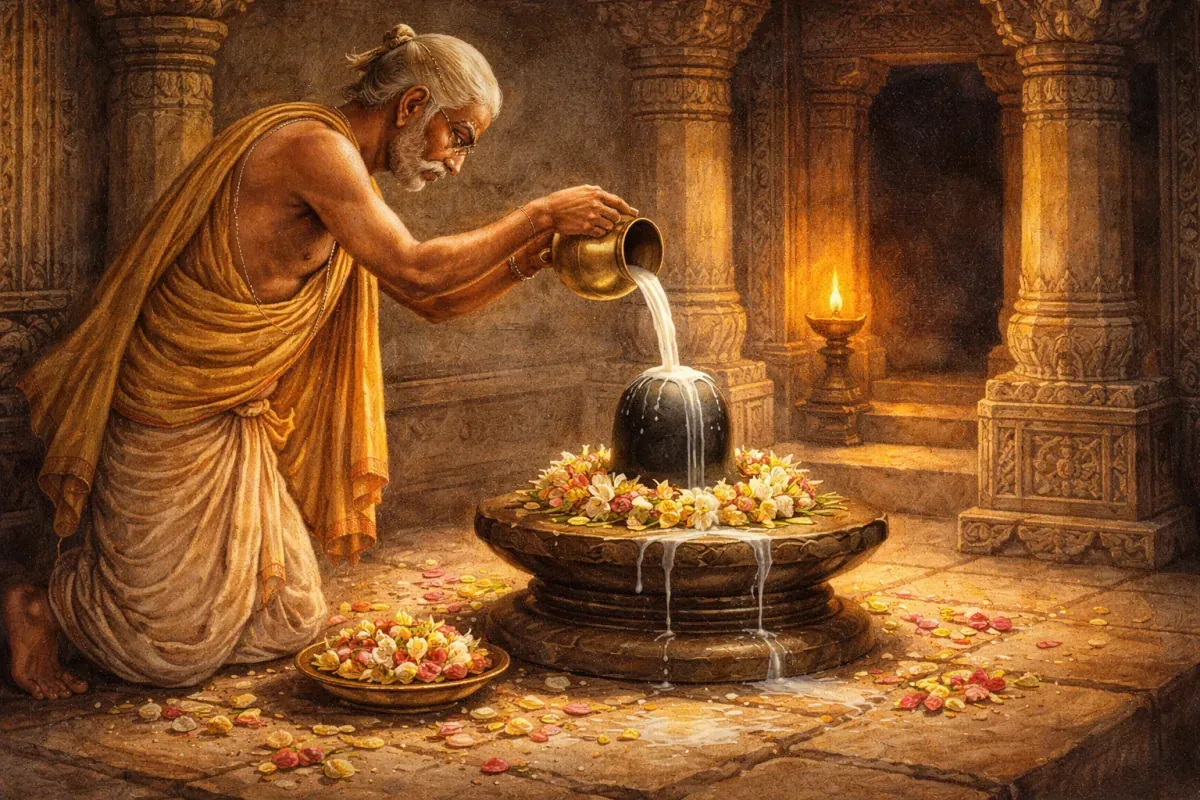
When milk mixed with honey, ghee, and sugarcane juice flows over the image of Rudra, and the temple is filled with the pranava and hymns of the Yajurveda, it is not merely a stone being washed. A descent is taking place. In the tradition of Sanatana Dharma, abhisheka (Skt. abhiṣeka) is both a precisely calculated shastric ritual and a living act of encounter: grace descends upon the murti, and through the murti, upon the devotee.
What is Abhisheka?
Abhisheka is the ritual bathing and anointing of a murti (the image of a deity) with consecrated liquids while chanting Vedic and Agamic mantras. In temple worship, abhisheka is part of the essential offerings of puja, along with naivedya (food offering), namaskara (prostrations), and tarpana (libation). In a broader sense, the same word refers to the consecration of a king, the initiation of a disciple by a guru, and the coronation of deities during the installation of a murti.
Abhisheka is always associated with flow. The liquid flowing down the lingam or murti makes the invisible visible—the descent of grace (anugraha).
Etymology and Meaning
The word abhiṣeka is formed from the prefix abhi- ("towards," "on," "from above") and the root siñc ("to pour," "sprinkle," "moisten"). The literal meaning is "sprinkling," "pouring over," or "the descent of a stream of liquid." The same root underlies the terms sechana (irrigation) and sikta (bathed, consecrated).
In the semantic field of Sanskrit, abhisheka is closely related to snana—bodily and ritual bathing—and diksha, initiation. What distinguishes it from puja (worship with offerings) is the specific emphasis on the descent of the flow. This semantic depth makes abhisheka a key gesture of the tradition: purification, veneration, and the initiation of a disciple are united in a single ritual.
Abhisheka in Sacred Texts
The procedure for abhisheka is described in detail in the "Rudra-samhita" of the "Shiva Purana," in the Shaiva Agamas (including the "Chandra-jnana-agama"), in the "Siddhanta-shikhamani," and in tantric manuals for puja. In the South Indian tradition of Shaiva Siddhanta, temple abhisheka is regulated by the "Kamika-agama" and "Karanagama."
The classical prescription of the "Rudra-samhita" maintains an immutable order:
"Rudra should be duly bathed with water scented with sandalwood, in the exact same manner as with pancha-gavya, having previously placed it in a vessel properly filled with mantras. Then, while uttering the pranava, one should bathe the deity with cow's milk, curd, honey, and sugarcane juice."
Rudra-samhita, Shiva Purana
This sequence forms the core of any traditional abhisheka and is repeated with variations in all Shaiva texts. For rituals dedicated to Devi, similar prescriptions are given in the "Devi-mahatmya" and "Lalita-sahasranama"; for Vishnu—in the "Purusha-sukta" and Vaishnava Agamas.
Types of Abhisheka
The tradition identifies several main forms of the ritual:
- Nitya-abhisheka — daily temple ritual. Performed by the pujari within the puja-mandala, usually six to seven times a day.
- Panchamrita-abhisheka — bathing with the five nectars (panchamrita): milk, curd, ghee, honey, and sugarcane juice or sugar syrup.
- Rudra-abhisheka — bathing of the Shivalingam with the recitation of the hymn "Shri Rudram" from the "Yajurveda." Performed as an especially auspicious ritual on Shivaratri and during the month of Shravana.
- Kumbha-abhisheka — consecration of a temple and murti during installation, associated with the rite of prana-pratishtha.
- Abhisheka as diksha — initiation of a disciple by a guru through bathing with consecrated water, combined in higher forms with shaktipata (the transmission of power).
Some texts also mention mahabhisheka—a full, solemn version involving pandits and a choir of Veda reciters; it is performed on major festivals and during royal consecrations.
Substances (dravyas) and Mantras
The list of consecrated substances is canonically established. The basis is panchamrita, to which are added:
- pancha-gavya — five products of the cow: milk, curd, ghee, urine, and dung, which purify at a subtle level;
- water from sacred springs and tirthas (tirtha-jala);
- water scented with sandalwood and saffron;
- sugarcane juice, rose water;
- finally — pure water.
Each substance is offered with a corresponding mantra. The Vedic foundation remains continuous: "Shri Rudram," "Chamaka," "Purusha-sukta," "Shri-sukta," "Mrityunjaya-mantra," the panchakshara "Oṁ Namaḥ Śivāya," "Atharva-shirsha-mantras," and pushpa-suktas are used. The "Rudra-samhita" specifies: water should be offered "a thousand or one hundred and eight times... strictly in accordance with Vedic prescriptions or by reciting the names of the Deity." According to the tradition, an abhisheka without mantras has no ritual power—it is merely a washing, but not a consecration.
Sacred Meaning
External bathing serves as an image of descent on several levels. On the cosmological level, it is shakti descending from the deity's own essence into the material form. On the soteriological level, it is grace washing away the karmic impurities and subtle veils (mala) of the devotee. A tantric reading adds another dimension: abhisheka activates and sustains the energy of the deity within the murti.
Here, the ritual is inseparable from the rite of prana-pratishtha—the "establishment of life-breath" in the image. Swami Vishnudevananda Giri, in lectures on tantric worship, notes that at the moment "when a deity is first installed on an altar, an abhisheka is performed, or a mantra and visualization are recited, a subtle light form like a hologram resides within each murti." The murti ceases to be stone or bronze and becomes a yantra—a point of connection with the deity, who is "diffused in space and present everywhere on a subtle level." Regular abhisheka keeps this connection alive; interrupting the ritual in already consecrated temples is considered a violation of the very principle of worship.
In an internal sense, abhisheka is described in Shaiva texts as the bathing of consciousness: discerning vision is called the deity's clothing, forgiveness is his abhisheka, and truthfulness is his ornament. Behind the external action stands internal sadhana, and the rite becomes a mirror of the devotee's state.
Fruits of Abhisheka
The fruits (phala) vary by level. Earthly fruits include healing from diseases, longevity, the removal of obstacles, and prosperity. Subtle fruits include the purification of karma, auspicious birth, and connection with the lineage of transmission. The highest fruit is called Shiva-pada, the abode of Shiva, leading up to sayujya—dissolution into the deity.
The day of Shivaratri is endowed with special power. The "Shiva Purana" conveys the words of Ishvara himself:
"He who on this day performs worship to my lingam and image will be able to perform the work of creation and maintenance of the entire universe... In worship on the day of Shivaratri, believers gain the fruit that usually comes to one who constantly worships me for a year."
Shiva Purana
Such is the internal logic of the ritual: the abhisheka of a short day is equal to a year of ordinary worship because on this day the very order of time shifts closer to the divine. Behind this lies an ancient conviction of Sanatana Dharma—form and gesture, consecrated by mantra, contain as much reality as the practitioner's consciousness can hold. The more precise the ritual and the purer the concentration, the more fully the flow descends.
