

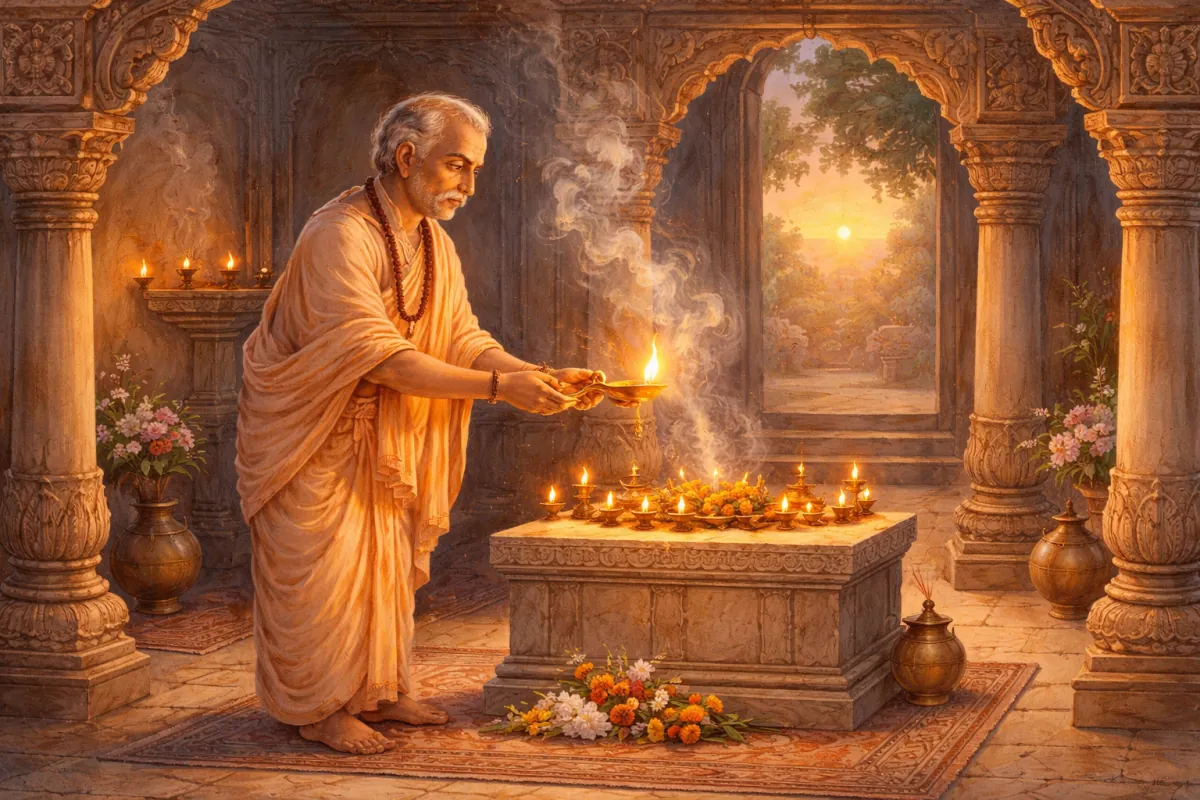
A copper lamp appears in the hands of the one performing puja. Wicks are lit. The fire begins its slow circular motion before the image of God — and something in space changes. A bell, incense, chanting. This moment is called arati. A simple gesture, repeated in Indian temples and home altars around the world day after day for millennia.
What is Arati
Arati (Skt. āratī; also āratrika, Skt. āratrika) is a ritual of offering the light of fire to a God, Goddess, or Guru during a puja or as a standalone rite. Etymologically, the term traces back to āratrika — "dispeller of darkness" (from rātrī — "darkness, night"). According to another version, ā means "towards" and rati means "virtue." Both meanings are consistent: arati is a movement toward God that dispels the darkness of ignorance.
Arati evolved from Vedic fire ceremonies — homa and yajna — and took a central place in temple and home worship. In the Agama Shastras, it is recorded as one of the sixteen elements of traditional puja (shodasha-upachara, Skt. ṣoḍaśa-upacāra): the offering of fire, deepa-upachara, is the mandatory conclusion of worship. It is here that the mantra traditionally recited during arati is taken — from the Katha Upanishad and Mundaka Upanishad:
“There the sun shines not, nor the moon and stars, nor these lightnings — how then could this fire? Everything shines only after Him; by His light all this world is lit.”
The lit lamp is a symbol. The visible fire offered to the Lord serves as a reminder that any light is but a reflection of the primordial Light.
How Arati is Performed
Before arati, the one performing the puja washes their hands and gathers everything necessary on a ritual tray — an arati-thali made of copper, bronze, or silver. The main item is an oil lamp (deepa, Skt. dīpa) with an odd number of cotton wicks soaked in ghee: one, three, five, or seven. Often, camphor (karpura, Skt. karpūra) is burned instead of or alongside oil wicks. The tray also holds flowers, incense, a conch shell with water, and a bell (ghanta, Skt. ghaṇṭā).
Before offering the fire, the practitioner establishes a sankalpa (Skt. saṅkalpa) — an intention: to whom the arati is dedicated and for what purpose. Then the lamp is taken in the right hand, while the left hand rings the bell — and the fire begins slow circular movements (pradakshina, Skt. pradakṣiṇā) before the image in a clockwise direction. First, it encompasses the entire murti, then separately — the feet, knees, abdomen, chest, face, and crown. For each part, there are seven circles. The movement is unhurried, with the attention focused on the Lord.
After the fire, the conch with water is circled, a piece of white cloth is offered — symbolically wiping the Lord's face — followed by flower petals. Finally, the leader brings the lamp to those present: everyone touches the flame with their palms and brings them to their eyes and forehead. This is the acceptance of the prasada of arati — the blessing of the Lord through fire.
If arati is not performed alone, it is accompanied by chanting. The leader holds the lamp while the others clap their hands or ring bells, creating a common rhythm and a unified direction of attention.
Camphor and the Symbolism of the Five Elements
Camphor is one of the most precise symbols of arati. The crystalline substance burns away completely, leaving no ash, only fragrance. In the tradition, this is interpreted as an image of the ego dissolving in the fire of knowledge: nothing remains but light.
The objects of arati collectively represent the five great elements (pancha-mahabhuta). The flame of the lamp is fire (agni). Flowers and incense, carrying the fragrance of the earth, are prithvi. Water in the conch is jala. The bell and the yak-tail fan (chamara) represent air (vayu). The sound of the conch is ether (akasha). Arati is the offering of all creation to the Lord.
Types of Arati and Timing
Forms of arati vary depending on the number of lights and the context. Daily home practice is usually built around eka-deepa arati — with one lamp. Pancha-deepa arati with five lamps is a more solemn form, corresponding to the five elements. Camphor arati is distinguished by the special symbolism of total dissolution. On festive days, maha-arati is performed with the participation of many priests; the most famous is the Ganga-arati in Varanasi, held on the riverbank daily at dawn and dusk.
In temples, arati is performed several times a day, following the deity's own daily routine. Mangala-arati — at dawn, when the sanctuary first opens. Rajbhoga-arati — at noon, after the offering of a meal. Sandhya-arati — at twilight: a transitional time of day (sandhyā — "junction"), which is particularly revered in the tradition. Shayana-arati concludes the liturgical day, "putting the Lord to sleep." In home practice, two aratis — morning and evening — are sufficient.
During arati, prayer hymns are sung, which are also called aratis. In the Shaiva tradition — "Om Jai Shiva Omkara," in the Vaishnava tradition — "Jai Jagdish Hare." The leader makes circular movements with the lamp in time with the mantra, while those present respond with clapping and bells.
External Action and Inner Work
Arati is not just a beautiful rite. In the Sanatana Dharma tradition, a specific mechanism of its impact is described: the mind directed towards the image of God becomes like a magnet. By honoring a specific deity, the practitioner attracts its energy into their own stream of consciousness. After a correctly and consciously performed arati, the practitioner's mind may suddenly clear, and their mood may improve — the tradition's teaching describes this directly, without metaphors: "Your external Saraswati on the altar has awakened your internal Saraswati."
It is important to understand what the deities themselves are in the context of the tradition. Shiva, Vishnu, Saraswati, Lakshmi — in images, they look similar to humans, but they are not humans. They are inconceivable cosmic forces, super-intelligences that the tradition has clothed in anthropomorphic forms to make it easier for humans to establish a connection with them. By honoring Shiva, the practitioner addresses the Primordial Emptiness (Shunyata) that dissolves illusions. By invoking Vishnu — the sustaining wisdom of the Universe. By worshiping Saraswati — the power of creative knowledge.
At the same time, these forces are not only external. "The microcosm is identical to the macrocosm" — one of the central principles of tantric practice. By invoking a deity, the practitioner awakens it within themselves, opens up to descending blessing (shaktipata), and gradually transforms their own consciousness.
Arati in the Sanatana Dharma Tradition
In our tradition, arati is performed during morning and evening pujas, as well as on the festivals of the Vedic calendar — by both monastics and laypeople. Arati is not the fulfillment of a formal order, but a living bhakti. When attention is held on the Lord and the movement of the fire coincides with inner prayer, the boundary between ritual action and the state of presence is erased.
Any sincere worship is a contribution to one's relationship with God. Even a small but regular one. In the tradition's teaching, this principle is described figuratively: "The rusted link of connection with the divine Source begins to be cleaned, to shine, and then to awaken us." It is not a one-time effort, but consistency that turns an external ritual into a living sadhana.
“The Vedic tradition is a tradition that knows how to show respect to certain energies. This showing of respect is called puja, arati, bhajan. If we know how to show such reverence, such respect, then these energies respond, because the world of divine beings consists of these energies.”
— Swami Vishnudevananda Giri, lecture “The Five Principles of Sanatana Dharma and the Path to Liberation,” 2017
For those who have received diksha (dīkṣā), arati is also an act of remembrance: every rotation of the fire is an appeal to the Guru and to the boundlessness of God-Shiva.
Conclusion
Arati is easier to explain than to understand. While the lamp is only being studied — how many circles, which hand to hold it in, when to ring the bell — the essence escapes. It is revealed in practice: when the fire no longer requires thought, and the hands move by themselves, and all attention is turned to the Lord.
One can start with eka-deepa arati before a home altar — morning and evening. It is better to learn the correct order from a teacher or within a tradition: not because form is more important than content, but because a refined form frees the attention for what matters most.
