

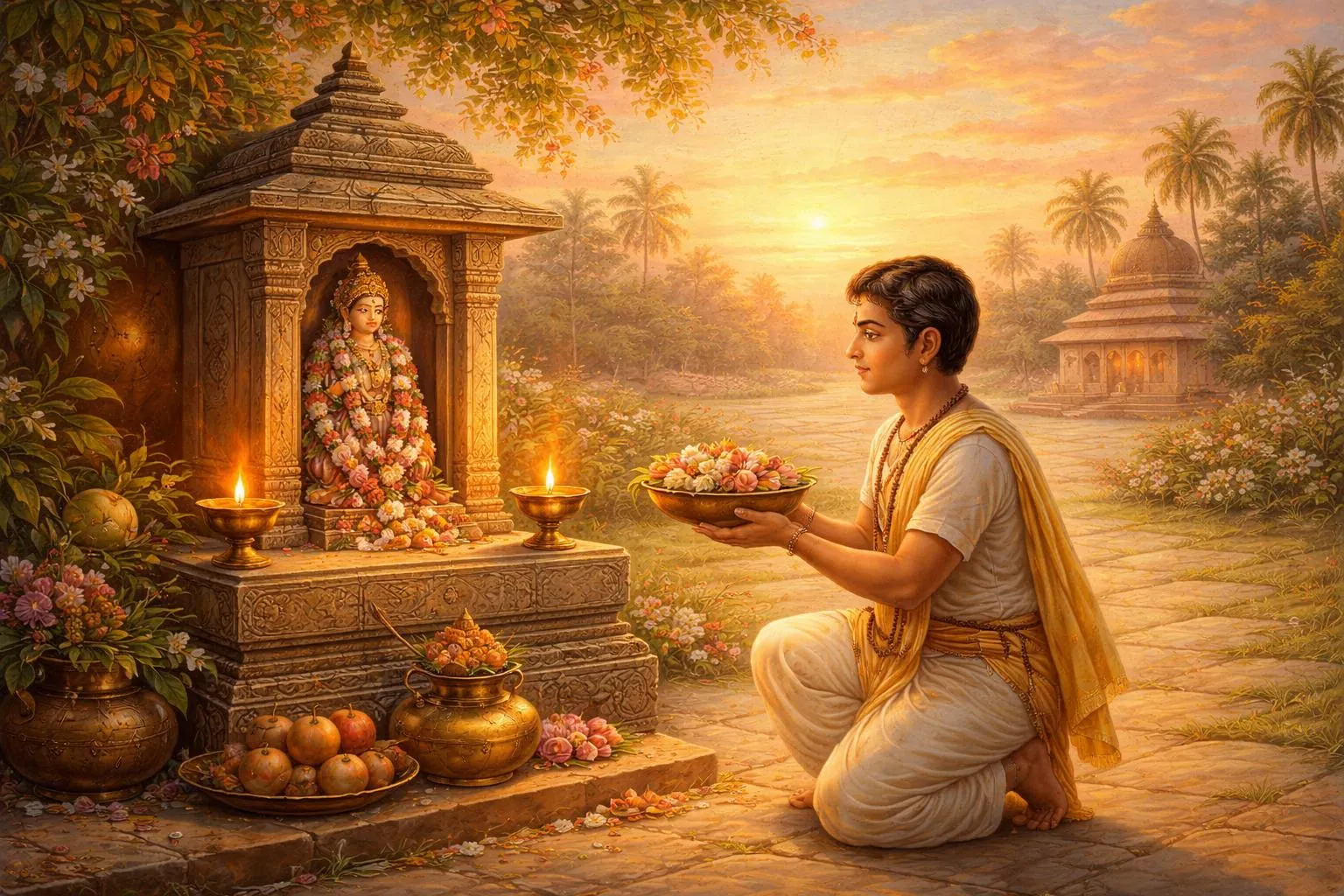
In tradition, there is a principle that sounds paradoxical at first: the practitioner does not worship something outside themselves, but their own absolute nature. Not the ego, not the personality—but that primordial Awareness which is Shiva, Brahman, Sahaja, the Higher Self. It is from this perspective that bhakti yoga (Skt. bhakti yoga) is considered in the teachings of Laya Yoga and Anuttara Tantra. This approach is fundamentally different from the common understanding of bhakti as worship before an external image of God—and this difference is worth clarifying from the very beginning.
What is Bhakti Yoga
The word bhakti comes from the Sanskrit root bhaj—"to divide," "to partake," "to serve," "to love." Bhakti yoga is the yoga of devotion, a path on which the practitioner directs the entire mind and all life force toward the Absolute. "Yoga" here means "connection" or "union": bhakti yoga is union through love.
The first systematic exposition of the principles of bhakti belongs to the sage Narada, whose aphorisms are collected in the "Narada Bhakti Sutras." Venerating Ishvara (Skt. Īśvara), contemplating his qualities, and constant remembrance—these principles are recognized by all schools of the Vedantic tradition, including Advaita Vedanta. Bhakti is not the exclusive property of dualistic schools. According to the teachings of the tradition, bhakti yoga and jnana yoga (the path of knowledge) do not contradict but rather complement each other.
"The magnificent worship of jnana is the life of life."
— Tirumantiram
Bhakti and Advaita: Unity, Not Contradiction
Among those studying Advaita Vedanta, the notion often arises that bhakti yoga and jnana yoga are different, incompatible paths. This view is common where dharma reaches people in isolation from a living tradition. The history of spiritual seeking suggests otherwise: in the ashram of Sri Ramana Maharshi, where Atma-vichara (self-inquiry) was practiced, bhajans were sung and worship was performed simultaneously. Jnana yoga and Advaita Vedanta have always been combined with bhakti—in both Shaivite and Vaishnavite traditions.
The apparent contradiction is resolved when the difference between dvaita-bhakti (dualistic devotion) and advaita-bhakti is understood. In dualistic teachings, the bhakta says: "I want to eat sugar"—that is, to enjoy God as an object. Advaita offers something else: to become the sugar—to merge with God, to dissolve the boundary between the worshiper and the object of worship. This is what the teaching calls devotion without a devotee.
"Since we do not practice dvaita-bhakti (dualistic), our devotion to God is something quite specific. It is devotion without a devotee. Devotion to God beyond the concepts of 'God' and 'devil'."
— Swami Vishnudevananda Giri
Brahman in Advaita is not a person in the usual sense, but the impersonal Absolute, pure Consciousness-Existence-Bliss (sat-chit-ananda). But it does not follow from this that love for Him is impossible. On the contrary: precisely because Brahman is the very foundation of being, love for Him is the most natural state. It does not need image or form. It is the discovery of the very depth of one's nature.
Three Views on Bhakti in the Sanatana Dharma Tradition
Three great currents—Advaita Vedanta, Kashmir Shaivism, and Laya Yoga—provide different angles of vision on bhakti, converging on the main point.
In Advaita Vedanta, bhakti is the path to dissolving duality through love. Nididhyasana—continuous contemplative immersion in God—is simultaneously the highest form of bhakti and the highest form of meditation. According to the Guru's lectures, "in bhakti yoga it is called perfect devotion to God, perfect love for God"—and this is identical to the sattvic absorption (sahaja-sthiti, Skt. sahaja-sthiti) spoken of in the "Yoga Vasistha." The combination of shravana (hearing), manana (reflection), and nididhyasana (contemplation) is a path where jnana and bhakti are inseparable.
In Kashmir Shaivism (Skt. Pratyabhijñā, or Trika)—a school very close to our tradition—bhakti is understood through the key concept of pratyabhijna: the self-recognition of Shiva by Shiva. Here, bhakti is not external worship, but internal recognition: the soul recognizes its eternal absolute nature and its unity with Shiva. "Before such self-recognition can occur, there must be total surrender, total self-giving, there must be total devotion." Devotion here is not weakness, but a condition for discovery. Abhinavagupta, one of the founders of Kashmir Shaivism, insisted: recognizing Shiva within oneself is possible only when the ego has completely surrendered to the Supreme. The entire philosophy of Kshemaraja's Pratyabhijna-hridayam is built on this principle.
In Laya Yoga and Anuttara Tantra, the transformation of bhakti is described most directly. Contemplation of the Source is combined with the energy of self-surrender and devotion. As awareness clarifies, the object of devotion is discovered to be one's own Awareness—not external, but profound. "Self-surrender is performed precisely to this Source, which we discover in our own awareness." The external God and the internal Awareness become one. This is the essence of the transition from external puja to internal sahaja-samadhi.
What is Self-Worship and Where is the Trap
The concept of "self-worship" requires precise definition—it is easy to fall into delusion here.
Self-worship is not the glorification of one's own ego. The difference is fundamental: the ego is a false, conditioned personality formed from karmic imprints and habitual reactions. The absolute nature is pure Awareness, which exists before any thought of "I." To worship oneself in the absolute aspect means to direct the mind not toward the personality, but toward that which transcends the personality.
"Tuning into bhava is also called self-worship. Not in the sense that you worship your own ego, thinking 'Glory to me!', but in the sense that your conceptual mind constantly performs worship of the essential pure consciousness. This pure consciousness is one in everyone; it is not solely your property."
— Swami Vishnudevananda Giri
There is only one criterion here: true bhakti weakens the sense of "I" and "mine," rather than strengthening it. If the practice leads to the dissolution of the doer—it is bhakti. If it feeds pride, specialness, or a sense of being chosen—it is ego dressed in spiritual clothes. Spiritual ego is the most difficult to recognize precisely because it justifies itself with high goals and subtle states.
Bhakti and Awareness
It is often believed that bhakti yoga is the path of feeling, whereas awareness belongs to the meditative practices of jnana. This distinction is inaccurate. In the teachings of the tradition, bhakti and awareness are inseparable—not as two parallel tools, but as two sides of the same state.
The highest state of bhakti is bhava-samadhi (Skt. bhāva-samādhi): immersion in God through a state. "If it is a high state of bhakti, it is bhava-samadhi. If bhava-samadhi continues uninterruptedly, it is the same as sahaja-samadhi. Bhava-samadhi is not connected with logic or concepts; it is connected with immersion in natural awareness." Devotion taken to the highest degree coincides with natural awareness—the goal of meditative practices. They converge at a single point.
Without awareness, devotion easily degenerates into sentimentality or religious ritualism. Without bhakti, awareness risks becoming cold and lifeless. Their union is the "invincible configuration of spiritual liberation," as the teaching describes: bhakti, jnana, ishta-devata-yoga, Guru-yoga, and Laya-yoga together.
The Practice of Bhakti on the Path of Anuttara Tantra
In the Sanatana Dharma tradition, four stages of the spiritual path are distinguished—padas: charya (external service), kriya (worship, bhakti yoga), yoga (meditative union), and jnana (enlightened knowledge). These are sequential stages of a single path.
External puja—the ritual of offering, lighting lamps, mantra—serves not as a mechanical rite, but as a gateway to an internal state. As practice progresses, external worship grows into a contemplative presence. Mantra-japa is the directing of the mind toward the Source, and simultaneously a return to one's nature. Service to the Guru and Guru-yoga form the central aspect of bhakti in the tantric path: through Guru-bhava, the practitioner first recognizes awareness in the Teacher, then in senior disciples, then in themselves. When the distinction vanishes, brahma-aham-bhava is born—the experience of unity with Brahman.
Self-surrender to this Source becomes fully possible only when awareness has sufficiently clarified and gained spiritual purity. Until that moment, bhakti is practiced in combination with other methods of the path—contemplation, viveka (discrimination), and self-inquiry.
"Bhakti yoga means: I believe there is an uninterrupted part of me and it is divine, I surrender to it, I try to give my whole self to it completely. Then this uninterrupted part grows within me, and I begin to feel it better."
— Swami Vishnudevananda Giri
What began as worship of the external becomes a recognition of the internal. The image that was worshiped ceases to be a figure of stone—it is discovered to be Awareness itself, in which the entire experience unfolds. This is the profound meaning of bhakti in the Siddha tradition: the Absolute's love for itself, experienced through a being that has opened enough to contain it.
