

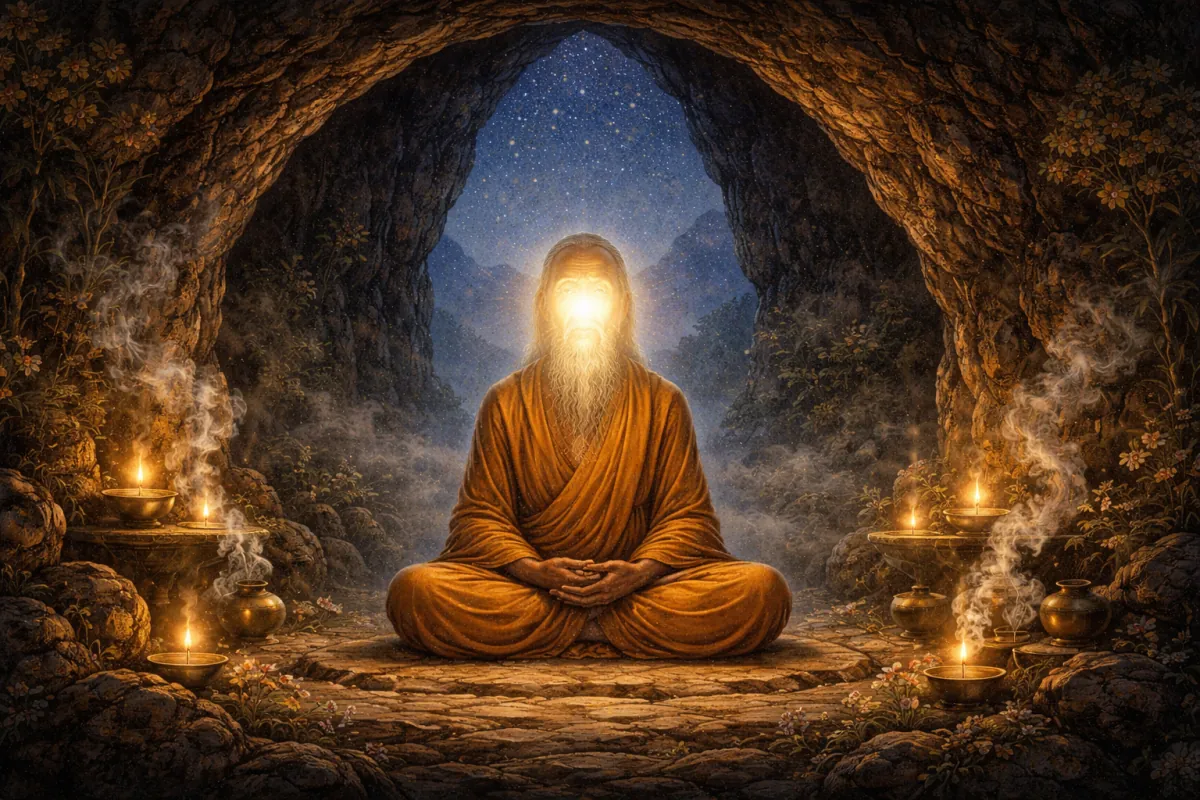
The word "light" is used so frequently in spiritual traditions that it risks becoming a mere poetic metaphor. However, in the tradition of Laya Yoga, jyoti-yantra (Skt. jyoti — light, yantra — instrument, path) is not an image or a symbol, but a strictly defined section of practice with specific methods, stages, and criteria for realization. According to primary sources, it is this section that is considered the pinnacle of the entire system: it describes the complete transformation of the human body into the state of Clear Light.
What is Jyoti-yantra?
Jyoti-yantra (Skt. jyoti-yantra) is a branch of Laya Yoga dedicated to meditation on internal and external light as a manifestation of the nature of consciousness. The word jyoti in Sanskrit means "light," "radiance," or "flame"; yantra means "instrument," "path," or "mechanism." The literal translation is "instrument of light" or "path through light."
In the Vedic tradition, jyoti does not refer to physical light perceived by the organs of sight, but to the primordial luminous clarity that is the nature of consciousness itself. According to Vedavyasa's "Brahma Sutras," "light is Brahman"—and commentators of the tradition emphasize that this refers not to conceptual light, but to the Absolute's very capacity to illuminate all that exists.
The first mentions of light as the nature of consciousness and the source of all existence are found in the Upanishads. Meditation on the inner light as an essential part of the knowledge of liberation was known as early as the 2nd–3rd millennium BCE and was practiced in Shaivite schools, among the Nathas, and in the traditions of the Tamil Siddhas.
"The teaching of Laya Yoga on the contemplation of inner light and sound (Jyoti Yoga, Nada Yoga) is a carefully guarded treasure, accessible only to true masters of meditation, the 'secret of secrets,' a key point in the practice of the ancient and exquisite tradition of the Siddha-Avadhutas, the greatest of whom is Avadhuta Dattatreya—the Great Lord of Yogins, the immortal one who realized the Great Transition into the Light Body."
— "The Radiance of Precious Secrets of Laya Yoga," Volume 1
History and Lineage
According to the mythology of the tradition, the Great Rishis invoked Mahadeva in the form of Self-Born Light — Swayam Jyoti. From this Light, by the power of meditation, the Cosmic Sphere (Brahmanda) was created, shining dazzlingly with golden light. Descending into the world of Brahma-loka, it transformed into the rainbow-light Mahabindu, containing countless non-dual teachings beyond words and method.
The historical lineage of the teaching is traced as follows. The yogi Anama (lit. "The Nameless One") received the teaching from Shuddha Dharma—an incarnation of Dattatreya—as a result of twelve years of tapas on Mount Kailash. According to the root text, on the fifth day of the transmission, Shuddha Dharma appeared to Anama as a dazzling radiance and transmitted the secret teachings of Jyoti Yoga—concerning the Great Transition into the Rainbow Body of Light. Having practiced the received teachings for five hundred years, Anama realized the Immortal Body. Through him, the teaching passed to Mahamurti, and then to the subsequent masters of the lineage.
Place in the System of Five Yantras
Laya Yoga is structured through five sections—five yantras, each representing an independent path to liberation. According to "The Radiance of Precious Secrets of Laya Yoga":
- Prajna-yantra — the path of wisdom (Jnana Yoga): contemplation of the nature of the Mind, the great non-action beyond concepts and effort.
- Shakti-yantra — the path of energy (Kundalini Yoga): working with the life force, spontaneous non-dual behavior (lila).
- Nada-yantra — the path of inner sound (Nada Yoga): contemplation of the mystical sound (Vamshanada) and its unification with empty awareness.
- Nidra-yantra — the yoga of sleep and dreams: maintaining awareness in all states—waking, dreaming, and deep sleep.
- Jyoti-yantra — the path of light (Jyoti Yoga): working with inner and outer light, revealing the Clear Light, and realizing the Rainbow Body.
Prajna-yantra is considered the foundation of the entire system—the trunk around which the other sections revolve. Nada-yantra, jyoti-yantra, and nidra-yantra are advanced sections and are traditionally not taught in the initial stages of training. Jyoti-yantra is described as the supreme and final yantra, granting full realization.
Primary Sources of the Teaching
Two Upanishads serve as the main shastric foundations of jyoti-yantra.
"Advaya-taraka-upanishad" (Skt. advaya-tāraka-upaniṣad — "the non-dual Upanishad that leads beyond") describes in detail the spaces of Clear Light achieved in meditation and constitutes the theoretical basis of the practice. The name indicates the goal: taraka is that which "ferries" one across the ocean of samsara to liberation. The text belongs to the Atharva Veda category and contains descriptions of various types of luminous spaces—akashas—sequentially revealed in practice.
"Mandala-brahmana-upanishad" describes the methods of contemplating external and internal light, lists their types and forms, as well as the corresponding states of consciousness.
In addition to these two texts, the teaching of light as the nature of Brahman is contained in the "Chandogya Upanishad" and "Katha Upanishad," which call for meditation on light; in Vedavyasa's "Brahma Sutras" ("Light is Brahman"); and in Dattatreya's "Avadhuta Gita." The tantric foundation is provided by the instructions from "Laya Amrita Upadesha Chintamani"—the root text of Laya Yoga, to which "The Radiance of Precious Secrets of Laya Yoga" serves as a partial commentary.
"In the Fourth — union with the non-dual, most transcendental layer of the mind occurs, and the eternal consciousness of Being is attained."
— Dhyanabindu Upanishad, Shloka 94
Spaces of Clear Light
The central concept of jyoti-yantra is the akashas (Skt. ākāśa — space, sky)—different levels of the luminous space of consciousness, sequentially revealed in meditation. The "Advaya-taraka-upanishad" and "Mandala-brahmana-upanishad" list them as follows:
- Chidakasha (cidākāśa) — "space of consciousness": the subtle space of internal perception, the first level accessible in meditation.
- Gunarahita-akasha (guṇarahita-ākāśa) — "space free from qualities": beyond the three gunas of nature—tamas, rajas, and sattva.
- Paramakasha (paramākāśa) — "supreme space": encompasses the entire universe as a single field.
- Mahakasha (mahākāśa) — "great space": infinite, inconceivable; in "The Radiance of Laya Yoga," it is described as the result of the merging of inner space (Chit-akasha) with outer space (Bhut-akasha).
- Tattvakasha (tattvākāśa) — "space of primordial principles": the source of all manifestation.
- Suryakasha (sūryākāśa) — "solar space": absolute radiance, the Light of Brahman itself.
Here we are talking about levels of the same consciousness, unfolding in its fullness as contemplation deepens. The causal body (anandamaya kosha) is experienced by the yogi in deep samadhi precisely as these spaces of dazzling light.
Methods of Practice
In jyoti-yantra, two main methods are used, complementing each other.
Contemplation of Light Space. The practitioner directs attention to external light—the sky, the solar disk, the flame of a candle—not as a physical object, but as a pointer to the nature of the Mind. As contemplation deepens, an experience arises: visible objects begin to reveal radiance, and then external reality gradually dissolves into the space of pure light. According to the "Advaya-taraka-upanishad," this experience is described as a golden flame, similar to the universal fire at the end of a kalpa. The practitioner does not create this experience through effort—they allow it to be discovered in the depth of the natural state.
Dark Retreat. The practitioner goes into complete darkness for several days or weeks. In the absence of external light stimuli, internal energies begin to manifest as visions of inner light—first as flashes, then more steadily. From this light, images of peaceful and wrathful deities arise, regarded in the tradition not as hallucinations, but as manifestations of the practitioner's own subtle nature of consciousness.
According to the teaching, both practices only make sense if there is a preliminary foundation: the revealed nature of the Mind and sufficient control of the internal prana-winds. The tradition does not recommend starting jyoti-yantra prematurely, as without this foundation, the practice yields no fruit and may create obstacles.
"When there is neither being nor non-being, the presence of the primordial 'I' is open and known, and there is nothing more to know, let the yogi continue to deepen contemplation, awakening subtle energies in his body, meditating on inner light and sound."
— "Laya Amrita Upadesha Chintamani," Instruction 45
Four Stages of Contemplation
The teaching describes four stages—steps (avastha) of deepening the practice of jyoti-yantra. These same stages describe progress in contemplation as such and correspond to the four states of consciousness.
The First Stage — Abhyasa ("Illumination"): the initial introduction to the natural state. The practitioner establishes contact with the Clear Light in the waking state (jagrat avastha) and learns to maintain this presence.
The Second Stage — Ghata ("Vessel"): contemplation is transferred to the dreaming state (svapna avastha). The practitioner is able to maintain conscious presence in the dream, and visions begin to reveal their luminous nature.
The Third Stage — Parichaya ("Increase"): presence penetrates into deep sleep without dreams (sushupti avastha). At this stage, the first and second levels of Clear Light are revealed. The mind rests in its pure formless ground, beyond thoughts and images.
The Fourth Stage — Nishpatti ("Completion"): the realization of Enlightenment. The practitioner reveals the four Empty Lights and contemplates the primordial Light of Reality—the state of turiya (the fourth), where "any duality of subject and object is transcended" and the transcendent Reality without qualities (Nirguna Brahman) is attained.
According to the teaching, "the ability to maintain such contemplation and the revelation of the four levels of Clear Light is the criterion for a monk or preceptor achieving Liberation."
Rainbow Body as the Goal of Practice
The supreme result of jyoti-yantra is considered to be kaya-vyuha ("The Great Transition")—the complete transformation of all the practitioner's bodies into the state of Clear Light. In the tradition, this is also called the rainbow body (jalabhāsa-kāya) or jyotir-deha — the "body of light."
According to the teaching, when the practitioner reaches the fourth stage of contemplation and is able to hold the Clear Light continuously, this Light begins to "pour out in a wide stream, purifying the coarser bodies, descending into them, until their complete transformation into the state of Light." The dense elements that make up the physical body gradually thin out; the identification of consciousness with a specific physical form is removed.
At the moment of death, such a yogi instantly recognizes the Clear Light and is liberated without delay—for him, there is no intermediate state (bardo) and no forced rebirth in an ordinary body. The tradition reports numerous individuals who realized this transition. For example, Paramguru Swami Brahmananda dissolved into light on April 6, 1986, leaving no physical remains.
"Having become the supreme Being itself, Bhagavan, the Creator of Universes, having acquired boundless capacities for manifestation, let the yogi, dwelling in various bodies, play in infinite manifestations for the benefit of all living beings."
— "Laya Amrita Upadesha Chintamani," Instruction 47
It should be understood that the rainbow body is not physical immortality in the ordinary sense. It refers to a state in which consciousness is no longer limited to one body and one timeline, but has acquired the ability for free manifestation. Just as sunlight is not bound to any specific reflection—so too is liberated consciousness not attached to any specific form.
Jyoti-yantra represents the concluding section of Laya Yoga, summarizing the entire path of working with consciousness through the contemplation of the nature of Light. This section has a strict shastric basis—primarily the "Advaya-taraka-upanishad" and "Mandala-brahmana-upanishad"—and a clear practical structure, including four stages of deepening contemplation and two main methods of practice.
Studying jyoti-yantra even at a theoretical level forms in the practitioner a correct understanding of the ultimate goal of the spiritual path in the Sanatana Dharma tradition: not dissolution into an impersonal void, but the complete transformation of the entire being—while maintaining the capacity for compassionate action in the world.
