

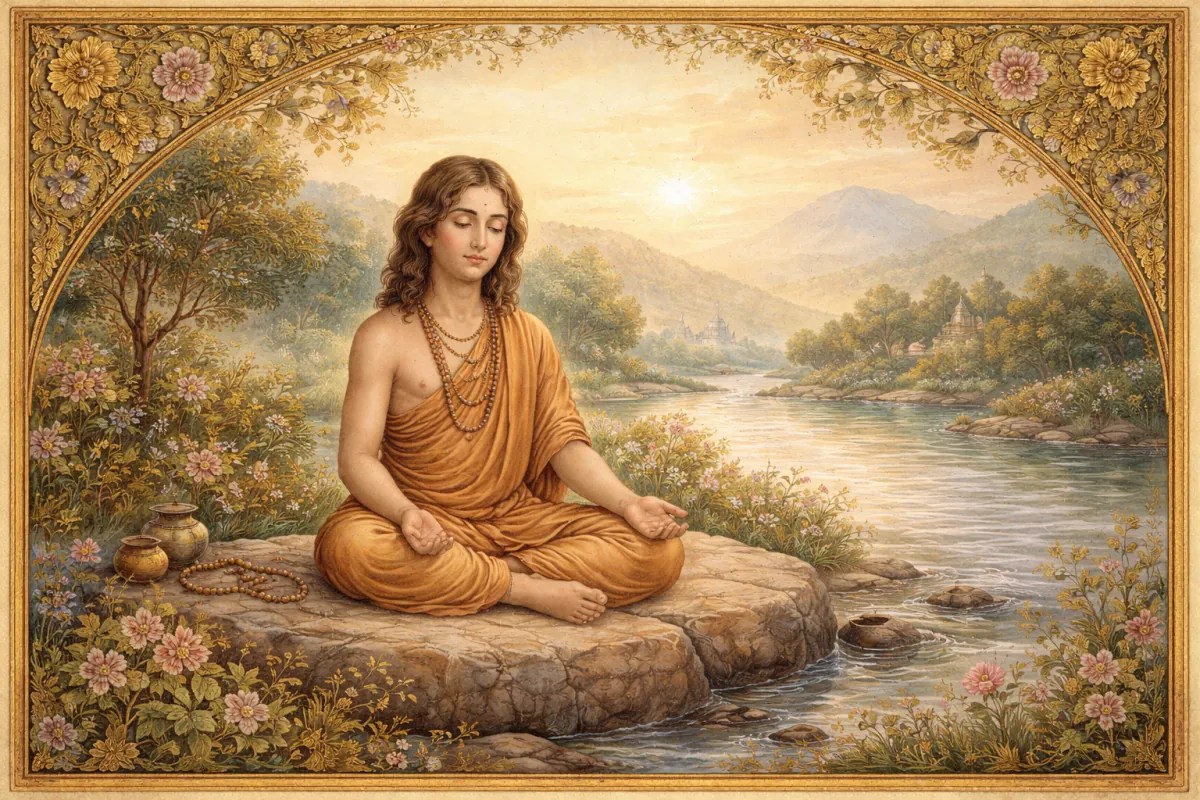
When a practitioner says, "I have entered the natural state," they almost always mean one of three things: deep relaxation, meditative peace, or a temporary absence of anxiety. None of these experiences is the natural state. The tradition of Sanatana Dharma provides a definition that is more precise—and more paradoxical.
Physical relaxation is a physiological process. Meditative peace is a state of the mind, still observing itself. The absence of anxiety is a void that tomorrow will be filled by the next worry. All three experiences share one thing: they come and go. The natural state—sahaja—does not come. It is already here.
The Guru warns: "Many think: 'I have relaxed so well, I am in the natural state!' But that is not the natural state... There is no natural state outside of abiding in the Atman, in the Absolute."
Behind this distinction lies a fundamentally different understanding of what liberation is, what practice is, and who is practicing at all.
What is the Natural State
The Sanskrit term sahaja (सहज) is composed of two roots: saha—"together" and ja—"born" (from jan, "to be born"). Literally: "born together with us," "innate," "inherently present."
The term appears in the early Shaiva Agamas, where it describes a state of consciousness not acquired through practice but discovered as always-already-existing. In the tradition of Kashmiri Shaivism, sahaja is synonymous with svarupa (svarūpa)—one's own nature, which the jiva never lost, but only lost the memory of. In the Vedanta tradition, the same meaning is conveyed by the term svabhava (svabhāva, "own being"). In Buddhist Vajrayana, sahaja became a central concept of Mahamudra—the teaching on the nature of mind.
However, in the context of Sanatana Dharma, the term points not to emptiness, but to fullness: purnatva (pūrṇatva). This distinction defines the entire methodology: Buddhist practice strives for dissolution into emptiness, while Shaiva practice strives for the recognition of one's original fullness.
The Teacher clarifies: "Sahajya is original wisdom." Not achieved or revealed by practice—it is that which precedes any practice and any experience.
Why Sahaja is the Highest
In the classification of samadhi adopted in the Sanatana Dharma tradition, three levels are distinguished.
Savikalpa-samadhi (savikalpa-samādhi, "samadhi with thought-forms")—a state of deep absorption in which the experiencer and the experienced are still separate. The meditator is immersed in light or silence, but the subject aware of this immersion is still present.
Nirvikalpa-samadhi (nirvikalpa-samādhi, "samadhi without thought-forms")—duality dissolves, the subject-object division disappears, and pure undifferentiated consciousness remains. Many mistake this experience for the highest point of the path.
Sahaja-samadhi (sahaja-samādhi)—not a state that is attained and lost, but the very foundation of being, which is recognized as always present. In it, there is no entry or exit. The Mandukya Upanishad describes this dimension as turiya (turīya)—"the fourth," the background pervading all three states of consciousness: waking (jagrat), dreaming (svapna), and deep sleep (sushupti).
"Sahaja-samadhi is the highest among all types of samadhi. In sahaja-samadhi, the yogi is naturally immersed in unity with the universal 'Self'—even when he acts."
This distinction overturns the usual logic of spiritual practice. Nirvikalpa-samadhi requires special conditions, a complete withdrawal from activity—otherwise, the meditator "falls out" of it at the first external sound. Sahaja-samadhi is compatible with any action because it is fundamentally not a state of the psyche.
The Yoga Sutras of Patanjali (I.3) describe liberation: "then the seer abides in his own nature." This "own nature" is sahaja: it is not achieved but discovered as the authentic foundation that has been observing all practices from the sidelines.
Waking with the Body, Sleeping with the Mind
The teaching offers an image that shatters all conventional notions of spiritual experience.
The Teacher describes sahaja thus: "To be in the natural state is like being in a dreamless sleep while awake: you see everything, hear everything, talk, yet in the depths of consciousness, you are sleeping a deep sleep without dreams."
Deep sleep without dreams (sushupti) is a state in which the mind has completely dissolved, where there is no "I," no objects, no time. Awakening from there, a person says: "I slept wonderfully, I remember nothing." This "nothing" is not an absence, but the presence of pure consciousness without coverings. Vedanta calls it prajna—wisdom folded into itself.
Sahaja is sushupti in the midst of waking. The body acts, the eyes see, words are spoken—behind all this, there is no doer, no one holding onto the result or waiting for confirmation.
The Mandukya Upanishad (7) describes turiya exactly like this: "not conscious of the internal, not conscious of the external... unfathomable, indefinable, beyond the reach of thought... peaceful, auspicious, non-dual." And at the same time—sarva-sakshi (sarva-sākṣi), the witness of all.
"This natural state (sahaja), unstained by the traces of thoughts and perceptions, which like ripples on water leave no tracks."
Swami Vishnudevananda Giri
The ripples disperse—the water remains water. Thoughts arise and dissolve—consciousness is untouched by any of them. Not because thoughts are suppressed, but because their nature is the same as the nature of consciousness. This is how sahaja differs from a trance: in a trance, thoughts are absent; in sahaja, they are present but do not "stick." "Unstained by traces" is the key phrase.
Purnatva and Lila: Action from Fullness
Why does sahaja allow for action? Why does the one who abides in non-doing continue to speak, move, and teach?
The teaching's answer: because his action proceeds not from need, but from fullness.
Purnatva (pūrṇatva)—fullness, completeness, self-sufficiency. Shiva acts not because He lacks something. His action is lila (līlā), play: a spontaneous manifestation of fullness without an internal movement toward a result. There is no tension between "what is" and "what should be." There is no gap in which anxiety is born.
The Guru says this directly: "Action in non-action is a game, it is lila. Lila comes from purnatva and non-action."
This subverts the common equation: "first liberation—then withdrawal from the world." The one who abides in sahaja does not leave the world—the world simply ceases to be a source of threat or expectation. The potter continues to mold pots. The teacher continues to teach. But behind this, there is no appropriation of the result, no dependence on the response.
The Bhagavad Gita (III.17) describes such a person: "but for the man who rejoices only in the Atman, who is satisfied with the Atman... for him there is no duty to perform." His activity is not the working off of a karmic debt, but a free outpouring of that which is already full.
The Ishavasya Upanishad opens with the words: īśā vāsyam idaṃ sarvam—"all this is pervaded by the Lord." For the one who sees sahaja, every action unfolds within this pervading—not outside of it.
Svabhava as the End Point
The natural state is not the lot of great yogis—it is svabhava, the own nature of every being.
"All saints, all gods of the Refuge tree—they all abide in sahaja-samadhi," says the Teacher. But every jivatma also carries this as its original foundation. Karma, maya, avidya are not a prison. They are, as the tradition explains in the teaching of the three pashas (pāśa), a school system: the soul learns within it to recognize itself. Sahaja is not the end of the lesson. Sahaja is the discovery that you never left the classroom: you were the teacher from the very beginning.
The Shiva Sutras (I.1) open with the words: caitanyam ātmā—"consciousness is the Atman." Not "consciousness leads to the Atman"—but "consciousness is the Atman." Here and now, without any mediation of practice.
The practice of meditation, the study of shastras, service to the Teacher—all of this does not build sahaja, but removes what prevents its recognition. Just as the sun does not need to be lit: one only needs to disperse the clouds.
"To be in the natural state is like being in a dreamless sleep while awake: you see everything, hear everything, talk, yet in the depths of consciousness, you are sleeping a deep sleep without dreams."
Swami Vishnudevananda Giri
This is pratyabhijna (pratyabhijñā)—"recognition," the central concept of Kashmiri Shaivism. Not the attainment of something new, but the recognition of what you already are. The path ends not where you have arrived somewhere, but where you discovered: there was nowhere to go. You are already home.
