

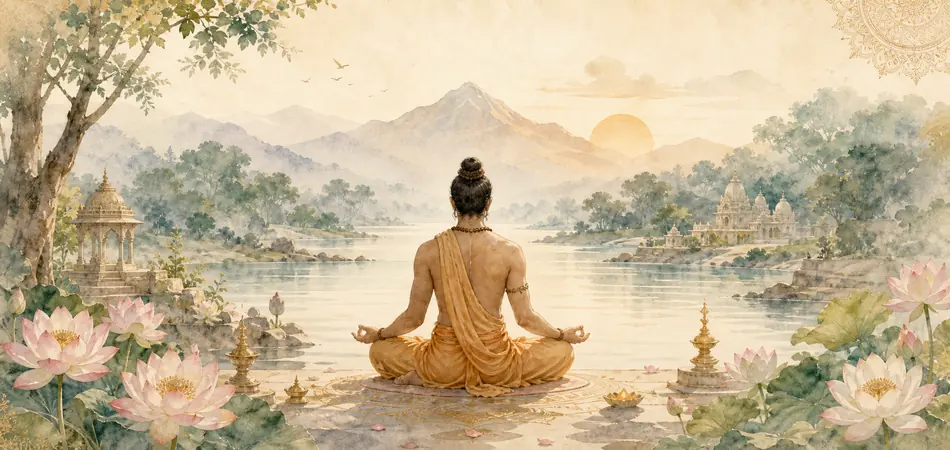
Hatha Yoga (Sanskrit: haṭha-yoga) is one of the main branches of yoga, a system of working with the body, breath, and life force that developed in the Nath tradition. The goal of this system is not flexibility or robust health. The goal is to purify the body's subtle energy channels and direct prana into the central channel, opening the path to meditation and, ultimately, to liberation.
Today, this name is carried by thousands of studios across the world. If you were to ask a random person what Hatha Yoga is, they would describe something like morning gymnastics with exotic poses. This is understandable. And it is inaccurate.
What is Hatha Yoga
The word itself carries a precise map of the practice. Haṭha is composed of two syllables: ha — "sun" — and tha — "moon." Behind these symbols stand the two main flows of life energy in the body: the solar, right, active one — pingala-nadi, and the lunar, left, calming one — ida-nadi.
Hatha Yoga is the yoga of union. Not the sun without the moon. Not the moon without the sun. When both forces are balanced, prana stops darting through the side channels and enters the sushumna-nadi — the central channel that pierces the axis of the body. It is then that meditation becomes not an effort of will, but a natural state.
"Hatha Yoga Pradipika," "Gheranda Samhita," "Shiva Samhita" — the classical texts that systematically expound this science — speak in one voice: the physical side of practice exists for the sake of the subtle one. The body and prana are a single instrument. And they should be treated accordingly.
What Hatha Yoga is Not
Hatha Yoga is not therapeutic gymnastics or a method for stress relief. It did not emerge as a system for health improvement. It arose among serious sadhakas — people who renounced the world for the sake of the only thing they considered important: the realization of their true nature.
The benefit to the body is a real and pleasant side fruit. But to confuse it with the goal is like coming to a river with buckets for water and leaving with a handful of pebbles that caught your eye along the way.
The Essence: Working with Prana
Everything in Hatha Yoga is subordinated to one thing — working with prana. Prana (Sanskrit: prāṇa) is the life force moving through the body via subtle channels, nadis. When the nadis are clogged, prana is scattered, and the mind is unstable. Meditation does not go deep. Subtle states remain closed.
Purifying the channels is the first threshold. To pass it means creating the conditions for the next step: for pranayama, the management of life force. Pranayama opens the path to steady meditation, dhyana. And dhyana leads to that for which everything begins.
The chain is simple. As Swami Vishnudevananda Giri said: "Asanas help pranayama, which, in turn, helps dhyana, and peace of mind comes. This is the goal of Hatha Yoga."
Awareness and Bhava: Body Without Mind is Not Yoga
This is where the main mistake of modern practice lies. The body bends. The breath is regulated. The poses are performed technically correctly. But inside, the most important thing is missing.
There is no bhava (Sanskrit: bhāva) — a living presence, the correct internal attitude, a conscious relationship with what is happening. There is no motivation that looks beyond one's own body.
One can study the biomechanics of every pose, know exactly which muscles are working and at what angle — and this will have nothing to do with true practice. "If you are working with prana," says the Guru, "you don't necessarily need to delve into the medical details of muscle work at all. You feel the prana, and it tells you everything itself."
This is not a call for carelessness. It is a description of how real experience works. When the mind is present — fully, without layers of interpretation, without judgment — the body itself finds the correct position, and prana itself indicates the direction.
And the second question that tradition inevitably asks: for what purpose do you practice? For health and flexibility — these are acceptable motives. But they do not lead to liberation. Hatha Yoga without view — without jnana (Sanskrit: jñāna), without understanding the nature of the mind, without aspiration for moksha — remains, in the Teacher's words, "endless sadhana for many births." Good karma. Not moksha.
The method works when you know where it leads.
A Place on the Map of the Path
In the Nath system, Hatha Yoga occupies the first stage — arambha (Sanskrit: ārambha), "the beginning." It means: everything begins here, and you cannot cut corners here.
Without a purified body and free nadis, meditation encounters obstacles. The mind wanders. Prana is scattered. Subtle experiences are inaccessible. Hatha Yoga removes these obstacles — not as an end in itself, but as a foundation for everything that lies above.
The path then continues: to Kundalini Yoga, to Raja Yoga, to Laya Yoga, to contemplation. Each level relies on the previous one. Building meditation on an impure body and chaotic prana is like building walls on a swamp. The foundation decides everything.
That is why, in the traditional daily schedule — during brahma-muhurta (Sanskrit: brahma-muhūrta), the pre-dawn hour — Hatha Yoga was part of a single flow of sadhana alongside puja, japa, and meditation. Not as a separate activity. But as the first step of a single ascent.
Hatha Yoga is an upaya (Sanskrit: upāya), a method. A method is valuable when you know where it leads. When the method becomes a goal in itself, the path stops. The practitioner sets up camp at the foot of the mountain, mistaking it for the summit.
True Hatha Yoga is alive. In it, the body moves in presence, not by instruction. Breath is not a technique, but a living contact with the life force. And motivation is not "to become healthier," but to move toward the only thing for which a human being is born.
