

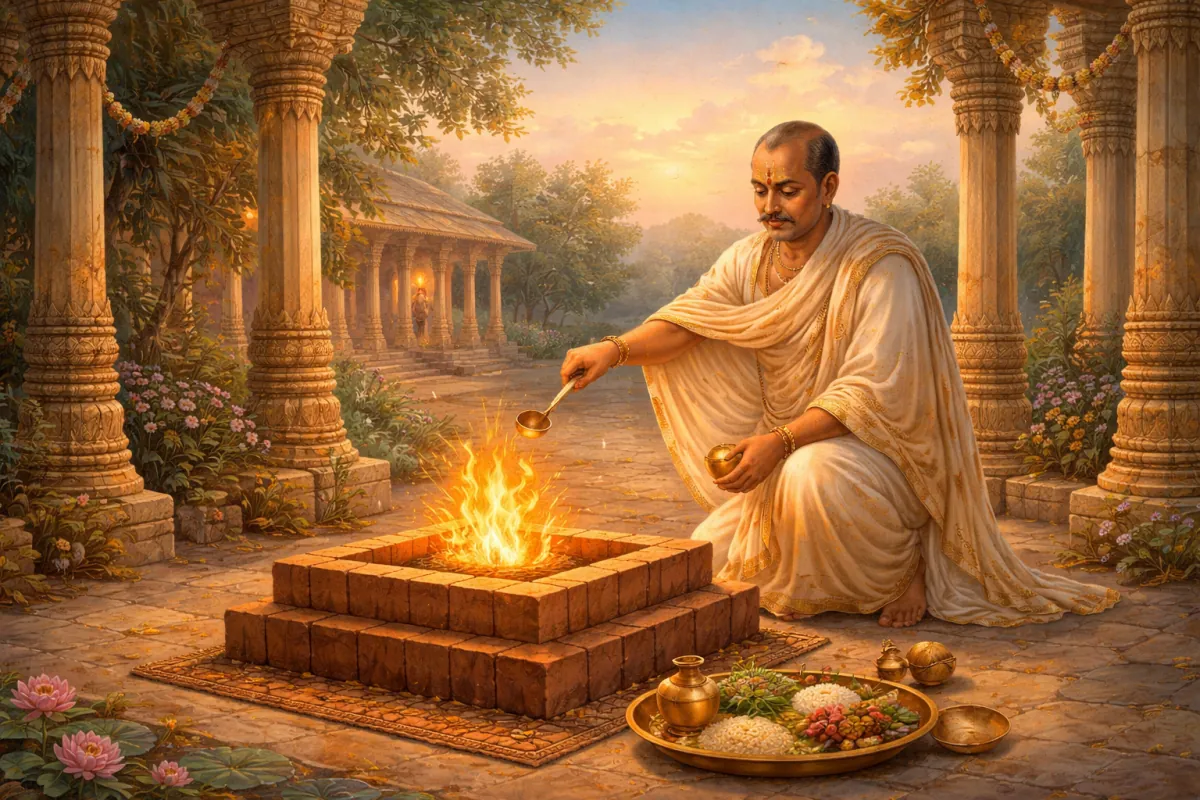
Fire rises above the kunda, smoke ascends vertically, and the priest pours clarified butter into the flames while reciting mantras. In this moment, as it was thousands of years ago, Agni accepts the offering and conveys it to the gods. The tradition of homa has reached our days through a living, continuous lineage of transmission.
What is Homa?
Homa (Skt. homa) is a Vedic ritual of fire offering, one of the oldest rituals of Sanatana Dharma. The word originates from the root hu — "to pour into fire," "to sacrifice": offerings — purified butter, grains, herbs, aromatic mixtures — are poured into the sacred fire while mantras are continuously chanted.
In the system of Vedic rites, homa should be viewed as a simplified, accessible form of yajna (Skt. yajña) — a grand sacrifice involving many priests. A synonym for homa is havan (Skt. havana), a term more common in the northern tradition. Agni-yajna (Skt. agni-yajña), the fire sacrifice, is mentioned in the Yajurveda and Shiva Purana as a mandatory element of practice for both the householder and the monk.
The tradition of homa dates back to the Rigveda — the oldest of the Vedic texts. A systematic description of its procedure is contained in the Grihya-sutras (manuals for domestic rituals) and Shrauta-sutras (texts on solemn sacrifices). In the Shaiva tradition, the detailed regulations for homa are recorded in the Agamas — specifically, in the Karana Agama and Kamika Agama.
*
Agni — Mediator Between Worlds
Agni (Skt. Agni) is the Vedic deity of fire, the mediator between the worlds of humans and gods. Without an understanding of Agni, homa remains an external rite. Agni accepts the offerings and transmits them to the higher powers; he is simultaneously the flame on the altar and the invisible priest performing the offering.
The Rigveda describes this role as follows:
"No sacrifice is possible without Agni. He is both the flame on the altar and the priest of the offering. When a person expresses a desire to sacrifice their entire being to the gods, it is this fire they must kindle. For it is fire that brings the sacrifice to the gods and delivers in return all spiritual treasures: divine will, light, power, and heavenly rain."
The Samaveda speaks of the same through another image — the yearning of all living things toward the fire of the altar:
"Like hungry children sitting around their mother, all beings sit in expectation around the agnihotra."
Swami Vishnudevananda Giri expands on this same image in the lecture "Agni: The Divine Fire of Transformation": "Agni is a friend of the jiva, a friend of understanding, a friend of knowledge, because he personifies the light of clarity and awareness, and he will never betray the soul."
In the Shastras, Agni is described as a force acting at all levels of existence — from the physical fire of digestion to the supreme fire of consciousness. The external fire of the kunda corresponds to the inner fire of the practitioner. This correspondence is not a metaphor, but an ontological statement of the tradition.
Ritual Procedure
Homa is performed at a special altar — a kunda (Skt. kuṇḍa): a square or rectangular depression made of fireproof brick or stone. The shape and size of the kunda are determined by the purpose of the ritual and the deity being invoked. The altar is set up in a cleansed, ritually prepared place, traditionally oriented to the east.
The procedure for conducting homa includes the following mandatory stages:
Sankalpa (saṅkalpa) — establishing the intention. The priest or practitioner states the intention to perform the ritual, mentions their name, gotra (lineage), date, the purpose of the rite, and the deity being invoked. The Sankalpa sets the direction for the entire action.
Invoking Agni and Lighting the Fire. The fire is lit using samidhi (Skt. samidhi) — ritual firewood from trees with specific properties: Banyan, Udumbara, or Ashvattha. Mantras are recited to invoke Agni as the witness and mediator of the ritual.
Main Offerings (āhuti). Purified clarified butter — ghee (Skt. ghṛta) — is poured into the flame while mantras are continuously recited. Simultaneously, grains, herbs, and incense are placed into the fire according to the established order. Each offering is accompanied by the exclamation svāhā — the traditional ritual word signifying the transfer of the offering to Agni.
Purnahuti (pūrṇāhuti) — the final complete offering. A significant amount of ghee is poured into the fire, often along with a whole coconut. This is the culmination of the ritual.
Conclusion. Gratitude mantras are recited, and the fire is respectfully appeased. The ash from the homa — vibhuti (Skt. vibhūti) — is considered sacred and used as prasada.
It is important to understand the role of the priest in this process: the Brahmin is the conduit for the offering, not its recipient. As the Guru says: "Yajna is possible when all offerings are poured into the fire and mantras are recited, and the Brahmin-priest is the one who transfers this, performing this function." The grace itself belongs not to the priest, but to the god being invoked.
Necessary Items
To perform a homa, the following are required:
- kunda — an altar of appropriate size and shape;
- samidhi — ritual firewood from the specified trees;
- ghee — purified clarified butter;
- samagri (sāmagrī) — a mixture of herbs, grains, spices, and aromatic components;
- coconut, fruits, and other offerings according to the specific type of homa;
- deepa — an oil lamp to maintain the fire;
- the text of the mantras and the ritual order.
The composition of the samagri varies depending on the tradition and the deity being invoked. For a homa to Shiva, tila (sesame seeds), barley, rice, and white flowers are traditionally used; for a homa to Ganesha — durva grass and modakas.
When Homa is Performed
Homa can be performed on established days of the lunar calendar: on amavasya (new moon), purnima (full moon), on ekadashi days, as well as on festivals associated with a particular deity. A number of homas are timed to specific needs: purifying space, removing karmic obstacles, invoking prosperity and health. According to the "Svacchanda Tantra," homa is also performed when inauspicious signs appear in dreams or when spiritual balance is disturbed.
In the daily practice of a householder, there is agnihotra (Skt. agnihotra) — the morning and evening offering to the fire at sunrise and sunset. This is the simplest form of homa, available to anyone who maintains a household in accordance with the Dharmic way of life. Agnihotra is described as the foundation of the correct way of family life in several texts of the Yajurveda.
Inner Dimension of the Ritual
The tradition of Sanatana Dharma sees in the external ritual a reflection of the inner spiritual process — and in homa, this is particularly clear.
Swami Vishnudevananda Giri describes contemplative practice as antar-tapasya (Skt. antar-tapasya) — the inner sacrifice: "If a klesha appears, you must offer it into the fire of awareness, transform it into pure clarity, and offer it to the subtle bodies. Then the energy is drawn into the central channel, and the klesha is transformed into a deity."
The Vedic text points to the same reality: "Fire was born as our son; fire is the son who was born in the yajna. He is the father of all fathers as the universal fire" (Vedas). Agni acts at all levels — from the physical flame of the kunda to the fire of pure consciousness. External homa and inner sadhana support each other.
Fruits of the Practice (Phala)
According to the Shastras, the regular performance of homa brings the following fruits:
- purification of space and neutralization of negative samskaras;
- removal of karmic obstacles;
- attraction of the grace of the invoked deity;
- strengthening the well-being of the family and surroundings;
- accumulation of punya (spiritual merit);
- deepening of the practitioner's connection with the lineage.
It should be noted that in the tradition of fire rituals, the fruits of homa are always considered in connection with the purity of intention. An offering poured into the fire with sincere aspiration reaches its goal. One performed mechanically remains merely an external action. Ghee, mantras, and samidhi are tools; the living power is given to the ritual by the orientation of the practitioner's consciousness toward God.
