

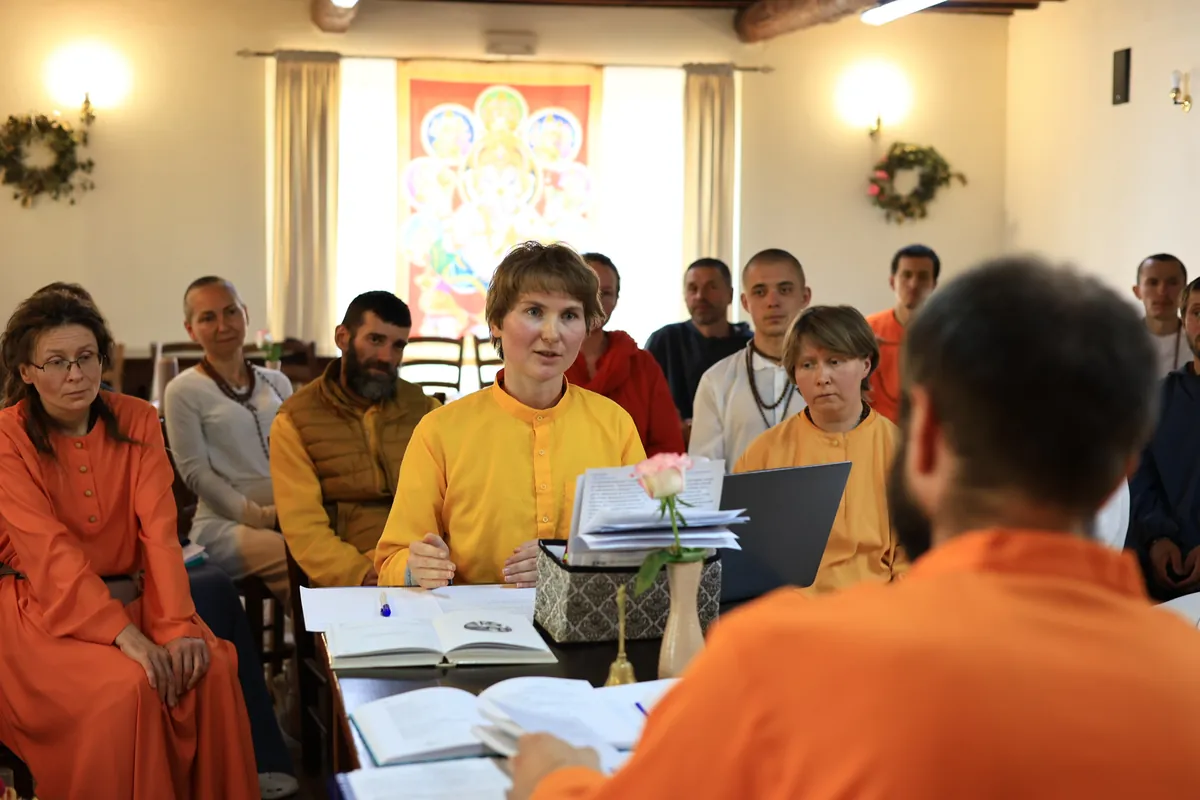
The spiritual path consists not only of meditation and rituals, but also of a deep internal transformation of the personality. The further we advance, the more important the understanding of the sadhu culture (spiritual ascetic) becomes. Without mastering its foundations, without a clear understanding of "what is good and what is bad" for a seeker, movement toward liberation is impossible.
Below is a set of principles that constitute the "Disciple's Code," based on the teachings of enlightened masters and sacred scriptures.
I. Worldview and Meanings
A true sadhu does not look at the world with a mundane gaze. He learns to see reality through the eyes of sacred scriptures and holy sages.
Sacred Vision: A sadhu strives to see the world as a divine mystery, as a single mega-mind — the Absolute. For him, the world is a play of divine energy (chit-shakti-vilasa) and, at the same time, a great school.
Rejection of Materialism: It is unbecoming for a disciple to rely on a secular, materialistic worldview or to pass judgments based on mundane perception.
Attitude toward Samsara: A sadhu sees the world simultaneously as a divine reality and as a material trap from which one must break free. The inability to see the harmfulness of samsara is an error for one walking the Path.
II. Core Values and Goals
The heart of a disciple belongs to his Dharma. He is ready to part with anything except his spiritual ideals.
Higher Priorities: Faith, the spiritual path, the realization of Truth, and sadhana (practice) are the main treasures of life. Sadhana is not performed to improve the "quality of life"; life itself is dedicated to sadhana as an offering.
Goal of Life: To serve the divine law, to help all living beings rid themselves of suffering, and to attain absolute wisdom.
Devotion: A sadhu is a "patriot" of his Teaching, Master, and Chosen Deity. Betraying one's ideals due to a lack of faith, pride, or cowardice is considered unacceptable.
III. Samaya — The Sacred Bond
Samaya is a pure spiritual connection with the Guru, the Teaching, and spiritual brothers. Observing and preserving it is the most important duty.
Purity of Relationships: One must not enter into conflict with their root Guru or the Teaching, even in thought. It is also not customary to conflict with spiritual brothers and sisters, as this is a sign of weak self-control.
Restoration of the Bond: If the samaya has been defiled, the disciple immediately restores it through repentance and special practices. It is unacceptable to carry "spiritual dirt" in the heart for long.
Discernment in Association: A sadhu avoids associating with those who violate or insult the samaya, as this destroys spiritual merits.
IV. Ethics of Conduct (Actions)
A disciple's actions must always be conscious and directed toward the benefit of all living beings. Ethics are based on the principle of Ahimsa (non-violence).
What is mandatory for a sadhu:
- Vegetarianism: Rejection of "slaughtered" food (meat, fish, eggs).
- Rejection of Intoxicants: A total ban on alcohol, tobacco, and drugs.
- Brahmacharya: Control of sexual energy. For monks, this is celibacy; for householders, it is the ethics of a Vedic family.
- Service: Readiness to care for others without expecting reward or praise.
V. Discipline of Speech and Mind
External purity must be a reflection of internal purity.
Pure Vision: A sadhu controls his thoughts, striving to see the divine in other people. Impure vision (negative evaluations, condemnation) is perceived as a demonic quality that deprives one of wisdom.
Humility of Mind: A disciple does not rely on his egoistic mind, knowing that he "knows nothing" in the face of the Great Mystery. He is always ready to learn and does not cling to rigid concepts.
Control of Speech: Speech should be restrained and harmonious. The use of slang, swear words, a loud voice, or an irritable tone is unacceptable.
VI. Lifestyle and Nutrition
A sadhu's daily life is organized to support spiritual practice.
- Nutrition: Moderate vegetarian food. One should avoid overly spicy and salty food to maintain the balance of the body's energies (doshas).
- Time Management: A sadhu does not waste time on idleness, laziness, or mundane entertainment. He does not strive for goals unrelated to spiritual evolution and service (seva).
- Diligence: A disciple's life should be filled with the enthusiasm of knowledge; he "burns" with the flame of faith day and night.
Conclusion: Observing this Code is not just a formality, but a way to purify one's consciousness and prepare it for the perception of the Higher Truth. A sadhu builds his life relying on spiritual authorities: the Scriptures, the Saints, and the Inner Teacher.
