

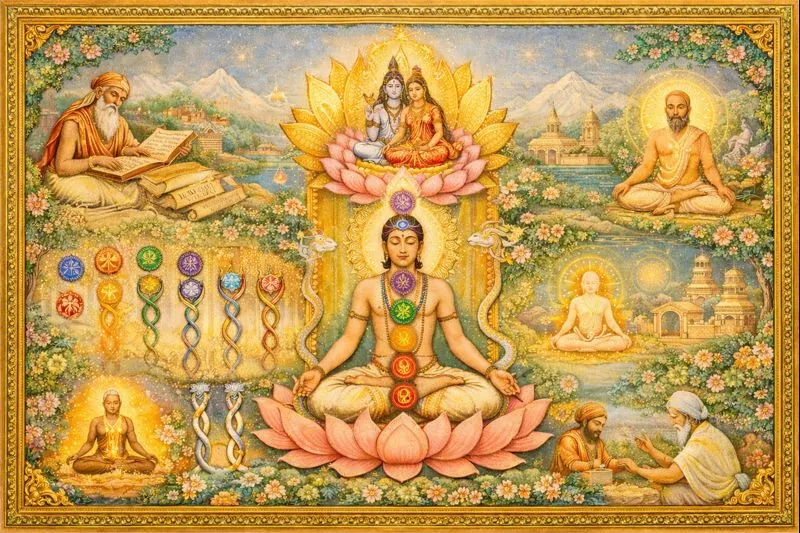
Kundalini Yoga (Skt. kuṇḍalinī-yoga) — the "yoga of coiled power," is a system of spiritual practice aimed at awakening and raising the dormant cosmic energy (kundalini-shakti) from the base of the spine to the highest energy center in the brain to achieve spiritual realization. The term is derived from the Sanskrit word "kundalini" (kuṇḍalinī — coiled like a ring, from kuṇḍala — ring, coil) and "yoga" (yoga — union, joining, from the root yuj — to join), indicating a path of uniting individual consciousness with the Absolute through the activation of hidden spiritual energy.
I. Definition and Etymology
In the classical tradition of Hinduism, Kundalini Yoga is the central practice of Tantric sadhana, especially in the branches of Shakta Tantra (śākta-tantra — Shakti-oriented Tantra) and Kashmir Shaivism (Kaśmīra Śaivism). The system belongs to Laya Yoga (laya-yoga — yoga of dissolution), where individual consciousness dissolves into the Absolute through the union of Shiva (consciousness) and Shakti (energy).
The classical definition of kundalini is given in the "Hatha Yoga Pradipika" (Haṭha-yoga-pradīpikā, 15th century):
«Kuṇḍalinī śaktiḥ suptā bhujagākārā sārddhatribhiś ca bhogaiḥ
> Brahma-dvāre kuṭilayā nidrālasya vasati sā»
> "The Kundalini Shakti sleeps, coiled like a snake in three and a half turns, at the Brahma-dvara; remaining there, she slumbers."
> (Hatha Yoga Pradipika, III.1)
II. Classical Sources and Authoritative Base
Early Tantric Texts
The concept of kundalini was first systematically expounded in the Tantric Agamas (āgama), dating approximately from the 6th to 9th centuries CE:
- "Kularnava Tantra" (Kulārṇava Tantra, approx. 10th-11th centuries) — one of the most important texts of the Kaula tradition, describing the practices of awakening kundalini in the context of non-dualistic philosophy.
- "Sharada-tilaka Tantra" (Śāradā-tilaka Tantra, 11th century), compiled by Lakshmanadeshika, contains detailed descriptions of the chakras, nadis, and methods for awakening kundalini.
- "Shat-chakra-nirupana" (Ṣaṭ-cakra-nirūpaṇa — "Investigation of the Six Chakras"), compiled by Purnananda (Pūrṇānanda) in 1577 in Bengal, is the most authoritative and detailed description of the chakras. The text became the basis for most subsequent works on Kundalini Yoga.
Hatha Yoga Texts
Classical Hatha Yoga regards the awakening of kundalini as the ultimate goal of practice:
- "Hatha Yoga Pradipika" (Haṭha-yoga-pradīpikā), compiled by Swami Svatmarama (Svāmī Svātmārāma) in the 15th century, likely in Varanasi or neighboring regions of Northern India. This text of four chapters and 389 verses systematizes the practices of asanas, pranayamas, mudras, and meditation for awakening kundalini.
«Haṭhena cālayitvā tu bhruvor madhye niveśayet
> Nirālamba-daśāṃ yāti tato vāyuḥ prajāyate»
> "Having awakened kundalini by force, one should direct it between the eyebrows; then a state without support arises, from which prana is born."
> (Hatha Yoga Pradipika, IV.43)
- "Gheranda Samhita" (Gheraṇḍa-saṃhitā), compiled by the sage Gheranda in the 17th century in Bengal. This seven-chapter text details ghatastha yoga (ghaṭastha-yoga — yoga of the bodily vessel), including purification practices (shatkarma) and methods for awakening kundalini.
- "Shiva Samhita" (Śiva-saṃhitā, approx. 17th-18th centuries) — a comprehensive text expounding the philosophy and practice of yoga in the form of a dialogue between Shiva and Parvati. It contains detailed descriptions of energy anatomy and practices.
Yoga Upanishads
A group of late Upanishads dedicated to yoga (approx. 14th-17th centuries) includes detailed descriptions of kundalini:
- "Yoga-kundalini Upanishad" (Yoga-kuṇḍaliny Upaniṣad) — a specialized text entirely dedicated to the theory and practice of awakening kundalini.
- "Yoga-tattva Upanishad" (Yoga-tattva Upaniṣad) — outlines philosophical foundations and practical methods.
- "Dhyanabindu Upanishad" (Dhyānabindu Upaniṣad) — describes meditative practices for the ascent of kundalini.
Kashmir Shaivism
The tradition of Kashmir Shaivism (Kaśmīra Śaivism) developed a sophisticated philosophy and practice of kundalini:
- "Vijnana-bhairava Tantra" (Vijñāna-bhairava Tantra, approx. 8th century) — a text of 112 meditation methods, many of which are related to energy practices.
- "Spanda Karika" (Spanda-kārikā), compiled by Vasugupta (approx. 9th century) or his student Kallata, describes spanda (divine vibration) associated with the movement of kundalini.
- Abhinavagupta (950-1016 CE) of Kashmir, in his monumental work "Tantraloka" (Tantrāloka), systematized Tantric philosophy and practice, including detailed teachings on kundalini as chit-shakti (cit-śakti — power of consciousness).
III. Historical Continuity and Geography
Origins in the Tantric Tradition
The concept of kundalini emerged within the context of the Tantric movement, which developed in India between the 6th and 10th centuries CE. Geographically, Tantric centers were located in Kashmir (Northern India), Bengal and Assam (Eastern India), Odisha (East Coast), and Tamil Nadu (Southern India).
Early Tantric kundalini practices were transmitted through guru-shishya-parampara (guru-śiṣya-paramparā — teacher-disciple lineages) esoterically, without being recorded in publicly accessible texts. Knowledge was passed through diksha (dīkṣā — initiation) to qualified students.
Natha Sampradaya
The Natha tradition (Nāth sampradāya), founded by the legendary Matsyendranath (approx. 9th-10th centuries) and systematized by his disciple Gorakshanath (approx. 11th-12th centuries), made kundalini practices central to Hatha Yoga.
Gorakshanath, also known as Gorakhnath, is associated with Gorakhpur (Uttar Pradesh, Northern India), where the main temple of the Natha tradition is located. He is credited with authoring many texts, including the "Goraksha Shataka" (Gorakṣa-śataka) and "Siddha Siddhanta Paddhati" (Siddha-siddhānta-paddhati).
The Nathas established monasteries (maṭha) throughout Northern India, with major centers in Gorakhpur, Jalandhar (Punjab), and Ujjain (Madhya Pradesh), where kundalini practices were transmitted through a strict system of discipleship.
Kashmir Shaivism
Vasugupta (9th century) discovered the "Shiva Sutras" (Śiva-sūtra) on a rock at Harwan near Srinagar (Kashmir) and founded the Pratyabhijna philosophical school (Pratyabhijñā — recognition), where kundalini is viewed as parashakti (paraśakti — supreme power), identical to consciousness.
His successors — Somananda (late 9th century), Utpaladeva (10th century), and Abhinavagupta (10th-11th centuries) — developed a system integrating kundalini practices with non-dualistic philosophy.
Shaktism of Bengal and Assam
In Bengal and Assam, a powerful tradition of Shakta Tantra developed, centered on the worship of the Mother Goddess. The temples of Kamakhya in Guwahati (Assam) and Tarapith in Bengal became centers for Tantric practices.
Ramakrishna Paramahamsa (1836-1886) from Dakshineswar (near Kolkata) practiced Tantra under the guidance of Bhairavi Brahmani and described experiences of kundalini rising in the context of devotion to the Goddess Kali.
Modern Dissemination
Swami Sivananda Saraswati (1887-1963) in Rishikesh systematized the teachings on kundalini in works such as "Kundalini Yoga" and "The Science of Pranayama," adapting the classical tradition for modern practitioners.
His disciple Swami Satyananda Saraswati (1923-2009) founded the Bihar School of Yoga in Munger (Bihar, Northern India) in 1964 and created a comprehensive methodology for Kundalini Yoga, systematized in the texts "Kundalini Tantra" and "Asana, Pranayama, Mudra, Bandha."
IV. Fundamental Principle: The Link Between Energy and Consciousness
Interdependence of Prana and Chitta
The central principle of Kundalini Yoga, expounded in classical texts and confirmed by the living tradition of succession, lies in the inseparable link between prana (energy) and chitta (consciousness). This principle traces back to the "Hatha Yoga Pradipika":
«Cale vāte calaṃ cittaṃ niścale niścalaṃ bhavet
> Yogī sthāṇutvam āpnoti tato vāyuṃ nirodhayet»
> "When breath moves, the mind moves; when breath is still, the mind becomes still. The yogi achieves stability; therefore, one should restrain the breath."
> (Hatha Yoga Pradipika, II.2)
Modern transmission of the teachings in the Advaita Vedanta tradition confirms this principle: human consciousness is directly dependent on the level of prana in the body. It is impossible to transform consciousness while ignoring the energetic dimension of the being. The task in Kundalini Yoga is to achieve control over the pranas to gain control over consciousness.
This approach distinguishes Kundalini Yoga from purely meditative or intellectual methods: instead of attempting to directly control the mind through will or reasoning, the practice works with the energetic foundation of mental processes.
Prana as the Mediator
Prana functions as a mediator between the gross physical body and the subtle mental body. By managing prana through pranayama, bandhas, mudras, and visualization, the yogi gains a lever of influence over consciousness that is unattainable through other methods.
V. Anatomy of the Subtle Body
The Concept of Pancha-kosha
According to Hindu philosophy, the human being consists of five sheaths (pancha-kosha — pañca-kośa), described in the "Taittiriya Upanishad" (Taittirīya Upaniṣad):
- Annamaya-kosha (annamaya-kośa) — the food sheath, consisting of physical matter
- Pranamaya-kosha (prāṇamaya-kośa) — the energy sheath, consisting of prana
- Manomaya-kosha (manomaya-kośa) — the mental sheath
- Vijnanamaya-kosha (vijñānamaya-kośa) — the intellect sheath
- Anandamaya-kosha (ānandamaya-kośa) — the bliss sheath
Kundalini Yoga works primarily with the pranamaya-kosha, the energy body, also called the sukshma-sharira (sūkṣma-śarīra — subtle body) or linga-sharira (liṅga-śarīra — causal body).
Energetic Structure
The "Shat-chakra-nirupana" describes the energetic anatomy:
- Nadis (nāḍī) — energy channels. Classical texts mention 72,000 nadis, of which 14 are considered primary, and three are the most important.
- Chakras (cakra) — energy centers where multiple nadis intersect. The classical system describes seven main chakras located along the central channel.
- Granthis (granthi) — energetic knots preventing the ascent of kundalini. Tradition identifies three granthis: Brahma-granthi, Vishnu-granthi, and Rudra-granthi.
- Kundalini-shakti — dormant cosmic energy, coiled at the base of the spine.
VI. Chakras — Energy Centers
1. Muladhara Chakra
Muladhara (mūlādhāra — root support) — the first energy center, located at the base of the spine in the perineum area. "Shat-chakra-nirupana" describes it:
«Adhāre kamalaṃ catuḥ-koṇa-catur-dalaṃ sundaraṃ sūtra-mālā-mayam
> Vaṇa-varṇaṃ vicitra-nirmāṇam adhomukhaṃ sthūlayā kuṇḍalinī»
> "At the base is a beautiful lotus with four petals and a quadrangular center, like a string of pearls, red in color, of wonderful construction, facing downward, where the gross kundalini resides."
> (Shat-chakra-nirupana, 4)
- Element: Prithivi (Earth)
- Bija Mantra: LAM
- Deity: Ganesha, Dakini
- Color: Red
- Petals: 4
- Qualities: Physical stability, survival, groundedness
2. Svadhisthana Chakra
Svadhisthana (svādhiṣṭhāna — one's own place) — the second center, located in the sacrum area, at the level of the genitals.
- Element: Apas (Water)
- Bija Mantra: VAM
- Deity: Vishnu, Rakini
- Color: White or Orange
- Petals: 6
- Qualities: Sexuality, creativity, emotionality
3. Manipura Chakra
Manipura (maṇipūra — city of jewels) — the third center, located in the navel or solar plexus area.
- Element: Agni (Fire)
- Bija Mantra: RAM
- Deity: Rudra, Lakini
- Color: Red or Yellow
- Petals: 10
- Qualities: Will, power, digestion, transformation
4. Anahata Chakra
Anahata (anāhata — unstruck sound) — the fourth center, located in the heart area.
- Element: Vayu (Air)
- Bija Mantra: YAM
- Deity: Isha (Shiva), Kakini
- Color: Smoky gray or Green
- Petals: 12
- Qualities: Love, compassion, balance
In the center of the Anahata chakra lies the hrit-padma (hṛt-padma — heart lotus) with eight petals, the residence of the Atman.
5. Vishuddha Chakra
Vishuddha (viśuddha — pure) — the fifth center, located in the throat area.
- Element: Akasha (Ether, space)
- Bija Mantra: HAM
- Deity: Ardhanarishvara (Shiva-Shakti), Shakini
- Color: Smoky purple or Blue
- Petals: 16
- Qualities: Communication, self-expression, purification
6. Ajna Chakra
Ajna (ājñā — command, control center) — the sixth center, located between the eyebrows, also known as the third eye.
- Element: Manas (Mind)
- Bija Mantra: OM
- Deity: Paramashiva, Hakini
- Color: White
- Petals: 2
- Qualities: Intuition, clairvoyance, wisdom
Ajna is the junction of the three main nadis (Ida, Pingala, Sushumna) and is called trikuti (trikaṭi — three-fold confluence) or mukta-triveni (mukta-triveṇī — liberated triple flow).
7. Sahasrara Chakra
Sahasrara (sahasrāra — thousand-petaled) — the seventh, highest center, located at or above the crown of the head.
- Element: Beyond elements
- Bija Mantra: None (or silent mantra)
- Deity: Paramashiva-Shakti in non-dual unity
- Color: All colors or brilliant white
- Petals: 1000 (symbolically infinity)
- Qualities: Enlightenment, union, transcendence
"Shat-chakra-nirupana" describes Sahasrara as brahmarandhra (brahma-randhra — the aperture of Brahman), the gateway to the Absolute.
VII. Nadis — Energy Channels
The Three Main Nadis
- Sushumna Nadi (suṣumnā-nāḍī) — the central channel, passing through the spine from Muladhara to Sahasrara. It is the path for the ascent of kundalini. "Hatha Yoga Pradipika" states: "Suṣumnā-śūnya-padavī nāḍī-cakrasya madhyagā" — "Sushumna is the empty path going through the center of the wheel of nadis" (IV.17).
- Ida Nadi (iḍā-nāḍī) — the lunar channel, starting from the left nostril, intertwining with Sushumna, and ending in the left part of Muladhara. It is associated with cooling, feminine, introverted energy, and mental activity.
- Pingala Nadi (piṅgalā-nāḍī) — the solar channel, starting from the right nostril, intertwining with Sushumna, and ending in the right part of Muladhara. It is associated with heating, masculine, extroverted energy, and physical activity.
The goal of practice is nadi-shuddhi (nāḍī-śuddhi — purification of the nadis) and balancing Ida and Pingala, which opens the Sushumna for the ascent of kundalini.
Other Important Nadis
Of the 14 main nadis, "Shiva Samhita" lists:
- Gandhari (gāndhārī) — starts from the left eye
- Hastijihva (hastijihvā) — starts from the right eye
- Pusha (pūṣā) — starts from the right ear
- Yashasvini (yaśasvinī) — starts from the left ear
- Alambusha (alambusā) — starts from the anus
- Kuhu (kuhū) — starts from the genitals
- Varuna (vāruṇa) — spreads throughout the body
- Vishvodara (viśvodara) — connects Muladhara and Anahata
- Shankhini (śaṅkhinī) — connects various parts of the body
- Sarasvati (sarasvatī) — runs from the tongue to Ajna
VIII. Awakening Kundalini
The Nature of Kundalini-Shakti
"Hatha Yoga Pradipika" describes kundalini in a state of rest:
«Sā kuṇḍalinī mahā-śaktiḥ paramātma-svarūpiṇī
> Yasmāt sarva-jagad-bhūtaṃ yasyāṃ līnaṃ carācaram»
> "This Kundalini is the great power, having the nature of the Supreme Atman; in her arises the whole world of beings, in her all that moves and is motionless is dissolved."
> (Hatha Yoga Pradipika, III.2, paraphrased)
Kundalini is symbolically depicted as a snake coiled in three and a half turns around a lingam (symbol of Shiva) in the Muladhara chakra, closing the brahma-dvara (brahma-dvāra — gate of Brahman), the entrance to the Sushumna nadi, with its body.
The three turns symbolize the three gunas (guṇa — qualities of nature): sattva, rajas, tamas; or the three states of consciousness: jagrat (waking), svapna (dreaming sleep), sushupti (deep sleep). The half turn indicates turiya (turīya — the fourth state, transcendental consciousness).
Methods of Awakening
Classical texts describe various methods:
- Pranayama — control of breath, especially practices like bhastrika (bhastrikā — bellows), kapalabhati (kapālabhāti — skull shining), and nadi-shodhana (nāḍī-śodhana — channel purification).
- Bandhas — energy locks:
- Mula Bandha (mūla-bandha) — root lock, contraction of the perineum
- Uddiyana Bandha (uḍḍiyāna-bandha) — abdominal lock, drawing in the belly
- Jalandhara Bandha (jālandhara-bandha) — throat lock, pressing the chin
- Maha Bandha (mahā-bandha) — great lock, a combination of the three
- Mudras — psycho-energetic seals:
- Maha Mudra (mahā-mudrā) "great seal" — a technique including asana, pranayama, and dharana aimed at awakening kundalini and uniting prana and apana.
- Maha Vedha (mahā-vedha) "great piercing" — involves breath retention (kumbhaka) followed by a sharp dropping of the buttocks on the floor, creating an upward impulse of prana.
- Khechari Mudra (khecarī-mudrā) "seal of moving in space" — the tongue is curled back toward the soft palate, stimulating bindu-visarga and inducing the secretion of amrita (nectar of immortality).
- Viparita Karani Mudra (vipparīta-karaṇī-mudrā) "seal of reversed action" — practice in an inverted body position, reversing the flow of prana and preventing the draining of amrita.
- Meditation — concentration on the chakras with visualization and repetition of bija mantras.
- Mantra Japa — repetition of specific mantras, especially OM or mantras for specific chakras.
Chandali Yoga — A Basic Practice
In the Laya Yoga tradition, the central practice is Chandali Yoga (caṇḍālī-yoga — yoga of inner fire), also known in Tibetan Buddhism as tummo.
The methodology includes:
- Visualization of fire in the Muladhara.
- Raising energy through the Sushumna to the Sahasrara.
- Descending energy back down.
- Repeated repetition of the cycle.
IX. Signs of Awakening and Five Types of Movement
Five Ways of Kundalini Movement
Classical texts describe five characteristic ways energy ascends:
- First way — energy rises gradually and slowly, like the movement of an ant, from chakra to chakra.
- Second way — energy moves upward in jerks, like the leaps of a frog, skipping over the distance between chakras.
- Third way — energy rises like a bird in smooth flight, with ease and naturalness.
- Fourth way — energy ascends rapidly, like a monkey jumping from branch to branch, with great speed.
- Fifth way — energy soars instantly, like a snake straightening from a coiled position, reaching Sahasrara in a single impulse.
Physical and Subtle Manifestations
- Physical: Intense heat, involuntary movements (kriyas), trembling, sensations of electric currents along the spine.
- Energetic: Pulsation in the chakras, sensation of an upward flow, manifestation of inner light and sounds (nada).
- Mental: Spontaneous states of meditation, cessation of thought, glimpses of non-dual awareness.
X. Stages of Kundalini Ascent
Piercing the Granthis
On the path of ascent, kundalini encounters three granthis (knots):
- Brahma Granthi (brahma-granthi) — located in Muladhara, represents attachment to the physical body and instincts.
- Vishnu Granthi (viṣṇu-granthi) — located in Anahata, represents emotional attachment and egoistic love.
- Rudra Granthi (rudra-granthi) — located in Ajna, represents attachment to supernormal powers and intellectual pride.
Samadhi — The Union of Shiva and Shakti
When kundalini reaches Sahasrara, mahasamadhi (mahāsamādhi) occurs — the union of individual consciousness with the cosmic, where Shakti (energy) joins with Shiva (consciousness).
XI. Kundalini Yoga as a Fast Path
In the Laya Yoga tradition, Kundalini Yoga is regarded as the most direct and rapid method of achieving liberation. The speed is due to the fact that kundalini-shakti burns away the samskaras (subconscious impressions) and vasanas (tendencies) accumulated over many lifetimes.
The "Kularnava Tantra" confirms:
> «Janmāntara-sahasreṣu tapasā tad avāpyate
> Tat labhyate kuṇḍalyāḥ sahajolāsa-siddhitaḥ»
> "What is achieved through austerity over thousands of births is attained through perfection in the awakening of kundalini."
XII. Cautions and Requirements for Practice
Dangers and Qualifications
"Hatha Yoga Pradipika" warns: "Asaṃśuddhe śarīre hi hāniḥ syād eva yogataḥ" — "In an unpurified body, the practice of yoga brings only harm" (II.13).
Kundalini Yoga is suitable only for those who possess:
- Strong will (ichcha-shakti).
- Flexible body (result of asanas).
- Purified nadis.
- Spiritual maturity and the guidance of a guru.
In the traditional system of monastic training, intensive practice begins only in the fifth or sixth year of study after mastering yama, niyama, shatkarma, and pranayama.
XIII. Kundalini in Various Traditions
- Advaita Vedanta: Kundalini is seen as vidya-shakti (power of knowledge), leading to the realization of the non-duality of Brahman.
- Kashmir Shaivism: The practice of shaktopaya uses the awakening of kundalini to recognize one's divine nature.
- Vaishnavism: Kundalini is interpreted as bhakti-shakti (power of devotion), awakened through chanting the names of the Lord.
- Vajrayana Buddhism: A parallel system with the practice of tummo (inner heat), aimed at the realization of emptiness.
XIV. Integration into Spiritual Sadhana
Kundalini Yoga complements other paths:
- With Raja Yoga: through concentration on the chakras.
- With Bhakti: when energy is awakened through supreme love.
- With Jnana: when reaching Sahasrara leads to self-knowledge (atma-jnana).
XV. Significance for Spiritual Practice
Kundalini Yoga is a systematic method for the transformation of consciousness. The ultimate goal is not the attainment of siddhis (superpowers), but kaivalya (absolute liberation) or sahaja-samadhi, in which the non-duality of consciousness and energy is realized.
It is a path of fire and alchemy, where the gross physical body is transformed into a divine body of light. As stated in the "Hatha Yoga Pradipika": "Those who practice only Hatha without knowledge of Raja Yoga, I consider deprived of the fruits of their efforts" (IV.79). Kundalini Yoga is a means of achieving the natural state, where the practitioner realizes the immortal nature of the Atman, attaining full liberation from samsara.
