

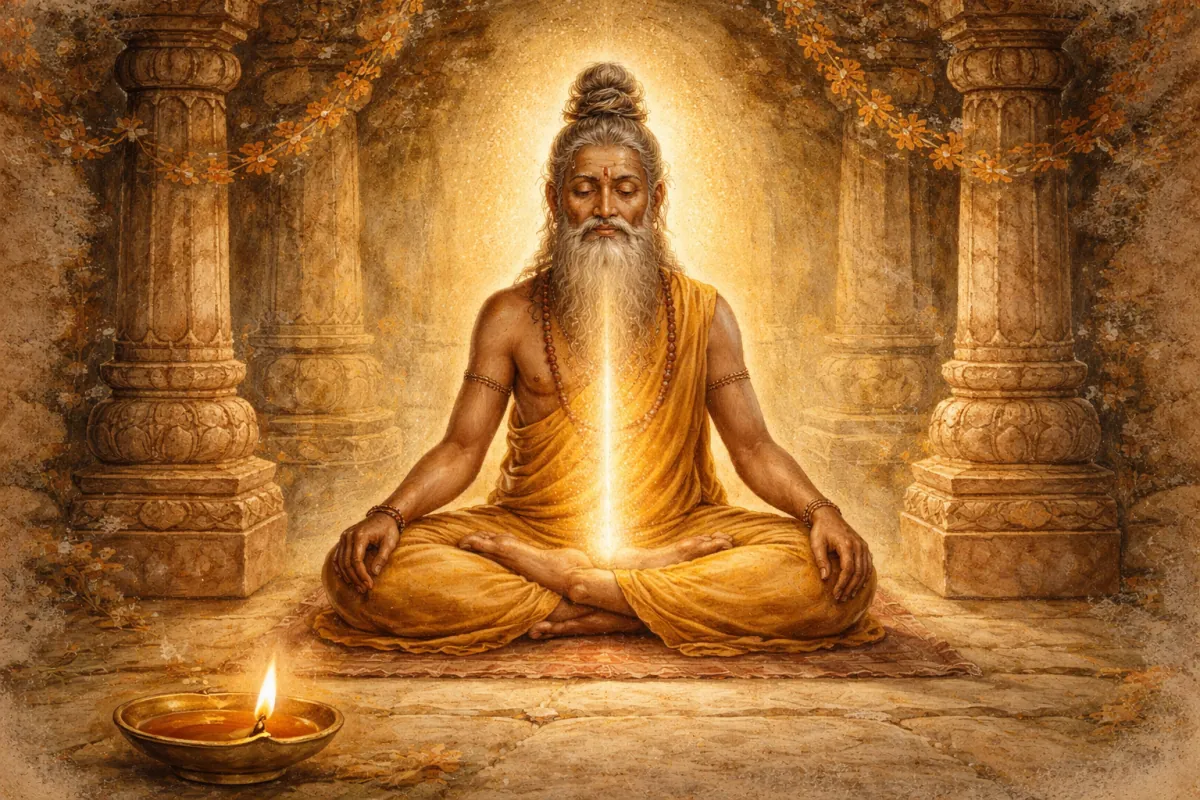
Kundalini yoga (Sanskrit: kuṇḍalinī-yoga) is a system of spiritual practice aimed at awakening the dormant cosmic energy of Shakti, coiled at the base of the spine, and guiding it through the central channel to the body’s higher energy centers. This path is described in the “Tirumantiram” by the Tamil rishi Tirumular (5th–6th century), the “Hatha Yoga Pradipika” by Swami Svatmarama (15th century), the “Shiva Samhita,” and the “Goraksha Shataka”—and continues to be transmitted to this day through the living lineages of Sanatana Dharma.
Popular interpretations often reduce Kundalini yoga to a set of breathing exercises or gymnastics. The traditional view is different: it is precise work with subtle energy that requires consistent preparation, a stable foundation in spiritual life, and a living teacher. The path begins not with awakening, but with purification.
The Subtle Body: The Landscape of Practice
According to the teachings of Sanatana Dharma, a human being consists of several bodies—the physical body (anna-maya-kosha) and subtler bodies, including the energy body (prana-maya-kosha). The energy body contains nadis (Sanskrit: nāḍī—“channel,” “streambed”)—subtle channels through which prana (Sanskrit: prāṇa—life force) flows. Classical texts count between 72,000 and 350,000 nadis, three of which are the principal ones.
Ida nadi runs along the left side of the spine and carries lunar, cooling energy. Pingala nadi runs along the right side and carries solar, active energy. The central channel, sushumna nadi (Sanskrit: suṣumnā), runs within the spinal column and remains the primary path of Kundalini Shakti. In the ordinary state, prana moves through ida and pingala without entering sushumna. The yogin’s task is to change this.
Prana exists in five principal forms—vayus (Sanskrit: vāyu—“wind”): the ascending prana-vayu in the chest, the descending apana-vayu in the lower abdomen, the balancing samana-vayu around the navel, the pervasive vyana-vayu throughout the body, and the expelling udana-vayu in the throat. The first three are fundamentally important for working with Kundalini. It is their union in the manipura chakra that creates the condition for prana to enter the central channel.
Chakras (Sanskrit: cakra—“wheel,” “circle”) are energy centers located along sushumna at points where numerous nadis intersect. The seven principal chakras—from muladhara at the base of the spine to sahasrara at the crown of the head—correspond to levels of the unfolding of consciousness. In muladhara rests Kundalini Shakti, the dormant cosmic energy that, according to Tantric texts, is coiled three and a half times around the central channel.
“The Kundalini fire of our consciousness rises to the higher chakras, burning away the remnants of ignorance and past karmas.”
Sadguru Sivaya Subramuniyaswami
The Preparatory Stage: Purifying the Channels
Forcing the awakening of Kundalini while the nadis remain impure is not only fruitless but also dangerous. The “Hatha Yoga Pradipika” (Chapter II, shlokas 1–10) and the “Shiva Samhita” explain in detail that impure channels make the awakening incomplete and the experiences accompanying it destabilizing.
Purification begins with asanas (Sanskrit: āsana)—stable yogic postures that make the body flexible and ready for the movement of prana. They should be performed not as physical exercise, but in a state of nonconceptual presence—with attention directed toward the movement of prana through the channels rather than toward anatomical details. Padmasana and siddhasana hold a special place among these postures: prolonged sitting in them begins, in itself, to raise apana-vayu upward.
The next step is pranayama (Sanskrit: prāṇāyāma—control of prana), primarily anuloma-viloma (alternate breathing) and sahita-kumbhaka (breath retention). As the practice progresses, the yogin begins to physically feel the currents of ida and pingala—warm strands of energy along the sides of the spine. This is the first sign that the channels have been sufficiently purified and that one can proceed further.
With regular practice, developing a stable perception of prana and beginning to control its currents generally takes between one and three years.
Methods of Awakening: Bandhas and the Three Great Mudras
Bandha (Sanskrit: bandha—“lock,” “bond”) is a technique of muscular locking that blocks the movement of prana in a particular direction and redirects it into sushumna. The tradition identifies three principal bandhas.
Mula bandha (perineal lock) is the contraction of the muscles of the anus and perineum while holding the breath. It draws apana vayu upward, overcoming its natural tendency to move downward.
Jalandhara bandha (throat lock) is performed by pressing the chin against the collarbone. It closes off the ida and pingala channels in the throat area and directs prana vayu downward, preventing it from dissipating.
Uddiyana bandha (abdominal lock) is performed by drawing the abdomen in toward the spine while holding the breath after exhalation. It creates the conditions for prana and apana to merge in the region of the manipura chakra and subsequently enter the sushumna.
The combined application of the three bandhas is described in classical texts as maha bandha (the great lock). The mechanism is precise: mula bandha raises apana, jalandhara bandha lowers prana, samana vayu at the navel serves as the “fire” in which they merge, and uddiyana bandha directs the united current into the central channel.
In addition to the bandhas, for awakening kundalini the tradition prescribes three great mudras (tri-mahāmudrā): maha mudra, maha bandha, and maha vedha. They are practiced in conjunction with sukha purvaka pranayama—calm alternate-nostril breathing with breath retention—and form the classical core of energy practice.
Signs of Kundalini Awakening
The Shiva Gita and a number of Tantric texts describe five successive stages of awakening recognized in the Siddha yoga tradition.
The first is ananda (Sanskrit: ānanda—bliss): a sudden surge of blissful ecstasy in the body, expansion of consciousness, and a sensation of energy rising through the sushumna toward the sahasrara. An important indicator is that if the awakening is accompanied solely by bliss, without destabilizing experiences, this is a sign that the channels are sufficiently purified.
The second stage is udbhava (Sanskrit: udbhava—rising): a sensation of energy moving within. The third is kampa (Sanskrit: kampa—trembling): involuntary bodily vibrations. The fourth is nidra (Sanskrit: nidrā—sleep): states resembling conscious inward immersion; dreams become significantly more vivid, and the subtle body gains autonomy. The fifth is anava samavesha (Sanskrit: āṇava-samāveśa—entry): deep immersion in samadhi, accompanied by the experience of inner light.
Indirect signs of progress include lightness of the body, a reduced need for sleep, increased vitality, and a weakening of automatic desires. When the level of prana is high, the mind is sharper and the intellect refined. When prana declines, tamas arises: drowsiness, lethargy, and mental dullness. An experienced yogin learns to monitor this balance daily.
Safety Guidelines and the Role of the Teacher
The path of kundalini yoga without a living teacher entails serious risks. Pandit Gopi Krishna (1903–1984) described in his books a spontaneous kundalini awakening that occurred in 1937 without any guidance, followed by a years-long crisis with severe physical and psychological consequences. This case is cited in modern literature as a warning.
Subtle instructions governing the work with heat, bliss, and the experience of nonduality cannot be transmitted through books. Without their proper application, awakening remains partial or destabilizing. The tradition identifies four fundamental principles of safe practice.
Gradual progression. Abruptly increasing the duration of breath retention and deliberately “forcing” kundalini upward before the channels are ready are common mistakes. The path is designed to take years, not weeks.
A sattvic lifestyle. Moderation in diet, a regular daily routine, nonviolence, and celibacy during periods of intensive practice are not restrictions as such, but conditions for preserving bindu (Sanskrit: bindu—vital essential energy), without which prana dissipates.
Discernment of experience. The ability to distinguish genuine signs of awakening from secondary phenomena—heat, tingling sensations, and psychic visions—develops only through dialogue with a teacher who knows this territory from within.
Kundalini Yoga in the Laya Yoga Tradition
In the Laya Yoga system, kundalini yoga belongs to the Shakti Yantra section—practices involving work with manifested energy—alongside shat chakra yoga and kriya yoga.
A characteristic feature of this teaching is the inseparability of energy practice and contemplation. Only one-third of the process of bringing prana into the central channel is achieved through physical techniques; the rest is the result of the depth of contemplative presence. Prana follows the mind: the more deeply the mind abides in its natural state, the more easily prana enters the sushumna.
“Shakti is the manifested energy of the primordial emptiness of our Mind. When we purify the channels, work with the winds and pranas, and purify the elements and essential substances in the body, all of this belongs to the section of Shakti Yantra.”
Swami Vishnudevananda Giri
The practical sequence includes anuloma-viloma, sahita-kumbhaka, sukha-purvaka, tri-bandha, maha-bandha, maha-mudra, and maha-vedha. The work proceeds in stages: asanas without breath retention, then with a simple kumbhaka, followed by a double kumbhaka—and full contemplative presence. With regular practice and no serious obstacles, the first genuine experiences arise, on average, after two to three years.
The ultimate goal is not “awakening” as an end in itself, but samarasya (Sanskrit: samarasya—one taste): a state in which consciousness and energy unite in nondual awareness. The practitioner gains the ability to maintain this state continuously—in action, at rest, and during sleep.
📍It is recommended that the practices described above be learned under the guidance of a qualified teacher.
