

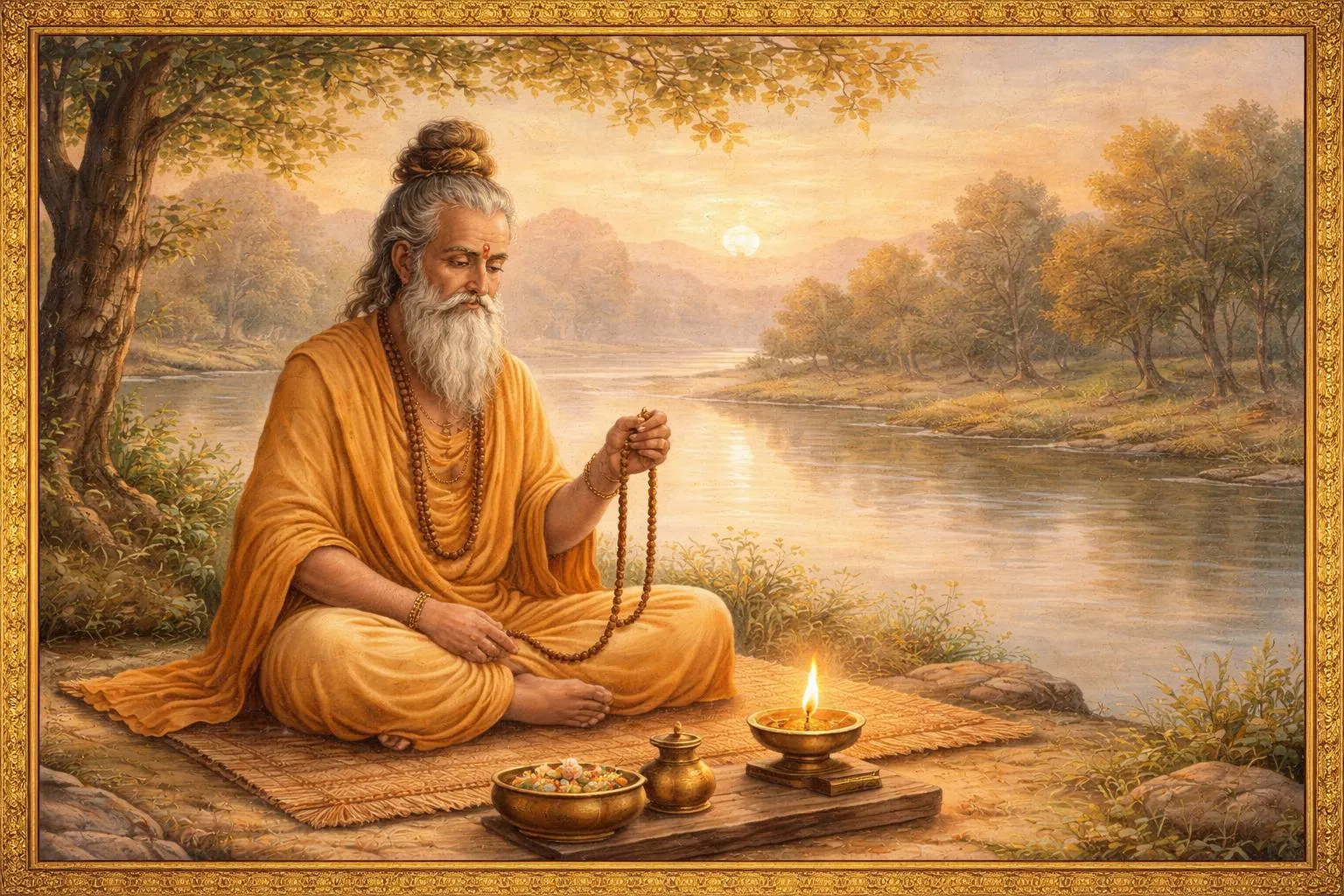
In Sanatana Dharma, mantra yoga (Skt. mantra-yoga) is an independent and complete path of spiritual realization based on the transformative power of sacred sound.
Mantra yoga is a branch of the yogic tradition in which the primary tool of spiritual practice is the systematic recitation or mental repetition of sacred sounds, names of God, or special formula-mantras.
The word mantra (Skt. mantra) originates from the roots man — "mind," "to think" — and tra — "instrument," "to liberate." The literal meaning is "instrument of the mind" or "that which liberates the mind." The Manu Smriti (II.87) defines: "A mantra is called that which protects the one who reflects upon it." Texts emphasize the dual nature of the mantra: on one hand, a concentrated sound form; on the other, a living consciousness-shakti that awakens through correct practice.
Yoga in this context means "union," "path," or "discipline." Mantra yoga is the path of reuniting with the Supreme through the discipline of sacred sound.
Among the many paths — jnana yoga (the path of knowledge), bhakti yoga (the path of devotion), karma yoga (the path of action), raja yoga (Patanjali's eightfold path) — mantra yoga occupies a special place as the most accessible method in the age of Kali (kali-yuga). Swami Sivananda states directly:
"In Kali Yuga, only the practice of Japa can give eternal peace, bliss, and immortality."
Mantra in Sacred Texts
Mantras permeate the entire Vedic tradition. The four Vedas — Rigveda, Samaveda, Yajurveda, and Atharvaveda — largely consist of mantra-hymns (Skt. mantra-saṃhitā), which priest-singers used in ritual actions.
In the Bhagavad Gita (X.25), Lord Krishna proclaims: "Of sacrifices, I am the sacrifice of Japa." This recognition of japa as the highest of all forms of sacrifice places mantra yoga at the center of spiritual practice.
The Mandukya Upanishad is entirely dedicated to the primordial sound Om (Skt. Auṃ) as the quintessence of all existence:
"All this is Om. Everything that was, is, and will be — is Om."
— Mandukya Upanishad, Verse 1
The primordial sound Om, also called pranava (Skt. praṇava), is recognized as the mother of all mantras in most schools of Sanatana Dharma.
In the Shaiva tradition, the central place is occupied by the Panchakshara mantra "Namah Shivaya" (Skt. namaḥ śivāya) — "homage to Shiva," mentioned in the Krishna Yajurveda (Taittiriya Samhita, IV.5.8.1). Tirumular says in the "Tirumantiram": "'Namah Shivaya' is, truly, both the Agama and the Veda." The five syllables of the mantra symbolize the five elements: Na — earth, Ma — water, Shi — fire, Va — air, Ya — akasha (ether).
The Shiva Samhita emphasizes the role of the guru in the transmission of the mantra:
"Only the knowledge received from the guru, from his mouth, is powerful and useful; otherwise, it becomes fruitless, weak, and very painful."
Classification of Mantras
By composition and purpose, four main types are distinguished.
Bija-mantras (Skt. bīja-mantra, "seed mantras") — monosyllabic or short sound nuclei carrying the concentrated energy of a specific aspect of the Absolute: Om, Hrim, Krim, Shrim, and others. They serve as the basis for more expanded mantras and are integrated into other formulas.
Nama-mantras (Skt. nāma-mantra, "name mantras") contain the names of a God or Goddess: "Om Namah Shivaya", "Om Namo Narayanaya", "Om Shri Ramaya Namah". These mantras are accessible to practitioners of all levels and do not require prior initiation for recitation.
Gayatri (Skt. gāyatrī) — metrically organized hymns-mantras from the Vedas. Among them, the central place is held by the Gayatri Mantra of the Rigveda (III.62.10) — a prayer to the solar Brahman-Savitri: "Tat savitur vareṇyaṃ, bhargo devasya dhīmahi, dhiyo yo naḥ pracodayāt" ("We meditate on the glorious light of the Sun; may it guide our intellect").
Dharanis (Skt. dhāraṇī) — more expanded formulas common in tantric traditions; their purpose is the protection and support of the practitioner.
By method of recitation, the tradition distinguishes three types of japa. Vachika-japa (Skt. vācika-japa) — recitation aloud, used in the early stages. Upamshu-japa (Skt. upāṃśu-japa) — whispered japa, where the lips barely move; it is considered ten times more effective than loud recitation. Manasika-japa (Skt. mānasika-japa) — purely mental repetition, the highest form of practice, requiring developed concentration.
By the nature of initiation, mantras are divided into publicly accessible and initiatic (Skt. dīkṣā-mantra) — those transmitted personally by a teacher during diksha.
Japa: Practice Technique
Japa (Skt. japa) — the systematic repetition of a mantra, a name of God, or a sacred formula. The word comes from the root jap — "to whisper quietly." Japa is the most important anga (Skt. aṅga, "part," "limb") of mantra yoga.
The traditional tool for counting is beads (Skt. mālā) made of 108 seeds of rudraksha or tulsi. The number 108 has steady symbolic significance in the Vedic tradition: it is the product of the 12 zodiac signs and the 9 planets of Vedic astrology.
Rules of practice described in the texts:
- consistent time (preferably brahma-muhurta — the pre-dawn hours);
- a consistent place and bodily purity;
- a stable posture — sukhasana or padmasana;
- concentration on the image of the Ishta-devata (Skt. iṣṭa-devatā, "chosen deity") or on the meaning of the mantra;
- the absence of mechanical automatism.
Regarding the last point, it is worth mentioning separately. Mechanical repetition is a common mistake for beginners. Swami Sivananda points out:
"Japa must become a habit, and it should be practiced with sattvic (pure), divine bhava (spiritual mood), purity, prema (divine love), and shraddha (faith)."
Regarding the minimum daily practice, the Guru says: after receiving diksha, the practitioner is obliged to perform the sadhana of chanting every day. The minimum is eight repetitions of each received mantra, so as not to lose the living connection (Skt. samayā). In a full practice, one mantra is chanted from one round (108 repetitions) to sixteen or more.
Mechanism of Mantra Action
To understand how a mantra affects the practitioner, one should turn to the teaching of sphota-vada (Skt. sphoṭa-vāda) — the philosophy of sacred sound developed in the tradition of Vedic linguistics. The grammarian Bhartrihari (5th century) systematized this teaching in the treatise "Vakyapadiya."
According to sphota-vada, a mantra is a specific vibration. When reciting, the practitioner generates the sound body of the mantra — a vibration that gradually spreads through the subtle energy body (Skt. sūkṣma-śarīra), purifying it. The depth of this impact directly depends on the duration and quality of the practice.
At the level of the mind, the picture is different. Pranayamas purify the energy body, but they do not touch the mind and karma. The mantra is specifically designed for the purification of the mind. When a practitioner recites mantras and performs upasana (Skt. upāsanā, worship), sattvic tendencies are established in the mind, sublime bhavas arise, and sattva accumulates. As this accumulation occurs, the subtle body is internally restructured, a pure sattvic inner world is created — and contemplation begins to deepen.
Traditional texts point to another aspect: the inseparability of nama (name) and rupa (form). When a practitioner repeats the name of the Lord, His image rises before the inner eye. Thus, japa and dhyana (meditation) are interconnected: japa naturally transitions into meditation on the image of the Ishta-devata, and over time — into contemplation without reliance on form.
Transmission of the Mantra
Mantra yoga is inseparable from the system of diksha and the guru–shishya (teacher–disciple) relationship.
The transmission of a mantra from a teacher is the essence of the practice. A mantra received within a lineage (sampradāya) through diksha carries within it a living shakti, awakened by many generations of practitioners. "The secret of the mantra 'Namah Shivaya' is to hear it from the right lips at the right time. Then, and only then, will it be the most powerful mantra for you" (Subramuniyaswami, "Dancing with Siva").
The qualitative side of the practice is also important. In lectures, the Guru has repeatedly emphasized: for transformation, it is not enough to simply repeat a mantra — it is necessary to create a special space of practice.
"Not every mantra, not every pranayama or sankalpa, visualization can transform, but only that which has created such a space. Transformation happens when you succeed in creating such a space and establishing yourself and immersing yourself in it. Then you tear your mind out of circumstances and immerse it in yoga-desha, in yoga-kala."
— Swami Vishnudevananda Giri, lecture "The Fire of Tapas"
The results of mantra yoga in the tradition are viewed in stages: starting from the gradual calming of the mind, the purification of karma, the strengthening of the connection with the Ishta-devata — and up to spiritual liberation (Skt. mokṣa). "In the end, japa leads to samadhi — union with the Lord" (Swami Sivananda, "Mantra Yoga: The Path to God-Realization and Calming the Mind").
Mantra yoga is a strictly organized system of spiritual practice rooted in the Vedas and Tantric Agamas. Its power consists of three components: correct transmission through diksha, the regularity and depth of japa, and the inner disposition (bhava). Remove any one of them, and the practice remains on the surface.
The path of mantra is open to any level of physical fitness, at any age, and at any pace of life. But even the most accessible practice requires one indispensable condition: a living connection with the teacher and the lineage.
