

In a world overflowing with external sounds, the idea that something self-born—without a strike, without a cause, without a source—resonates within a person might seem like a poetic image. However, in the tradition of Laya Yoga, nāda-yantra (Skt. nāda — sound, yantra — instrument, path) is a strictly defined branch of practice with specific techniques, stages, and criteria for realization. According to primary sources, it is this section that grants access to the primordial sound of the Universe—the vibration of pure consciousness itself.
What is Nada-yantra?
Nada-yantra (Skt. nāda-yantra) is a branch of Laya Yoga dedicated to meditation on internal sounds as a manifestation of the nature of consciousness. The word nāda in Sanskrit means "sound," "vibration," or "tone." The word yantra means "instrument," "path," or "mechanism." The literal translation is "instrument of sound" or "the path through sound."
In the Vedic tradition, sound (nāda) is viewed not as a physical phenomenon but as the primary manifestation of the Absolute. According to Tantric teachings, the entire manifested Universe arises from a primary sound-vibration: the Primordial Sound (Paranada) unfolds into the Creative Sound (Pranava), and from it into the Primary Sound (Om), and further into a multitude of forms (nāda). The nature of pure consciousness at the energy level manifests in two ways: as the eternal self-luminous Light (Nitya Svayam Jyoti) and as the self-generated sound (Anahata-nada). Nada-yantra works specifically with the second aspect.
Anahata-nada—the "unstruck sound" or "causeless sound"—is a vibration that arises not from a physical strike but from the energetic processes within the body and consciousness. Essentially, the internal sound that a yogi hears during meditation is neither a hallucination nor a physiological phenomenon, but a direct perception of the vibrating nature of consciousness. By meditating on Anahata-nada, the practitioner discovers the true source of any sound—the primordial space of non-dual awareness.
"Nada-yantra (The Universe of Sound). It includes the path of awareness of the internal sound. Nada-yoga is a true treasure, a mysterious mystical path of achieving internal realization up to Liberation into the Rainbow Body, transmitted through the lineage of the Siddhas. By meditating on the internal sound and the external sounds of the five elements, the yogi discovers the true source of any sound—the primordial space of non-dual awareness."
— "The Radiance of Precious Secrets of Laya Yoga", Volume 1
According to the tradition's legend, the teachings of nāda-yoga were first revealed through the revelations of Adinatha—Shiva himself—to the ancient rishis and siddhas. The most revered among those who transmitted this teaching in historical times are Matsyendranath and Gorakshanath—the founders of the Nath Sampradaya. It is to Gorakshanath that Svatmarama attributes the original description of the practice of nāda in the anahata-chakra in his "Hatha Yoga Pradipika."
Primary Sources of the Teaching
The teaching of sound as the nature of the Absolute and of meditation on internal sound as a path to liberation relies on a wide range of Shastric sources.
"Nada-bindu Upanishad" is considered the main text dedicated to nada-yoga—it is here that the teaching on the nature of nāda, its types, and meditation methods is systematically laid out. The title of the text speaks for itself: nāda (sound) and bindu (point, primordial concentration) are viewed as two inseparable aspects of a single reality.
"Hatha Yoga Pradipika" by Svatmarama contains an extensive exposition of nada-yoga. The author explicitly states that he follows Gorakshanath: "I give the practice of Nada in the anahata-chakra, as described by Gorakshanath, for those who have not studied the Sacred Scriptures and are unable to understand the Truth" (4.64). This instruction is noteworthy: nada-yoga is offered as a direct path to realization regardless of theoretical preparation.
"Gheranda Samhita" (5.78, 5.82) provides a detailed description of the practice of Bhramari Kumbhaka—breath retention while listening to internal sounds—and classifies ten types of sounds that arise sequentially in practice.
"Vijnana Bhairava Tantra" describes practices for working with internal sound and internal light in the format of brief meditative instructions. Sutra 13 points to the connection between hearing and internal space: "By touching the eyes lightly like a feather, you will open the light between the eyebrows, and boundless space will arise in the heart."
"Mandukya Upanishad" and its commentary "Mandukya Karika" by Gaudapada provide the philosophical foundation of nada-yoga: "As the space inside a vessel completely merges with the surrounding space when the vessel is broken, so does the individual 'I' merge with the supreme Reality of Being." This description of non-dual merging is what a nada-yoga practitioner achieves through dissolution in sound.
"Yoga Sutras" of Patanjali state that the name of the supreme Reality (Brahman) is the Primordial Sound (Pranava), and the sound is not different from the Source itself. The philosophy of nada-yoga (Nadanta) develops this thesis: the eternal transcendental soundless Sound (Paranada) is the first vibration from which the entire universe emanates.
The Nature of Nada: Hierarchy and Types of Sound
The teaching distinguishes several levels of sound—from the cosmic hierarchy to what the yogi specifically hears in meditation.
In the Laya Yoga system, four levels of sound are identified in its cosmic hierarchy. The first is Parada (Primordial Sound)—the undifferentiated source, soundless in the ordinary sense, existing beyond the perceivable. The second is Pranava (Creative Sound)—the creative principle that generates manifestation. The third is Om (Primary Sound)—the quintessence of all sounds, the sacred syllable, the vibrational expression of the Absolute. The fourth is Nada (secondary sounds)—the variety of sounds in the manifested Universe.
By the level of perception, three types of nada are distinguished. At the gross level, sounds are perceived as external sounds of material objects—ordinary auditory experience. At the subtle level, sounds are perceived as internal vibrations of the energy channels (nadis) within the body. At the super-subtle level, sounds are experienced as fluctuations of pure consciousness itself—that which the Shastras call Brahman. The practice of nada-yoga begins at the subtle level and gradually leads to the super-subtle.
Among all forms of internal sound, a special place is held by Anahata-nada—the "unstruck sound," a self-generated vibration associated with the anahata-chakra (heart center). The sound perceived in the region of the heart is the vibration of pure consciousness in the center of the chest. It arises when a balance of the elements of wind and fire (samyoga) is achieved in the energetic body and serves as a natural expression of the nature of the Higher Self.
"Gheranda Samhita" lists ten types of internal sounds that the practitioner hears sequentially as the practice deepens. First, subtle and high sounds arise: the chirping of a cricket, the melodious sound of a flute, the humming of a bee. Then, denser and more powerful ones are heard: the ringing of a bell, the hum of a brass gong, the beat of a drum, a clap of thunder. Finally—the sounds of a trumpet, fanfares, the mridanga drum, kettledrums, and the large dundubhi drum.
"In the practice of kumbhaka, the yogi will hear various internal sounds: first resembling the sound of a cricket, then a flute, then a clap of thunder, a drum, a bee, a bell, a brass gong, then a trumpet, fanfares, a Mridanga drum, kettledrums, and a Dundubhi drum. In this sound, there is resonance. In this resonance, there is light, and into this light, thinking enters and dissolves there. When thinking is absorbed, the supreme state of Vishnu (Paramapada) is reached."
— "Gheranda Samhita", 5.78, 5.82
This quote points to a fundamentally important aspect of the tradition: sound and light are inseparable. Deep sound contains light, and thinking, upon entering this light, dissolves there. This is why nāda-yantra and jyoti-yantra are viewed as two aspects of a single process: an experienced yogi working with sound eventually discovers that sound transforms into light.
Methods of Practice
The practice of nāda-yantra assumes several preliminary conditions. For its full execution, clean energy channels (nadis) are necessary, which is achieved through regular practice of pranayama and asanas. Stable concentration is also required—the ability to hold attention on a single object without distraction. A quiet environment is favorable, allowing one to listen to internal sounds without external interference. Finally, the tradition insists on mandatory instructions from a realized teacher: nada-yoga belongs to the "secret" teachings and is transmitted only through direct upadesha.
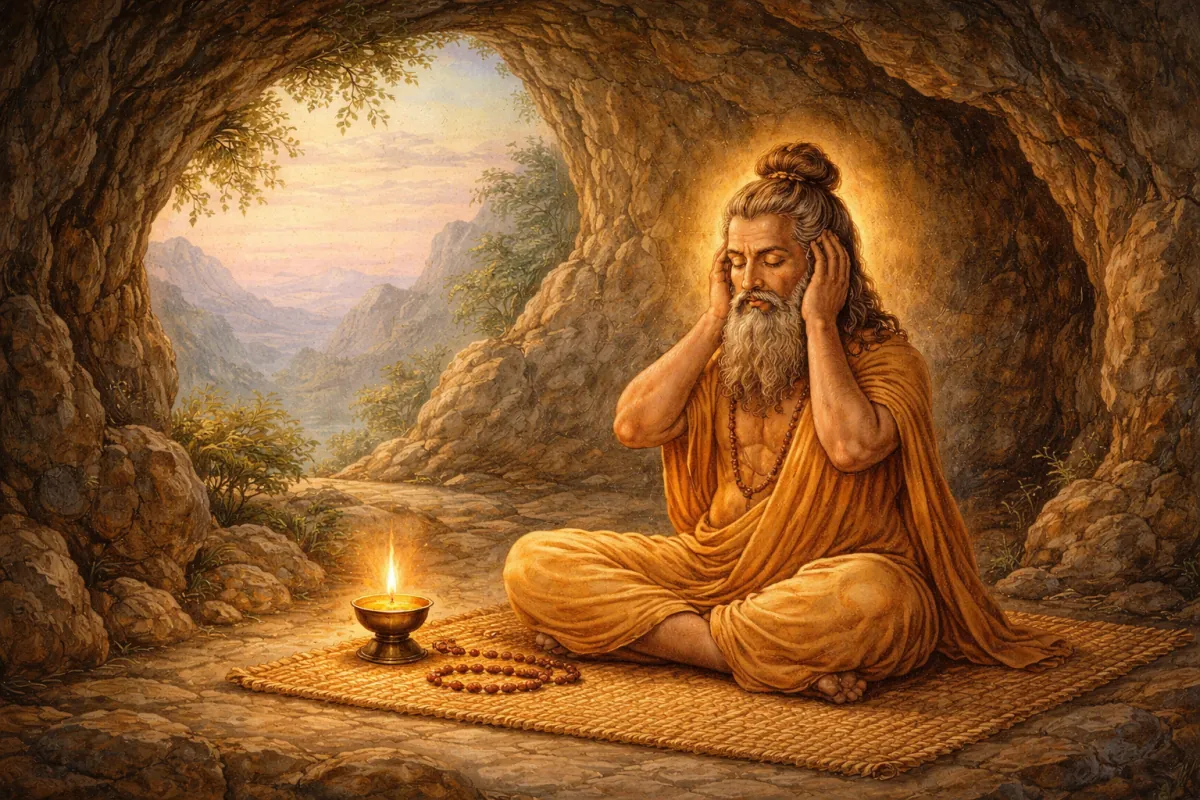
Shanmukhi-mudra (closing the six gates) is the central technique of nada-yantra. The yogi sits in a comfortable, stable asana with a straightened spine. With the thumbs, he closes the ears; with the index fingers, the eyelids; the middle fingers are placed by the nostrils, and the ring and pinky fingers by the lips. This completely cuts off external sounds and visual impressions, directing awareness inward. In the space of this closed perception, the internal hearing awakens—the ability to distinguish subtle vibrations arising in the energy channels.
Bhramari Kumbhaka (humming breath retention) is a breathing practice that enhances the perception of internal sounds. Shanmukhi-mudra is performed, a full inhalation is taken, then kumbhaka (breath retention) is performed, and in this state, attention is directed to the sounds arising within. According to the "Gheranda Samhita," it is during this breath retention that the ten types of anahata-sounds manifest sequentially. Daily practice of Bhramari Kumbhaka gradually reveals increasingly subtle levels of sound perception.
Concentration on the Anahata-chakra is the primary object of meditation in nada-yoga. The Anahata-chakra is the center of manifestation of the self-born sound; therefore, all the yogi's attention is focused on the space of the heart. The sound is initially heard at this point, and as the practice deepens, it spreads first throughout the body and then fills all space.
The philosophical basis of the practice is expressed in the image of the hollow bamboo.
"If the bamboo is hollow and the wind blows, a wonderful melody can sometimes arise, produced by the wind as if someone were playing the flute, while the bamboo sways as if dancing. In the same way, when we empty ourselves, the wind of our energy, circulating in the nadis, generates our internal clarity, deep awareness, which manifests in the form of Anahata-nada sounds. At the same time, we experience unspeakable lightness, joy, and clarity, a state of hovering and unity with all Being."
— "The Radiance of Precious Secrets of Laya Yoga", Volume 1
This image reveals a key principle: the practitioner does not create sounds through effort and does not strive to hear them by force. Attention must remain natural and relaxed. The task is to "empty oneself"—to leave attachments, judgments, and expectations outside the practice. It is then that the wind of prana, circulating through purified channels, generates Anahata-nada on its own.
The tradition allows for the practice of nada-yoga not only in the waking state. As the practice deepens, the yogi develops the ability to listen to internal sounds in the dream state (svapna-avastha) and in yoga-nidra, which explains the close connection between nāda-yantra and nidra-yantra in the system of the five yantras.
Four Stages of Nada-yoga
The practice of nāda-yantra passes through four successive stages, analogous to the four stages of jyoti-yantra. They are described in the "Hatha Yoga Pradipika" and other sources and are analyzed in detail in the commentaries of the Laya Yoga tradition.
The first stage is Arambha (Beginning, Initiation). Sounds arise in the region of the anahata-chakra and are initially perceived as something external, localized in a specific place. Subtle sounds are heard: the chirping of a cricket, humming, flute melodies. At this stage, active effort in meditation is required: the yogi intentionally directs attention to the sounds and holds it there. Initial experiences of the consciousness merging with the sound occur, but they are still unstable.
The second stage is Ghata (Vessel, Development). The sounds become more distinct and begin to spread from the point in the heart throughout the body. A blending of the internal and external occurs: the yogi feels that the sounds fill not only the body but also the space around it. The variety and richness of perceived sounds increase. At this stage, significantly less willpower is required—the sounds themselves capture the attention.
The third stage is Parichaya (Increase, Maturity). Sounds are perceived as omnipresent: they fill all space without exception. Here, there is no longer a need to apply any effort—the practice develops spontaneously. Sound is no longer perceived as a separate objective reality; it proves to be a manifestation of one's own consciousness. A "single taste" is achieved—an equal attitude toward all manifestations, a sense of non-duality. Karmic pranas begin to transform into wisdom pranas. At this stage, siddhis (extraordinary abilities) may arise spontaneously, and deep states of samadhi occur without special effort.
The fourth stage is Nishpatti (Exhaustion, Completion). All sounds dissolve into the empty space of awareness. Awareness becomes perfectly silent, yet infinitely clear—it is not the emptiness of non-existence, but the fullness of Presence. Sound as a form of perception exhausts itself. Nirvikalpa-samadhi is achieved—a non-dual samadhi in which all distinctions disappear. This is the stage of full realization and Liberation. The individual "I" finally dissolves into the transcendental source.
At the level of nishpatti, the sound does not disappear in the sense of destruction—it returns to its source. Just as the space inside a jar and outside the jar become one when the jar is broken (an image from the "Mandukya Karika"), so too the internal sound and the external silence prove to be one and the same reality.
Fruits of the Practice
The tradition describes the fruits of nāda-yantra on several levels—from the first signs of deepening practice to full realization.
Staged fruits. As one progresses through the four stages, the yogi experiences an increase in internal silence, an enhancement of clarity, and the gradual dissolution of habitual mental disturbances. External sounds stop triggering reactions—they begin to be perceived just like internal vibrations: as manifestations of a single consciousness. A stable state of sama (equanimity) arises, which persists not only during meditation but also in daily life.
Samadhi. The nada-yoga practitioner sequentially realizes various levels of samadhi: from savikalpa-samadhi (samadhi with the support of an image or sound, where the meditator, the meditation, and the object are still distinguished) through nirvikalpa-samadhi (formless samadhi without distinctions) to sahaja-nirvikalpa-samadhi—a spontaneous natural state of non-duality maintained in all states of consciousness.
Transformation of the body. According to the teaching of the Siddhas, deep practice of nada-yoga causes real physical transformations. Karmic pranas are transformed into wisdom pranas. The five elements of the body begin to dissolve into the empty foundation of consciousness. The body becomes lighter and more transparent. At high stages of practice, signs are described that the tradition attributes to the state of Shuddha-deha (Pure Body): the face becomes radiant, the body emits an internal light, and abilities emerge that go beyond ordinary physiology.
"Such a yogi, having realized such dissolution of the five elements, abides as pure energy, filling space. He has no specific body or form and can take any form, spontaneously responding to situations. Without dying, such a yogi can take the form of an animal, a human, a bird, or a deity, manifesting for the benefit of people who have a karmic connection with him. He can also visit the pure worlds of the gods and return to such a world in his body."
— "The Radiance of Precious Secrets of Laya Yoga", Volume 1
Liberation into the Rainbow Body. The highest fruit of nāda-yantra is saruba-samadhi—a state of full realization with the transformation of the physical body into Pranava-deha (Immortal Body) or the Rainbow Body of Light. The physical elements dissolve into the empty foundation of pure consciousness, and the yogi is no longer limited by the laws of material existence. According to legend, this is the result of Anama's five-hundred-year practice: having realized the Immortal Body, he relocated to the abode of the gods, retaining the ability to manifest in any form for the benefit of all beings.
The tradition emphasizes that nada-yoga is considered a method that allows one to achieve full liberation in one lifetime. Svatmarama in the "Hatha Yoga Pradipika" specifically indicates that this path is open to those who are unable to comprehend the truth through the study of scriptures—it is direct and does not require preliminary theoretical preparation.
