

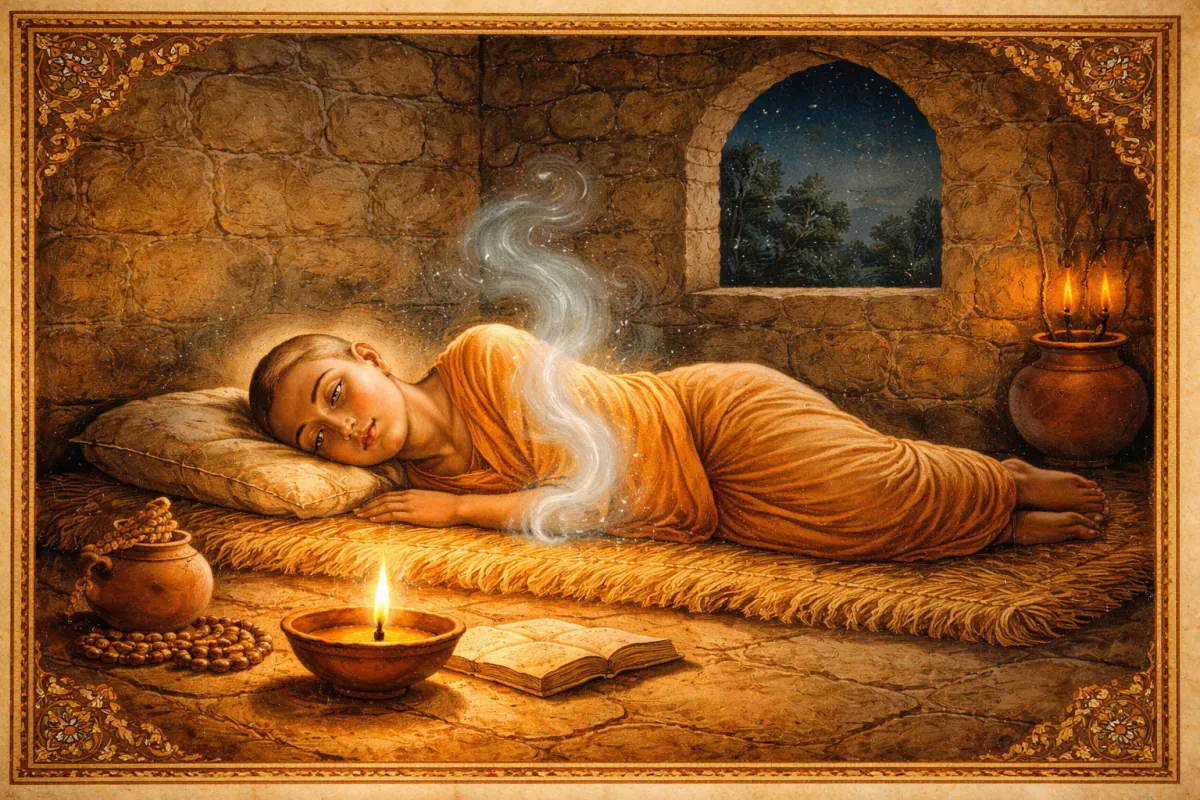
Nidra-yantra (Skt. nidrā — "sleep" and yantra — "instrument," "mechanism," "method") represents the fifth fundamental section (yantra) in the systematic structure of the Laya Yoga teaching. In the context of this tradition, the term "yantra" denotes an ordered set of practices and philosophical principles aimed at mastering a specific sphere of existence.
Nidra-yantra is classified as the sacred science of continuity of awareness (nirantara-smarana), encompassing three states of individual consciousness (avastha):
- Swapna — the state of dreaming sleep.
- Sushupti — the state of deep, dreamless sleep.
- Turiya — the fourth, transcendental state that permeates all others.
According to canonical texts and oral instructions (upadeshas) of the lineage, Nidra-yantra is not a branch of psychology or dream analysis in the Western sense. It is a rigorous Tantric discipline that integrates the Yoga of the Illusory Body and the Yoga of Clear Light.
The methodology is divided into two hierarchical levels:
1. Swapna Yoga (Yoga of Dreams) Relates to the methods of Tantra. The goal is to develop awareness in the subtle body (sukshma-sharira) to the point of its transformation into the "illusory body" (maya-deha). At this stage, the yogi learns to maintain subject-object discrimination, realize the illusory nature of dream phenomena, and carry out the willful transformation of dream objects.
2. Nidra Yoga (Yoga of Deep Sleep) The highest practice, aimed at recognizing the fundamental basis of the mind — the primordial Clear Light (Prabhasvara). Unlike Swapna Yoga, Nidra Yoga operates in the space of non-duality (Advaita), where there is no perception of objects, and consciousness dwells in its pure, self-luminous nature.
Authoritative quote from the Shastras:
"Sleep is not the darkness of ignorance, but an opportunity for the wise to behold the radiance of the Atman in the absence of external distractions." (Cf. Mandukya Upanishad).
PRACTICAL REALIZATION AND PREREQUISITES
The tradition of Laya Yoga emphasizes that mastery of Nidra-yantra requires preliminary preparation (adhikara). Unlike modern popularized "lucid dreaming" techniques, classical Yoga of Sleep is based on:
- Dhyana (meditative concentration): The ability to maintain a focus of attention in the waking state.
Prana-vidya: Control over the movement of vital winds (vayus) and the functioning of energy channels (nadis*).
Technical aspect: The practice involves working with the heart center (Anahata Chakra). Through special visualizations and the management of prana in the central channel (sushumna), the yogi achieves the "introduction of contemplation into the night." This allows the merging of waking consciousness with the Absolute (Brahman), turning physiological rest into an act of continuous spiritual realization.
GOAL AND SPIRITUAL SIGNIFICANCE
The ultimate goal of Nidra-yantra is to reach a state in which consciousness is not interrupted during the transitions between sleep, wakefulness, and, ultimately, between life and death.
Fundamental results of the practice:
- Creation of the Illusory Body: The formation of a stable energetic structure capable of conscious existence outside the physical shell.
- Preparation for the Bardo: Mastering the methods of Nidra-yantra is considered a key factor for successfully navigating the intermediate states at the moment of leaving the body (the post-mortem experience).
- Unity with Brahman: Connecting ordinary consciousness with the transcendental ideal proclaimed in Vedanta.
CONCLUSION
Nidra-yantra is an integral part of Sanatana Dharma, representing a highly effective technology for the evolution of consciousness. It allows the practitioner to utilize one-third of their life, usually spent in an unconscious state, as a powerful tool for achieving final liberation (moksha).
