

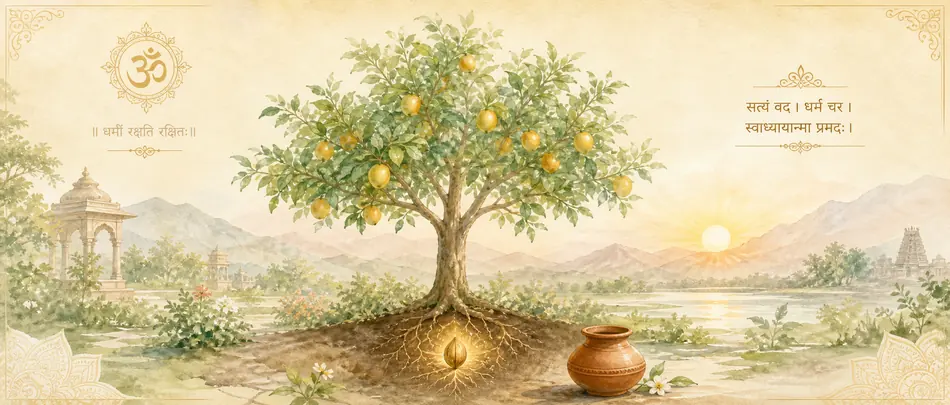
When speaking of a spiritual path, people often imagine something vague: daily meditation, a gradual increase in inner silence, a movement "towards the better" without clear landmarks. Meanwhile, in the Vedic tradition, there is a precise structure describing the architecture of any path—regardless of its external form. It is called Sambandha, Abhidheya, Prayojana—the Base, the Path, and the Fruit.
These three concepts are applicable to any teaching, any religion, and any life task.
What are Sambandha, Abhidheya, and Prayojana?
The word sambandha (Skt. sambandha) means "connection," "foundation," or "starting point." Abhidheya (Skt. abhidheya) means "method," "path," or "means of achievement." Prayojana (Skt. prayojana) means "goal," "fruit," or "final result." Together, they form a classical tripartite structure that the Vedic tradition applies to any Shastric text and any spiritual teaching.
Swami Vishnudevananda Giri has repeatedly returned to this scheme, pointing out its universality:
"In any teaching, there is a base, a path, and a fruit. Whether it is a Dharmic religion, an Abrahamic one, or any other—there is always a starting point, a final point, and a path that must be traversed. This is also called sambandha, abhidheya, and prayojana; that is, we always start with something, and we always have some good future, but there is a process that must be undergone to get from the beginning to the end point."
— Swami Vishnudevananda Giri
"This is a universal matrix that can be observed in any life situation," the Guru emphasizes. A sadhaka comes to the practice with what they have and moves toward liberation through specific methods.
The Base (Sambandha)
Sambandha is the starting point. It is the totality of everything a person brings to the path: their view, karma, inclinations, capacity for practice—and the very nature of the being, the spark of awareness that nothing can extinguish.
In his commentaries on the "Yoga Vasistha," Swami Vishnudevananda Giri describes the practitioner's Base as follows:
"As starting capital, we have the teaching of Advaita; even more—we have Brahman (God)—that is a very large starting capital. We have the philosophy of Advaita Vedanta, the sacred scriptures, the teachings of the Siddhas, the Guru, and our karma is also there... There are positive things, there are not-so-positive things, there are limitations, kleshas, obscurations, the mind; but on the other hand, there is our faith, devotion, there is aspiration, there is a desire to practice and develop—all of this is our given reality, our starting position."
— Swami Vishnudevananda Giri
The Base is dual in nature: it includes both ignorance (avidya) and the spark of awakeness.
One who does not understand where they are starting from risks either overestimating their strength or underestimating what is already present. The View—drishti (Skt. dṛṣṭi)—is itself part of the Base. This is why the tradition places such great emphasis on clarifying the view even before moving to intensive practice: a mistaken view leads one off the path, even if the technique is performed flawlessly.
The Path (Abhidheya)
Abhidheya is that which takes place between the Base and the Fruit. The Path is not just a set of exercises, but a directed movement in which every method holds its place.
The Guru describes this through a simple image:
"What is the base? It is like a seed. When you plant a seed in a garden, for example, a flower or a tree—that is the base. There is nothing yet, but the foundation is laid; if you water it later, it will grow. And what is the path? You water it, loosen the soil, the tree sprouts, a seedling appears, and it grows. When you move along the path—that is the path. And the fruit is when the tree bears fruit, or the plant produces flowers; you pick them and enjoy them."
— Swami Vishnudevananda Giri
In the context of sadhana, the Path is multi-layered work: devotion (bhakti), contemplative presence (samyama), invocation, Guru Yoga, and the observance of samaya. Each of these elements is a form of "watering." None of them act in isolation from the others.
One of the key features of a correct path is tuning into the Fruit from the very beginning. The Guru points out:
"And so, when we practice devotion, Guru Yoga, faith, samaya, and Refuge—we tune into the fruit, into the holy beings of the fruit. Since all deities, all Siddhas, and Rishis are in samadhi, in a state of already achieved realization. Therefore, we tune into the fruit. And it happens that a person's view was not clarified, but thanks to a karmic connection, just by tuning into the fruit, they immediately clarify what the base is and what the path is."
— Swami Vishnudevananda Giri
The Path, therefore, is not a linear road from ignorance to knowledge. Tuning into the Fruit at the beginning is capable of reorienting the entire movement. A practitioner who, from the first steps, keeps the image of the realized state in mind, walks differently than one who simply performs techniques.
It should be noted that in various traditions, the Path is developed with varying degrees of detail. Methods of practice are often described exhaustively. The Base and the Fruit are often described briefly. This creates an imbalance: the practitioner knows what to do, but does not always understand why exactly they are doing it.
The Fruit (Prayojana)
Prayojana is the final result. In the spiritual dimension, the Fruit is not a reward for correctly performed techniques. The Fruit is the unfolding of what was already contained in the Base but had not been recognized.
In a commentary on the "Yoga Vasistha," Swami Vishnudevananda Giri says:
"What does a 'god-man' mean? As you know, in the teaching there is the base, the path, and the fruit. Where the base is what we rely on in our view, the path is what we apply during practice, and the fruit is what we receive or hope to receive at the end, as a result. And the fruit of our practice is transformation into a god-man."
— Swami Vishnudevananda Giri
The "god-man" (divine human) is not a metaphor. It is a specific state: the final elimination of dualistic vision, the realization of one's nature as the Absolute. In lectures on the sixteen stages of the waxing moon of inner awareness—shodasha kala (Skt. ṣoḍaśa kalā)—the Guru unfolds the concept of the Fruit in great detail:
"In the teaching of the 16 stages of the waxing moon of inner awareness lies the very essence, the quintessence of the spiritual path, which describes the path and especially the fruit of spiritual practice. Often in various traditions, the base is well-described and developed, the path is described very detailedly, but regarding the fruit, there are often various obscurities."
— Swami Vishnudevananda Giri
The Fruit is understood not as a single final state, but as an entire "tree of possibilities": the body of light, continuous consciousness in sleep, the unfolding of levels of awareness, and the attainment of sarupya-mukti (Skt. sārūpya-mukti)—liberation in an embodied form. All of these are "beautiful flowers of one great fruit," which is becoming the Absolute.
There is another consideration. Even the beginning of the path is already the Fruit. "Even conception, in fact, is a fruit," the Guru says. The very awakening of the aspiration for liberation is the first sign that the Fruit is already acting, drawing the practitioner toward it.
When the Base Becomes the Fruit
Traditional understanding implies a sequence: first the Base, then the Path, then the Fruit. But in the teaching of contemplation, this sequence turns out to be conventional. It exists only in dualistic vision.
Swami Vishnudevananda Giri points this out directly:
"To practice contemplative presence means to unite the base, the path, and the fruit; to grow into the state of the fruit right now, since the division into base, path, and fruit exists only in dualistic vision. In the non-dual state, the base is already the fruit, and the path is also already the fruit. Here, you do not strive for achievement, but immediately enter this state and continue to remain in it."
— Swami Vishnudevananda Giri
To abide in contemplation means not to move toward the Fruit, but to already be in it. Division arises only when the mind creates a distance between what is right now and what it feels is not yet there.
From this follows an important consequence: the image of the Fruit organizes the entire path. "How we understand the sought-after fruit determines whether we can abide in the non-dual state," the Teacher emphasizes. A blurred or erroneous image of the Fruit makes movement chaotic. A clear one brings everything together.
The tripartite structure of Sambandha–Abhidheya–Prayojana is a tool for orientation, not a rigid route. It tells the practitioner: know where you are starting from; do what must be done; do not lose sight of where you are going. Beyond these three landmarks is the reality in which all three are one.
A question worth checking in with periodically: how do I understand my Fruit right now? Not in theory—but in how exactly I am practicing today. Because it is this very understanding that determines in which direction the practice is moving and how close it comes to what is being sought within it.
Sambandha, abhidheya, prayojana—three points by which any segment of the path can be verified.
