

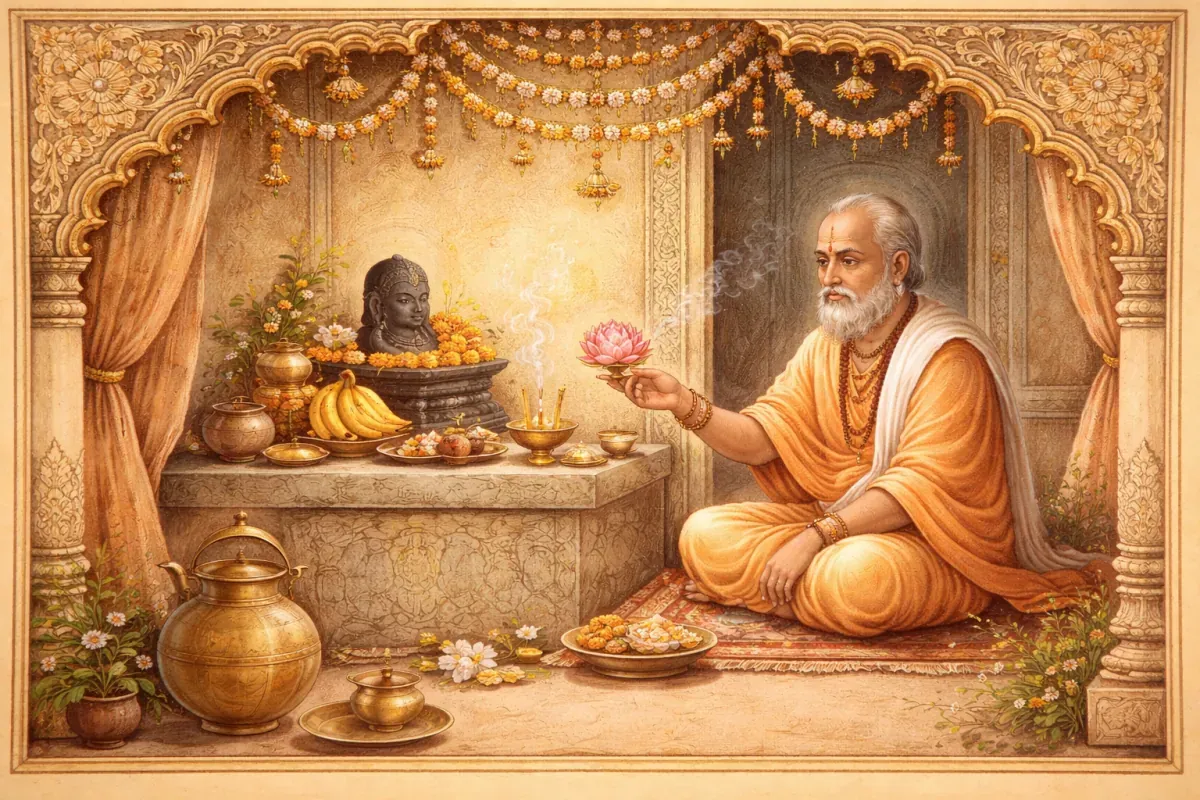
Puja is one of the most widespread spiritual practices in the world. Every day, in millions of homes and thousands of temples, lamps are lit, flowers are offered, and mantras are recited. Behind the outward simplicity of this ritual lies a profound theological system originating in the Vedic and Agamic traditions.
Etymology and Definition
The word puja (Skt. pūjā) traces back to the root puj- — "to honor," "to pay reverence." A number of researchers link it to the Tamil phrase pū-cai ("to offer flowers"), reflecting one of the central elements of the practice — the offering of flowers to the Deity. Both etymological versions converge in meaning: puja is primarily an act of reverence expressed through a specific material action.
According to the Shaiva-Agamic tradition, puja is a consecrated act of ritual worship: an intentional, structurally organized appeal to God and the gods, in which the practitioner expresses love, devotion, and self-surrender.
"The traditional ritual of worship, called puja, is a consecrated act, the most important for a follower of Sanatana Dharma. It is an appeal to God Siva and to the gods and a sincere expression of our love, devotion, and self-surrender."
— Satguru Sivaya Subramuniyaswami, "Dancing with Siva"
At the same time, puja is not prayer in the sense of a verbal petition, nor is it meditation as work with one's own mind. Puja is an encounter: a structured act of establishing a connection between the human and the Divine through image, mantra, fire, water, and flowers.
Puja in the Structure of the Spiritual Path
In the Shaiva-Agamic system, the spiritual path is divided into four sequential stages — padas (Skt. pāda, "step"):
- Charya (caryā) — selfless service and righteous conduct
- Kriya (kriyā) — ritual worship
- Yoga (yoga) — meditation under the guidance of a teacher
- Jnana (jñāna) — the state of realized wisdom
Puja is the heart of kriya-pada, the second stage of the path. It is here that the practitioner moves from external service to internal: the image of God is no longer perceived as a stone carving, but as a living embodiment of Presence. A key shift described by the Agamas concerns motivation. "We perform ritual and puja not because we have to, but because we want to," the tradition explains. It is this internal transformation that makes kriya-pada a genuine stage of sadhana, rather than a formal set of actions.
According to the "Tirumantiram" — a Tamil Shaiva-Agamic text from the 7th century CE — puja is among the ten niyama rules under the name ishvara-pujana (Skt. īśvara-pūjana): "cultivate devotion through daily puja and meditation."
Types of Puja
The tradition distinguishes several forms of puja depending on the location, participants, and degree of complexity.
Home Puja
Home puja is performed at a family altar — a specially designated space in the house. It is accessible to any practitioner and is usually conducted in the morning and evening. In its simplest form, it includes lighting a lamp (dīpa), offering flowers, water, and food to the image of God or the Shivalingam, and reciting a mantra — most often Namah Shivaya (Namaḥ Śivāya).
Home puja is that part of the day which the practitioner spends in the closest and most conscious contact with the Deity. This is why it is considered the foundation of religious life for Shaivite laypeople.
Temple Puja
A temple is not merely a meeting place, but a space where the Presence of God is maintained in a special way. Worship here is conducted by professional priests — pujaris — according to a strict schedule. In large temples, puja is performed seven times a day: at five, six, and nine o'clock in the morning, at noon, and also at six, eight, and ten o'clock in the evening.
Archana
Archana (arcanā) is an abbreviated form of temple puja in which the pujari introduces a specific person or family to the Deity by name, reciting the name of the petitioner, their nakshatra (astrological birth star), and gotra (lineage of the rishi). Archana is performed on special occasions: on birthdays, during important life events, or when making a special prayer.
Abhisheka
Abhisheka (abhiṣeka) is the ritual bathing of the image of God or the Shivalingam with water, milk, yogurt, honey, and other sacred substances. According to the Agamas, abhisheka is perceived as a direct "touch" of God, strengthening the connection between the soul and Ishvara.
Ritual Elements and Their Symbolism
The specific forms of puja vary depending on tradition and region, however, the structure is based on upacharas (Skt. upacāra) — "services" or "offerings" to the Deity. In its expanded form, there are sixteen (ṣoḍaśopacāra):
- Invocation of God (āvāhana)
- Offering a seat (āsana)
- Washing the feet (pādya)
- Offering water (arghya)
- Purifying the mouth (ācamanīya)
- Ritual bathing (snāna)
- Dressing (vastra)
- Investing with the sacred thread (yajñopavīta)
- Perfumes (gandha)
- Flowers (puṣpa)
- Incense (dhūpa)
- Light (dīpa)
- Food (naivedya)
- Offering water after food (ācamana)
- Circumambulation (pradakṣiṇā)
- Prostration (namaskāra)
The logic of this structure traces back to Vedic etiquette: the practitioner receives God as an exalted guest, offering Him the same signs of respect that were due to a venerable visitor. Every action carries a meaning established by tradition. The offering of fire (āratī) is the light of knowledge dispelling the darkness of ignorance. Flowers point to the purity of intention. The pouring of water symbolizes purification. Prasada — food offered to God and returned as grace — points to the mutual exchange between human and God.
Individual items of puja carry their own symbolism. A coconut (nārikela), broken before the altar, represents the destruction of the ego: the hard shell is the limited "I," the sweet fruit inside is the atman, the true "I," revealed through self-surrender. The Kalasha — a ritual vessel of water topped with mango leaves and a coconut — symbolizes God and is used at the beginning of the puja to invoke His presence.
The Inner Meaning of Puja
The most developed theology of puja is presented in the Shaiva-Agamic tradition, based on the corpus of 28 Shaiva Agamas. According to these texts, puja is a special kind of communication: the chanting of mantras, the ringing of the bell, the offering of fire and oblations invoke devas and mahadevas, who "come to bless and help." The ritual is viewed as a real interaction with subtle beings, rather than a psychological exercise or a metaphor.
The tradition distinguishes two levels of puja:
- External (bahir-pūjā) — the correct approach to the Image, bringing offerings, and performing ritual gestures.
- Internal (antar-pūjā) — dwelling in the joy of God's Presence: openness, quiet meditation, when the practitioner "bathes in the shakti" of the temple or home altar.
Both levels are considered inseparable. External form without internal readiness turns into a mechanical ritual; internal aspiration without form loses its foundation. In practice, this means that puja is not a ritual for the sake of checking a box, nor is it a purely mystical experience, but a living point of their union.
"Tapas, japa, serenity, faith in God, charity, Shaivite vows and the study of Siddhanta, sacred offerings, puja to Shiva and pure speech — these are the ten rules through which the path in niyama is perfected."
— Tirumantiram
The content of the puja can change depending on the occasion: it can be "an expression of celebration for important life events, adoration and thanksgiving, penance and confession, prayer and petition, or contemplation on the deeper levels of the subconscious," the tradition explains. This flexibility while maintaining the constancy of form is one of the distinguishing features of the ritual.
Puja is one of the oldest and most vibrant rituals of Sanatana Dharma. It is not an archaic form that has passed from era to era by inertia, but an active instrument of internal transformation: a daily opportunity to direct one's attention to God, freeing it from the bustle of the external world.
In puja, the material and the sacred meet — flower and mantra, fire and water, human intention and Divine presence. The Shaiva Agamas, "Tirumantiram," Vedic hymns — all have preserved and transmitted this ritual as a living thread connecting every practitioner to the continuous chain of tradition.
The lamp is lit. The mantra is spoken. God accepts the offering.
