

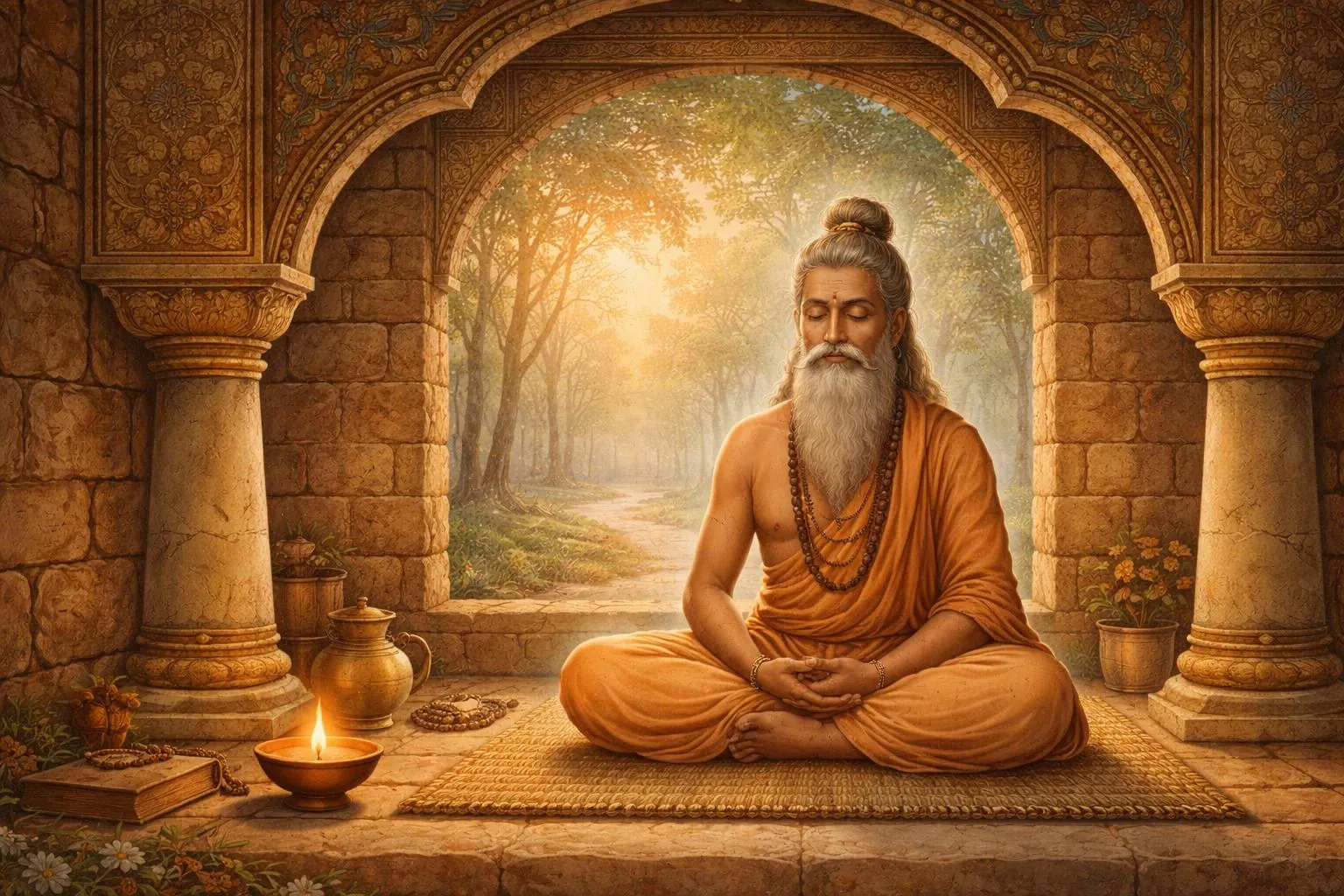
The word rāja in Sanskrit means "king" or "ruler." Raja Yoga is "Royal Yoga," a path on which the practitioner becomes the ruler of their own mind. The mind is viewed as the source of both suffering and liberation: an untamed mind generates attachments and defilements, while a disciplined one opens the way to the ultimate reality.
The classic source of Raja Yoga is considered to be the Yoga Sutras (Skt. Yoga-sūtra) of the sage Patanjali, likely composed between the 2nd and 4th centuries CE. In the very first sutra, Patanjali provides a definition that has become the foundation of the entire system:
Yogaś citta-vṛtti-nirodhaḥ — "Yoga is the cessation of the fluctuations of consciousness."
(Yoga Sutras of Patanjali, I.2)
The following sutra reveals the goal: when the fluctuations cease, purusha — pure consciousness — abides in its true nature (svarūpa). This very experience is the ultimate goal of Raja Yoga.
The term "Raja Yoga" itself does not appear in Patanjali's text. The term became established later; it was widely popularized by Swami Vivekananda in his treatise "Raja Yoga" (1896). Nevertheless, it is Patanjali's eightfold path — ashtanga yoga (aṣṭāṅga-yoga), "the yoga of eight limbs" — that is the universally recognized core of the tradition.
The Place of Raja Yoga Among the Paths of Yoga
In the tradition of Sanatana Dharma, several main paths to liberation are distinguished. Karma Yoga is the path of selfless service without attachment to the fruits of action. Bhakti Yoga is the path of devotion and love for God. Jnana Yoga is the path of discernment and direct realization of the Absolute. Hatha Yoga is a system of working with the body and subtle energy. Raja Yoga occupies the place of the "science of the mind" among them: it explores the nature of consciousness and offers a methodical toolkit for its transformation.
These paths are not in opposition to one another. Hatha Yoga historically developed as a preparatory stage for Raja Yoga: a steady body and freely flowing prana create the ground for deep meditation. Bhakti Yoga — self-surrender and openness of the heart — in turn facilitates the dissolution of the ego in samadhi, for the softness of devotion succeeds where the effort of will proves powerless.
Eight Limbs: From Ethics to Samadhi
Patanjali's system describes eight sequential stages of practice. They are referred to as ashtanga (aṣṭāṅga) — literally "eight limbs" of the body of yoga, where each component organically supports the others.
Yama and Niyama: The Ethical Foundation
The first two stages — yama (Skt. yama, "restraint") and niyama (Skt. niyama, "observance") — form the ethical and disciplinary basis of the practice. Without this foundation, all efforts in meditation will prove fruitless: a mind burdened by impure actions and instability is incapable of genuine concentration.
The five vows of Yama — ahimsa (non-violence), satya (truthfulness), asteya (non-stealing), brahmacharya (moderation in sensual pleasures), aparigraha (non-possessiveness) — apply to all levels: action, speech, and thought. The five observances of Niyama — shaucha (purity), santosha (contentment), tapas (asceticism), svadhyaya (self-study through the study of sacred texts), Ishvara-pranidhana (surrender to God) — regulate the practitioner's relationship with themselves and with spiritual life.
In the commentarial tradition, Yama and Niyama are not a list of prohibitions, but a description of how a mature practitioner behaves. Meditation deepens, and behavior aligns — not because the practitioner is trying, but because the mind is becoming clear.
Asana: Stability of the Body
The third stage — āsana ("seat," "posture") — in Patanjali's context has nothing to do with gymnastics. Only three sutras are dedicated to it, and the only quality they describe is sthira-sukha: "steady and comfortable." The body should not distract the mind. This is where Hatha Yoga, with its extensive system of asanas, originated — as an applied tool grown from this single requirement.
Pranayama: Control of Life Force
Prāṇāyāma — "extension of prana" or "control of breath" — is the fourth stage. Prana (Skt. prāṇa) is the life force, which in the human body manifests primarily through the breath. By regulating the rhythm, depth, and pauses of the breath, the practitioner gains control over subtle energy flows, which directly affects the state of the mind: restless, uneven breathing generates a restless mind, and vice versa.
Pratyahara: Withdrawal of the Senses
The fifth stage — pratyāhāra ("withdrawal" or "drawing back") — is the bridge between the "external" and "internal" stages. Pratyahara means the ability of the sense organs not to follow external objects — much like a tortoise draws its limbs under its shell. This is not a forceful suppression of perception, but the attainment of such focus that external impressions cease to automatically capture attention.
Dharana, Dhyana, and Samadhi: The Internal Limbs
The last three stages — dhāraṇā (concentration on an object), dhyāna (uninterrupted flow of attention toward the object), and samādhi (merging with the object) — are united by Patanjali under the general term samyama (saṃyama). These are not three different practices, but one single process gaining depth.
Dharana is holding the mind on a single point, whether it be the breath, a mantra, an image of a deity, or a center in the body. When this holding becomes continuous, without interruption, it transitions into dhyana — meditation in the proper sense of the word. In samadhi, the boundary between the meditator and the object of meditation disappears.
Samadhi: The Goal of Practice
Samādhi is the ultimate goal of Raja Yoga. Patanjali distinguishes two main types. Samprajnata-samadhi (samprajñāta-samādhi) — "samadhi with support" — represents a series of increasingly subtle states: with analytical thinking (savitarka), without it (nirvitarka), with reflection (savicāra), without it (nirvicāra). In each stage, some subtle "seed" object remains.
Asamprajnata-samadhi (asamprajñāta-samādhi) — "samadhi without support" — is a state in which all mental processes cease. Purusha, pure consciousness, abides in its own nature, without being reflected in any object. This is the goal set by Patanjali.
"Then the Seer abides in his own nature."
(Yoga Sutras of Patanjali, I.3)
The tapas of Raja Yoga, according to Swami Vishnudevananda Giri, consists precisely in "the sadhana of entering dharana, dhyana, and the experience of various types of samadhi" — as practiced, for example, by Sri Ramana Maharshi in his many years of remaining in motionless meditation.
Raja Yoga in the Teaching: Contemplation as the Background of All Methods
The tradition of Swami Vishnudevananda Giri — the teaching of Anuttara Tantra (Skt. anuttara-tantra, "supreme tantra") and Sahajya (Skt. sahajyā, "natural, innate") — views Raja Yoga in a broader context and, at the same time, offers a fundamentally different point of reference in practice.
The classical path of Raja Yoga moves from the bottom up: from yama-niyama to concentration, to meditation, to samadhi. It is a path of gradual intensification — step by step, stage by stage. Anuttara Tantra offers a different starting point: the practitioner immediately occupies the position of one who has already achieved.
Taking the Position of One Who Has Achieved
According to the teaching, the true nature of every living being is inherently pure and free. The only obstacle is the ignorance of this fact, not the absence of any qualities. Practice, therefore, is not the accumulation of abilities for the sake of future liberation. It is the recognition of what is already here.
The tradition calls this understanding the "position of siddha-bhava" (Skt. siddha-bhāva, "the feeling of being one who has achieved"): from the very beginning, the practitioner relates to themselves not as someone trying to reach enlightenment, but as someone discovering their primordial being. Practice is not canceled by this — it becomes a play, a lila (Skt. līlā). Not hard labor, but a joyful self-expression from a presence that is already full.
This view fundamentally changes the attitude toward all methods. As Swami Vishnudevananda Giri says:
"There is the path of Anuttara Tantra, which goes first through the fullness of attention, through jnana and the fullness of attention. Through the fullness of attention, one must achieve the continuous maintenance of mindfulness. When the continuous maintenance of mindfulness is achieved, you perform various types of sadhanas... Then, without passing through the path of samadhi, the path of dhyana, you can realize the state of turiya thanks to the maintenance of the mindfulness of the natural state — this is the uniqueness of the path of Anuttara Tantra."
All Methods as Auxiliary
The methods of Raja Yoga are not rejected here. Patanjali's eight limbs, pranayama, dharana, dhyana — all of them are applied with full force. But their role changes: they become upayas (Skt. upāya, "skilful means") designed to strengthen the practitioner in presence, rather than being ends in themselves.
Awareness is the guiding beacon; methods work in parallel with it, not instead of it. The Guru says:
"Besides awareness, one must actively apply upayas, all external methods, that is, establish oneself in sadhana, in stable sadhana, upasana, and purify and purify. Awareness concerns the internal, subtle states of consciousness, while purification concerns our prana, our mind, our external environment, and behavior — and this must be done continuously... All such methods always work, but they must also be applied in parallel with awareness."
Yama and Niyama continue to purify. Asana provides stability. Pranayama works with energy. Dharana and Dhyana deepen concentration. Not one of the eight limbs is discarded — but none is the final point. They all serve one thing: the maintenance and deepening of contemplative presence.
Contemplative Consciousness in Every Practice
The central instruction is this: in every method, the most important thing is not to lose contemplative consciousness. Whether the practitioner sits in dhyana or repeats a mantra, practices pranayama or stands in an asana — the internal vector is one: abiding in open, unclouded awareness.
Contemplation does not mean being closed to the world. As the Guru teaches:
"Abiding in free, relaxed awareness, we by no means withdraw into a void, 'freezing' consciousness or detaching from the objects of the six senses. We allow the eyes to see and the ears to hear, yet we do not follow the objects of perception, continuing to abide relaxedly in the radiance of our own natural awareness."
Contemplation is not a special state that opens only in the silence of a retreat. It is a basic position available in any circumstances. Every stage of Raja Yoga, in this light, becomes an opportunity for the direct transmission of presence. In the instructions of the tradition, it is formulated thus:
"Every aspect of practice in the method is a direct transmission of absolute presence. At first, this goes through fixation on certain postures, methods, practices, so that through repetition it may be recognized. When contemplation becomes stable, when the wisdom of contemplation opens every moment, then any state is seen as a direct manifestation of the Absolute."
Therefore, in our tradition, it is said: the correct "posture" of contemplation is the one the practitioner is in right now. Not in the sense of abandoning formal practice, but in the sense of understanding that not a single moment falls out of the unity.
Patanjali created one of the most systematically laid out maps of spiritual practice: eight stages from ethics to samadhi. This map works. Millennia of its application are sufficient evidence.
Anuttara Tantra and Sahajya offer not a rejection of this map, but a change in the one who walks it. Not the one who has not yet arrived — but the one who recognizes the way home. The eight limbs remain, the practice continues. Only the background changes: instead of the effort to achieve — the contemplation of what already is. Only one thing remains: not to lose the thread of awareness — neither in dhyana, nor in pranayama, nor in the hustle and bustle of an ordinary day.
