

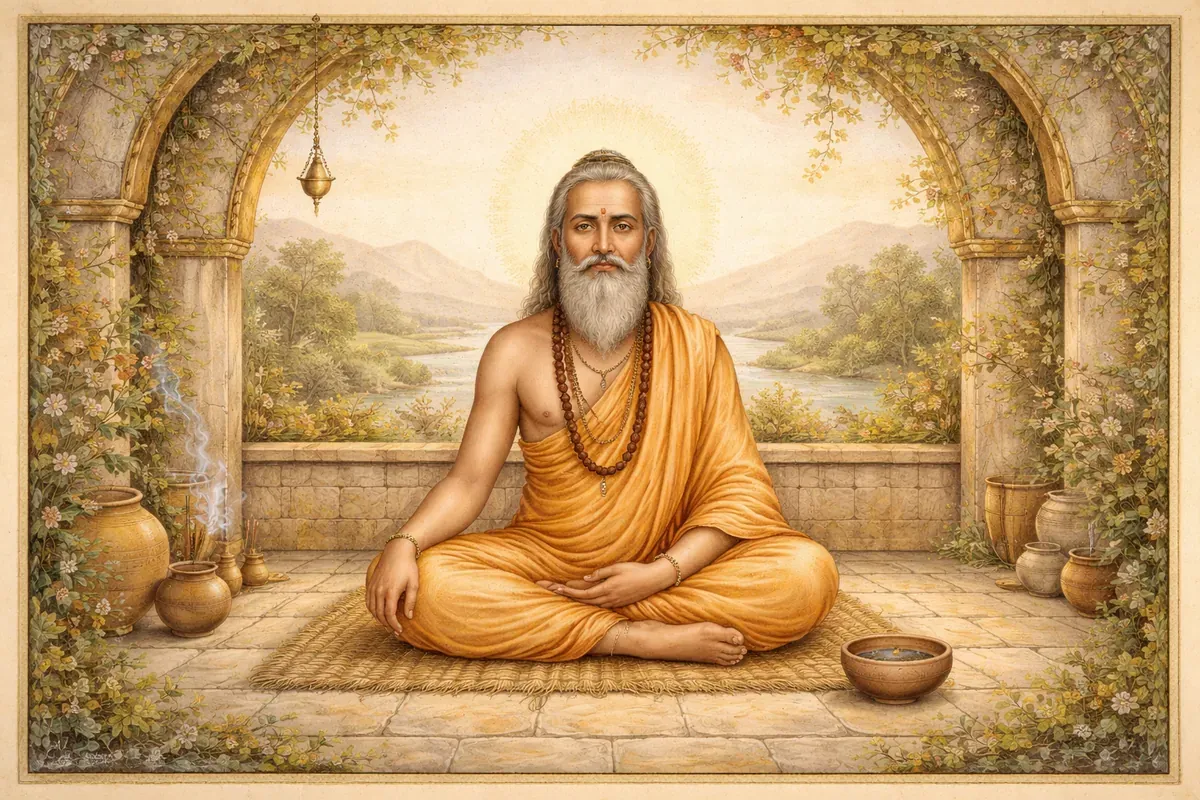
Sahaja
There are things that cannot be taken by effort. You cannot force yourself to fall asleep—the harder you try, the more awake you become. You cannot fall in love or laugh genuinely through sheer will. Likewise, you cannot "enter" Sahaja. You can only stop interfering with what already is.
Sahaja (Sanskrit: sahaja) is one of the key concepts of Sanatana Dharma, denoting the innate, primordial state of consciousness residing in inseparable unity with the Absolute. The term is found in the texts of Advaita Vedanta, Kashmir Shaivism, the Natha tradition, and Tantra—always pointing to one thing: man's true nature is not achieved, but recognized. It is not created by practice. It reveals itself as the veils of ignorance—avidyā (Sanskrit: avidyā)—fall away.
Etymology
The word "sahaja" is formed from two Sanskrit roots: saha—"together, simultaneously"—and ja, from the root jan—"to be born." The literal meaning is "born together," "that which arose simultaneously with the being itself."
It is not something that comes from the outside. It is what has accompanied you since your first breath, existed before birth, and will remain after it. Your original nature is sat-chit-ānanda (Sanskrit: sat-cit-ānanda)—being-consciousness-bliss—which you may have forgotten, but have not lost.
In the texts of the Natha Siddhas and in the teachings of Dattatreya, Sahaja occupies a middle position between two related concepts. Pratibha (Sanskrit: pratibhā) is the "flash," the first powerful experience of awakened consciousness. Samarasya (Sanskrit: samarasya) is the "equal taste," the complete integration with reality. Sahaja is the state into which the practitioner transitions when the flashes of pratibha have ceased to be a rarity and have become the background of their existence.
Definition in the Tradition
The strict definition in the tradition is: stable abiding in non-dual awareness without effort and without special conditions—such as posture, solitude, or silence.
Swami Vishnudevananda Giri speaks of it simply:
"Sahaja-samadhi, in simple terms, is living in God. It has no alternative, because everything else is living not in God; it is continuous living in God, or a life conditioned by some circumstances."
Those established in Sahaja remain in God while talking, working, or walking down a crowded street. Their samadhi is not interrupted because it does not depend on circumstances.
The tradition distinguishes between three types of samadhi. Savikalpa-samadhi (Sanskrit: savikalpa-samādhi)—"with forms": a deep meditative state in which the object of contemplation is still preserved. Nirvikalpa-samadhi (Sanskrit: nirvikalpa-samādhi)—"without forms": a complete cessation of mental movements, requiring a motionless body and suspended breath. Sahaja-samadhi (Sanskrit: sahaja-samādhi)—"natural samadhi": the same non-dual awareness, but not requiring the cessation of activity and not interrupted under any circumstances.
The difference is fundamental. As long as samadhi depends on a posture, it is not final. As soon as one leaves meditation, begins to speak, or does something—the state is interrupted. Sahaja is not interrupted. It is not a peak to be stormed again and again. It is the foundation.
Sahaja in Sacred Texts
The Yajurveda describes one who has realized this state: "He remains detached yet not detached, in the body yet not in the body; his inner essence becomes all-pervasive. Having purified his heart, the yogi sees: I am All, the Supreme Bliss." A precise portrait of a jivanmukta—he lives in the world without being caught by it.
Shri Siddhanta Shikhamani—an authoritative text of Veerashaivism—describes a three-stage scheme of realization: pratibha, sahaja, samarasya. A movement from flashes of awakening—to their stabilization—to complete merger with the Absolute.
Ramana Maharshi, whom the Laya Yoga tradition regards as a witness to this path, clearly formulates the relationship of Sahaja with other types of samadhi: "In Jnana Yoga, sahaja-sthiti (Sanskrit: sahaja-sthiti)—the natural state—is itself the state of nirvikalpa. The mind is free from doubts. Even while active, it knows that this activity is in reality, in the Atman, the highest being."
Three Stages: Pratibha – Sahaja – Samarasya
The path unfolds through three states.
Pratibha is the first authentic experience of awakened consciousness. The practitioner enters meditation and feels the dimension of God—powerfully, clearly, unforgettably. But it is unstable: as soon as you start to move or speak, the state leaves.
Sahaja is the next stage. Fleeting samadhi has grown into a stable natural state. The practitioner no longer "enters" awareness and "leaves" it. Awareness has become the background of their existence. Special conditions are no longer needed for this.
Samarasya is the "equal taste." Everything that is perceived—sounds, forms, bodies, events—is perceived as a manifestation of the single Consciousness. Duality has vanished not in formal meditation, but from the very fabric of perception.
These three stages describe the actual trajectory that a practitioner follows over many years of sadhana.
How to Practice Sahaja
A natural question arises: is it even possible to "practice" that which is by its very nature the most natural state?
The Guru answers it thus:
"Contemplation is such a complex thing. I have been teaching for 12 years, and only after 12 years can one even understand what it is. But in reality, this state is very simple; it is called amanaska, sahaja—the natural. Within us, there is a deep level of awareness; we must discover it. First, receive intellectual explanations, and then the Guru must transmit it—you cannot see it yourself, the Guru can transmit it. And you must purify it, verify it, confirm that 'this is it,' and then contemplate."
> — Swami Vishnudevananda Giri
This is key: Sahaja is not built, but recognized—through the Guru's transmission and then through the steady discovery and establishment in what was recognized.
Continuity of Awareness
The first and most important practical instruction is continuity. Not the depth of individual meditations, but the continuity of awareness in ordinary life.
"To abide in sahaja-samadhi, one must practice maintaining awareness. Continuously, from morning to evening, second by second, day after day, week after week, month after month, year after year. Standing, sitting, lying down, while eating, working, talking. If you can do this, then they say it is all the same to you whether it is meditation or not. You do not depend on scheduled meditation; you are always meditating."
> — Swami Vishnudevananda Giri
This does not mean "sitting with eyes closed all day." It means that a part of the consciousness is always directed toward the Source. You talk, but you talk meditatively. You work, but you work in awareness.
"If you abide in conscious presence without distraction, the question of meditation does not arise. The question of meditation arises when you have become distracted and need to 'enter' somewhere. If you abide in awareness without distraction, this is called the yoga of non-meditation, Sahaja."
> — Swami Vishnudevananda Giri
Contemplation in Motion
The second instruction is the integration of the meditative state into movement and activity.
"With eyes open, in movement, you try to remember this Light anyway, to relax, to establish yourself in non-doing, to surrender to it. This is called the path to sahaja-samadhi—contemplation in motion. Gradually, your whole life will become such a continuous abiding in this Light."
> — Swami Vishnudevananda Giri
An advanced form of such contemplation is sahaja-kriyā (Sanskrit: sahaja-kriyā)—action from the natural state, where contemplation is unified with the body, prana, and chakras. In this practice, there is no gap between meditation and life: any situation becomes a training of consciousness.
Self-Surrender
The third instruction—and perhaps the most subtle. Sahaja is not only the fruit of contemplation. It is, above all, the fruit of grace.
"Sahaja is bathing in the rays of the Absolute's grace; it is always a descent. It is a great attraction—you fly as if on wings. Here, not only contemplative clarity is important, but also devotion: to deserve such a descent, one needs aspiration toward God. If a person practices conscious presence without devotion, they will get lost."
> — Swami Vishnudevananda Giri
Contemplation without devotion (bhakti, Sanskrit: bhakti) leads astray: the powers of the subtle body open up and begin to overwhelm awareness rather than uplift it. This is why the tradition always points to the three pillars together: contemplation, awareness, and self-surrender.
The Practice of Shravana – Manana – Nididhyasana
The Teacher also points to the classical path of preparation known since the time of Shankaracharya (788–820 CE): shravana (Sanskrit: śravaṇa)—hearing and studying the teaching; manana (Sanskrit: manana)—deep reflection; nididhyasana (Sanskrit: nididhyāsana)—continuous practical abiding in what has been realized.
"We must always take this sahaja-samadhi as a standard and practice shravana, manana, and nididhyasana to approach it, and then establish ourselves in it."
> — Swami Vishnudevananda Giri
What Sahaja Is Not
A few important clarifications, because Sahaja is easily confused with what it is not.
Sahaja is not relaxation. A person can be perfectly relaxed and yet remain in complete ignorance. Relaxation is a state of the body and nervous system. Sahaja is a state of Consciousness.
Sahaja is not passionlessness in itself. One established in it can experience joy, compassion, or keen interest—and yet remain rooted in the Source. It is not an anesthesia of the feelings, but their transformation.
Sahaja is not the absence of activity. In sahaja-samadhi, there is no fixation, no visualization, no mantras. As the Guru says: "It is the open mind in its natural state. It is meditation without a meditator." Action continues, but the doer has vanished.
Just as a river that has reached the ocean does not stop moving, but no longer knows where it ends and the ocean begins—so too one established in Sahaja continues to live, knowing no separation from the Absolute.
Sahaja in the Sanatana Dharma Tradition
In the lineage of Swami Vishnudevananda Giri, Sahaja is the central concept of Laya Yoga. Not just one aspect of the teaching, but the point around which the entire path revolves.
"Sahaja-sthiti, sahaja-nishtha—this is the root concept in Laya Yoga around which everything revolves. We are not interested in seeing God once with one eye, as in savikalpa-samadhi; we are interested in being in God 24 hours a day, without interruption."
> — Swami Vishnudevananda Giri
Savikalpa and nirvikalpa are important stages, but they are preliminary. "Nirvikalpa-samadhi—you see God only as long as your breath is suspended. But as soon as the pranas start moving and the mind starts working—that's it, the samadhi is over. Sahaja-samadhi is not interrupted day or night. The goal is, once having entered it, never to lose it."
The spiritual level of a practitioner in the tradition is determined not by the depth of their retreat experiences, but by how much they have "grown into the divine reality"—and how stable this rootedness is in ordinary conditions. This is precisely what Sahaja is: not what happens on the meditation mat, but what remains when the mat is put away.
The entire path is built for this: discipline, practice, self-surrender, retreats, and the study of the Shastras. All of this is not an end in itself. It is the preparation to one day recognize: that which you were moving toward was always here.
