

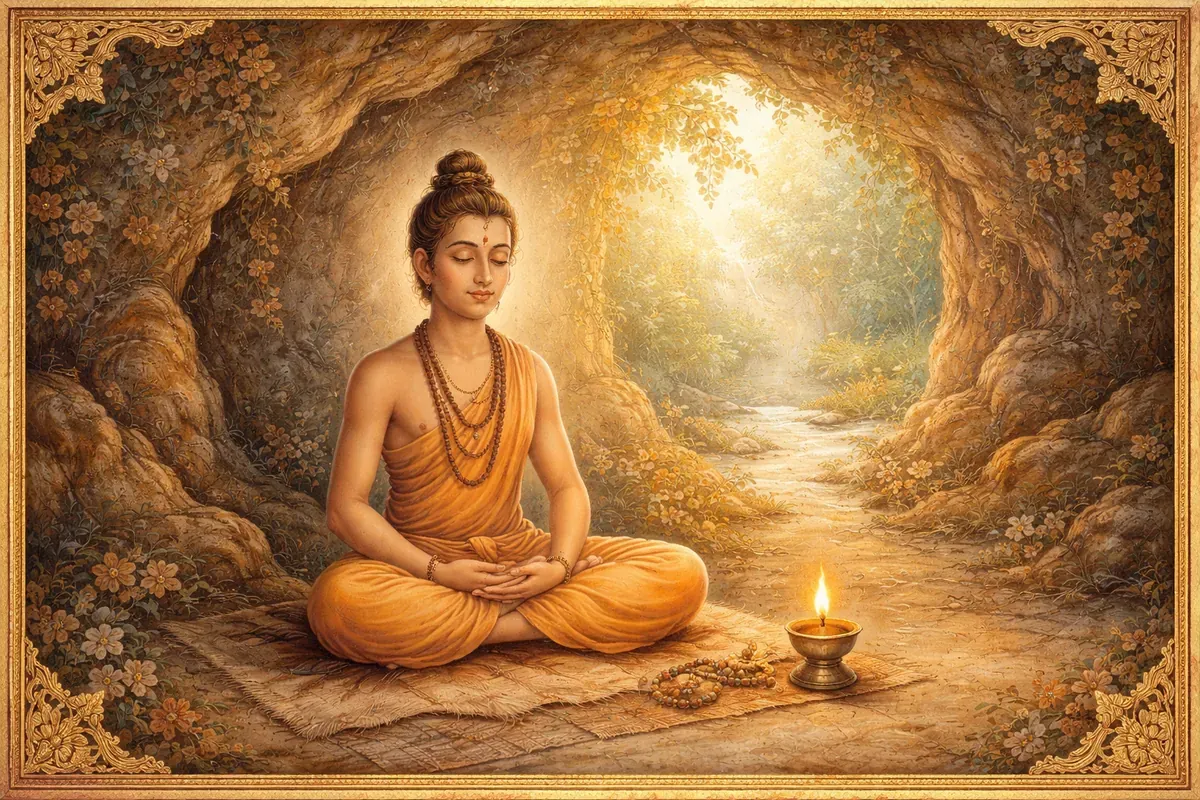
Shakti-yantra (Skt. śakti-yantra) is one of the five sections of the Laya Yoga teachings, dedicated to working with the energetic dimension of practice. Along with Prajna-yantra (the path of awareness), Nada-yantra (the yoga of sound), Jyoti-yantra (the yoga of light), and Nidra-yantra (the yoga of dreaming), Shakti-yantra forms a complete map of the path. While Prajna-yantra addresses the nature of the mind, Shakti-yantra explores what moves the mind—the living force that permeates every level of the human being.
Shakti: The Nature of Divine Energy
The word shakti (Skt. śakti) comes from the root śak—"to be able," "to have power." In the Sanatana Dharma tradition, Shakti is not just power as such, but the very nature of Brahman: His inherent, dynamic expression. There is no separation between Shiva and Shakti—just as there is no separation between fire and its heat. Shiva is the static, immobile principle of the Absolute; Shakti is His self-manifesting nature, impossible to exist apart from the source.
According to Shaivite teachings, Shakti manifests in three forms: iccha-shakti (Skt. icchā-śakti)—the power of will and intention; jnana-shakti (Skt. jñāna-śakti)—the power of knowledge and discernment; and kriya-shakti (Skt. kriyā-śakti)—the power of action and embodiment. All processes in the manifested universe, from the movement of planets to the arising of a thought, unfold as the play of these three forces.
"Recognizing the world as the embodiment of Shakti is the worship of Shakti. Pure knowledge, unattached to objects, is absolute."
Devikalottara Agama
Shakti-yantra in the Structure of Laya Yoga
The teaching of Laya Yoga is organized around five yantras—five paths of practice. The word yantra (Skt. yantra) means "instrument" or "matrix"; applied to the teaching, it indicates a specific method of working with reality. Shakti-yantra encompasses everything related to mastering the energetic dimension: awakening the kundalini-shakti, managing prana, concentrating on the chakras, and recognizing the primordial elements.
According to the lectures of Swami Vishnudevananda Giri, the section of Shakti-yantra describes "methods of contemplation and philosophy related to energy," and the ultimate goal of the path is "the unity of consciousness and energy." At the same time, Shakti-yantra is not practiced in isolation from the rest of the teaching: energetic practices are inextricably linked with awareness, and only their integration leads to genuine progress. The five yantras are not separate disciplines, but facets of a single practice.
The traditional path in Shakti-yantra begins with the preparation of the body and the purification of the channels. First, asanas and pranayama create the necessary foundation, then subtler levels are revealed. Each subsequent section assumes mastery of the previous one.
Kundalini Yoga
Kundalini Yoga (Skt. kuṇḍalinī-yoga) is the central practice of Shakti-yantra. Kundalini-shakti (Skt. kuṇḍalinī-śakti) is the dormant cosmic force, symbolically depicted as a coiled cobra at the base of the spine, in the muladhara chakra. When this energy awakens, it rises through the central channel—sushumna-nadi (Skt. suṣumnā-nāḍī)—to the sahasrara chakra at the crown of the head, where the reunification of the individual life force with pure Consciousness is achieved.
"...the central kundalini-shakti is like His divine stage, so in ecstasy He dances, He, Who is the Transcendental Light."
Tirumular, "Tirumantiram"
On the path of the kundalini's ascent, the practitioner encounters three granthis (Skt. granthī)—energetic knots that block the free movement of prana: the Brahma knot in the base region, the Vishnu knot in the heart center, and the Rudra knot in the brow area. Untying these knots sequentially opens three internal spaces and leads to the deepening of samadhi states.
Awakening the kundalini is a process that requires careful preparation and experienced guidance. Without sufficiently purified channels and without an understanding of what is happening, the practitioner's experience will be partial at best, and destabilizing at worst. The texts of the tradition, from the "Tirumantiram" to the "Samadhi-diksha" of Siddha Boganathar, are unanimous in this: the path requires a professional approach.
Pranavidya
Pranavidya (Skt. prāṇa-vidyā) is the science of the nature and management of the life force. The word vidya translates as "knowledge" or "science"; prana-vidya is literally "knowledge of the life force." In the Laya Yoga tradition, pranavidya takes the place of a fundamental discipline: before working with the chakras or awakening the kundalini, the practitioner learns to perceive and regulate the movement of prana in their own body.
Prana (Skt. prāṇa) is not just breath, although breath is its most accessible manifestation. According to the teachings of Sanatana Dharma, prana permeates all levels of the human being—the physical, vital, and mental bodies—and performs five main functions in the form of the pancha-vayus: prana-vayu, apana-vayu, samana-vayu, udana-vayu, and vyana-vayu. Managing prana through pranayama—kumbhaka (breath retention), anuloma-viloma (alternate nostril breathing), and bandhas (energetic locks)—creates the necessary foundation for the subtler practices of Shakti-yantra.
It is recommended to start with nadi-shodhana pranayama, gradually building up the proportion of breath retention. When the channels are sufficiently purified, prana and apana begin to naturally enter the sushumna. This is the transition point to the practice of Kundalini Yoga.
Shat-chakra-yoga
Shat-chakra-yoga (Skt. ṣaṭ-cakra-yoga) is a specific section of Shakti-yantra dedicated to systematic work with the six main energetic centers. The word shat means "six," and chakra means "wheel" or "circle." Chakras are junction points where numerous nadis (Skt. nāḍī), subtle energy channels, intersect.
In the Natha Yoga tradition, which the teaching of Laya Yoga draws upon, the practice of shat-chakra-yoga begins with the lower centers—muladhara and svadhisthana—and sequentially covers the five lower chakras. Prolonged concentration on each chakra purifies the corresponding element, transmutes polluted pranas into pure ones, and establishes authentic contact with the nature of that level. Gorakshanath, in the "Siddha-siddhanta-paddhati," indicates that the full knowledge of a yogi includes not only the six chakras but also sixteen adharas (support points), three lakshyas (objects of concentration), and five internal spaces—which testifies to the depth of the system beyond its basic level.
Shat-chakra-yoga is not limited to concentration as such. The practitioner learns to integrate presence with the chakra—not only focusing on it but also perceiving the corresponding element from within: what is all-earth, all-water, all-fire. Such work gradually unties karmic knots, heals chronic states, and creates the ground for the awakening of the kundalini.
Tattvavidya
Tattvavidya (Skt. tattva-vidyā) is the science of the primordial elements as living principles of reality. The word tattva (Skt. tattva) can be translated as "that-ness," "principle," or "essence"—that which all manifestation consists of. In Kashmiri Shaivism, thirty-six tattvas of three levels are described: pure tattvas (Skt. śuddha-tattva)—five higher principles associated with Shiva and Shakti; mixed tattvas—the level of the limited being; and impure tattvas (Skt. aśuddha-tattva)—the gross material world. Each level is not just a conceptual scheme, but a living experience available in practice.
In the context of Shakti-yantra, tattvavidya includes the mastery of svara-vidya (Skt. svara-vidyā)—the science of breath rhythms and the alternation of elements in the body. According to the text "Shiva Swarodaya," during each hour, five primordial elements—earth, water, fire, wind, space—are sequentially activated in the body, each with its own qualities and predispositions. A practitioner who has mastered this knowledge is able to harmonize their activities with the natural rhythms of the subtle life force.
On a deeper level, tattvavidya involves recognizing elements as manifestations of five aspects of wisdom. Earth is the principle of the goddess Bhumi, water is the principle of Varuna, fire is the principle of Agni. When a practitioner perceives any emotion or state as an expression of one of these forces, their purification and transformation occur. This is tattvavidya in its fullness.
Shakti-yantra as a Path to Unity
The four sections of Shakti-yantra describe the same process from different points of view. Pranavidya forms awareness regarding prana. Shat-chakra-yoga reveals chakras as portals into various dimensions of reality. Kundalini Yoga leads to the awakening of the life force in the central channel. Tattvavidya restores the sacred dimension to everything perceived. None of the sections work in isolation.
The ultimate goal of Shakti-yantra is the unity of consciousness and energy, the reunification of Shiva and Shakti. For steady progress on this path, it is necessary, at the very least, to seal the leaks of life force, purify the channels, and direct prana into the sushumna. Everything else is the fruit of this work. The tradition does not rush: it indicates what should be done first.
