

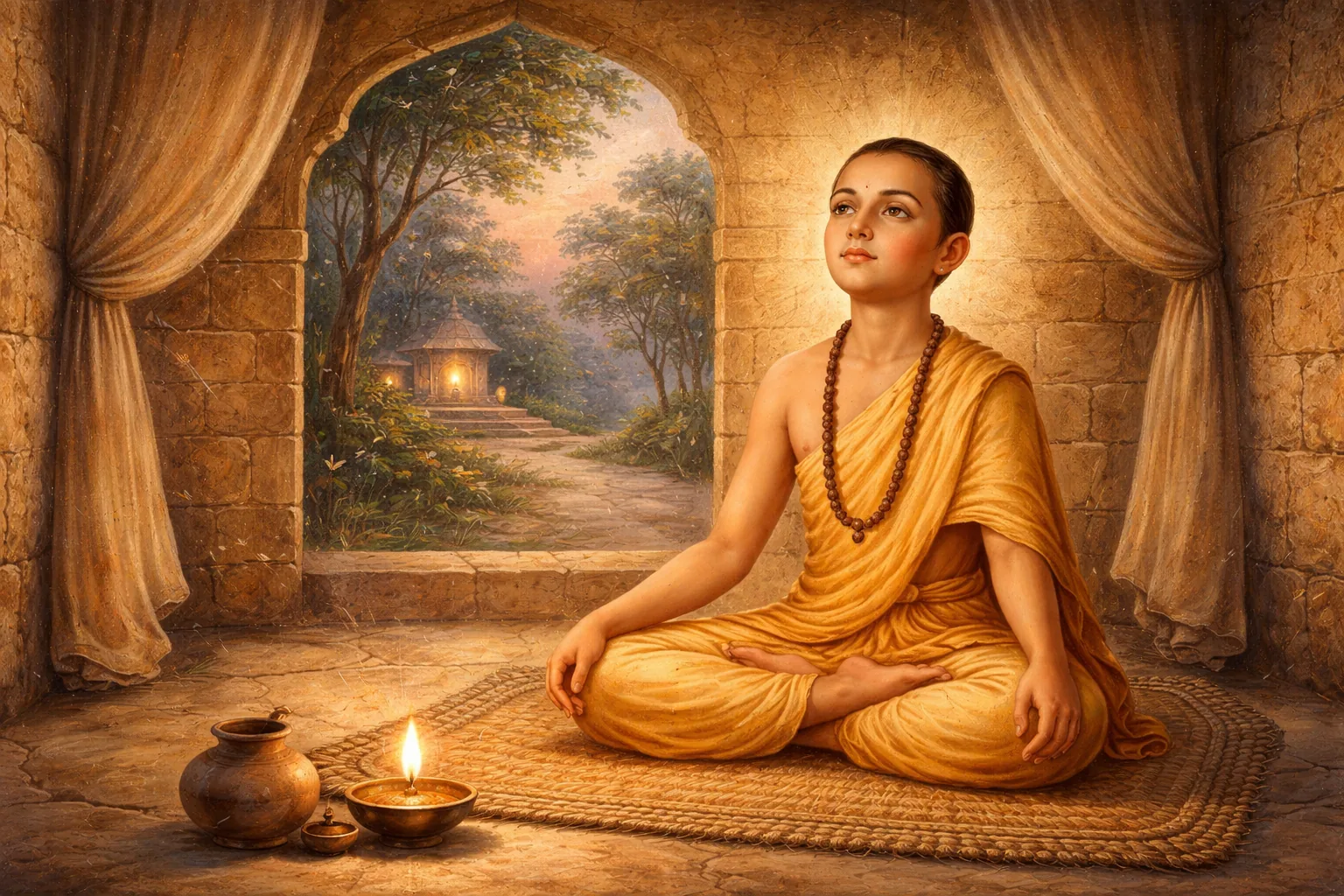
Shambhavi-mudra (Skt. śāmbhavī-mudrā) is one of the key contemplative practices associated with open eyes, an open mind, and the experience of space. Outwardly, it may look very simple: the practitioner sits motionlessly and gazes ahead. The position of the eyes here serves as a support; the decisive factor remains the state of awareness.
The word mudrā means "seal," "sign," or "gesture," while śāmbhavī refers to Shambhu, or Shiva. Therefore, in the Siddha tradition, Shambhavi-mudra is explained as the "seal of Shiva," the seal of non-dual vision that the yogi applies to perception. The world ceases to be a collection of objects, people, events, and stimuli. It gradually reveals itself as a single field of consciousness.
One of the instructions states briefly:
"Let the yogi gaze with a steady gaze into space."
Laya Amrita Upadesha Chintamani
This phrase opens the door to the practice. The gaze is steady, but without rigidity. The space is open, but without distraction. The mind is awake, but does not cling.
The Meaning of the Practice
The ordinary mind looks at objects. It sees a wall, a tree, a face, a cup, a road, a screen. Almost immediately, the internal work of evaluation begins: like, dislike, obstacle, danger, useful, mine, yours, pleasant, unpleasant. Thus, consciousness finds itself again in the habitual cage of name and form.
Shambhavi-mudra changes the very way of seeing. The practitioner learns to notice the space in which objects arise. They look ahead but do not fix their attention on a single point. The eyes are open, the body is calm, the breath is natural. Gradually, attention stops jumping after objects and returns to the field of awareness itself.
Just as waves on the surface of a lake hide its depth, the movements of the conceptual mind hide the inner space. When the waves calm down, the depth does not come from anywhere. It was always there.
In the teachings, Shambhavi-mudra is described as looking into the space before oneself without evaluation or judgment. The body relaxes. The psyche lets go of its habitual readiness to grasp, explain, or reject something. The mind opens wide. Consciousness begins to expand.
Inner and Outer Space
The main fruit of this mudra is the merging of inner and outer space. As long as a person is strongly identified with the body, it seems to them that consciousness is "inside" and the world is "outside." From this division, fear, struggle, tension, and the constant defense of one's small "I" are born.
Shambhavi-mudra gently leads to a different experience. Outer space awakens the inner. Inner awareness begins to recognize itself in the outer. At some point, the boundary between "I am looking" and "the world is before me" becomes thinner. One should not rush this experience. It cannot be achieved through effort.
In the "Mandukya Karika," the image of space in jars is given. As long as the jar is intact, it seems there is a separate space inside it. When the walls are broken, one single space is revealed. Similarly, the body and mind create a sense of separation, but the Atman is not divided into inner and outer.
"One should meditate on the Atman, whose form is light, whose essence is space."
Yajurveda
Shambhavi-mudra brings one closer to this understanding through direct contemplation. Here, a calm, vigilant abiding in the space of awareness helps.
How to Practice
Shambhavi-mudra is best understood as a way to open up perception and connect the external visible space with the internal space of awareness. The gaze here serves as a door: through it, consciousness stops contracting around individual objects and gradually becomes accustomed to abiding more broadly, calmly, and freely.
Three qualities are important in this practice: stability, relaxation, and vigilance. Stability prevents the mind from falling apart. Relaxation removes gross effort. Vigilance maintains clarity so that contemplation does not turn into sleepiness or daydreaming.
When Shambhavi-mudra begins to unfold correctly, the objects before the eyes no longer capture the attention so strongly. Sound, form, movement, and thought arise in the same field of awareness and dissolve there. The practitioner learns to see the space in which everything appears, instead of following every impression over and over again.
The Guru explains that in Shambhavi-mudra, outer space awakens the inner. At first, the person feels like an observer of the world, then this division becomes softer. Perception ceases to be narrow and evaluative; more silence, transparency, and pure presence appear within it.
Subtle stages of this mudra are associated with signs of contemplation, inner light, bindu, lakshya, and working with energies. Such things belong to the realm of instructions passed down personally and require the guidance of a Guru. But the main essence is this: Shambhavi-mudra opens the path from ordinary looking to the contemplation of space, and from the contemplation of space to the natural state.
Place in Laya Yoga
In Laya Yoga, this practice belongs to the section of space contemplation. It is associated with Prajna-yantra, pure vision, the natural state, and subsequent mudras such as krama-mudra and bhairavi-mudra. The Guru explains that Shambhavi-mudra can become a transition from ordinary meditation to sahaja-sthiti, the natural state of abiding.
When the sadhak becomes firm in contemplation, they learn to "seal" visible forms, sound, thought, feeling, time, space, and the very sense of "I." Sound no longer steals consciousness. The visible no longer pulls the mind outward. Internal reactions stop commanding the practitioner.
Thus, pure vision is born. It is not limited to beautiful images. Pure vision means that perception is freed from gross karmic projections. The world is seen as a manifestation of the Divine; fear, desire, and conflict lose their former power.
The Fruit
The fruit of Shambhavi-mudra is revealed in the stability of awareness. Subtle experiences may arise, but they remain secondary. The person is less gripped by the external. They return to presence more quickly. Inside, more space appears between impression and reaction.
If the practice deepens, Atma-vichara naturally transitions into a broader contemplation of the Absolute. First, you investigate the sense of "I," then you discover that this "I" is rooted in God. Thus, Shambhavi-mudra goes beyond sitting meditation and becomes a way of living: looking, hearing, acting, and not losing connection with the Source.
The sadhak begins to understand a simple thing. The space before the eyes and the space of consciousness are not at odds. The visible and the aware can be united in one presence. Then, even an ordinary gaze becomes sadhana.
