

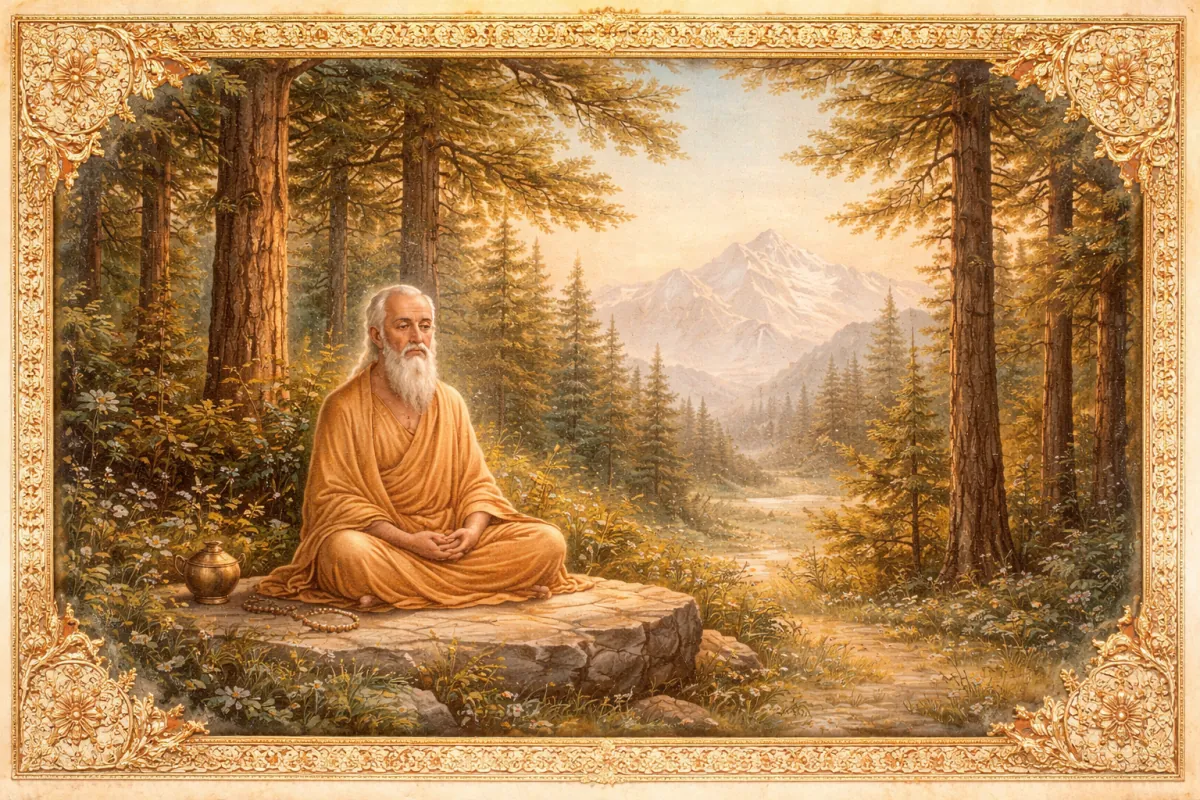
Imagine that all your life you have been looking at the world through a cloudy glass, without even suspecting it. You got used to distorted contours, dull colors, blurred shapes—and you considered this to be reality. And then someone wiped the glass, and for the first time you saw the world as it is: radiant, alive, filled with light.
This is exactly what the teaching of pure vision is about. Not about how to learn to see something new. But about how to stop not seeing what has always been right before your eyes.
“When a yogin sees everything as a manifestation of Shiva,
he himself becomes Shiva”
— the tradition of Kashmir Shaivism
What is Pure Vision
Pure vision (in Sanskrit—shuddha-vidya) is the ability to perceive reality without the distortions imposed on it by our conditioned mind. The name itself consists of two words: "shuddha" means "pure, purified," and "vidya" means "knowledge, vision." Literally—"unclouded knowledge."
There is another name—divya-chakshus, which means "divine eye." This is the ability to see the world as Consciousness itself sees it—holistically, without division into "good" and "bad," "one's own" and "another's," "pleasant" and "repulsive."
But what does it mean to "see without distortion"? Do we really see incorrectly?
Yes. A person's ordinary perception passes reality through many filters: our fears, desires, past grievances, hopes, expectations, and habitual judgments. We do not see the world—we see our projections onto the world. Like in a cinema: the screen is white, but we see on it what the projector of our mind is showing.
Pure vision is when the projector is turned off. And you see the screen itself. Or more precisely—you realize that the screen and the image on it are one and the same. That everything you look at is a manifestation of a single Consciousness, including yourself.
Why our ordinary vision is "impure"
Tradition describes three reasons why we do not see reality as it is. They are called the "three impurities" or the three malas.
The first impurity—the sense of limitation (anava-mala). This is the basic feeling of "I am small," "I am separate," "I am lacking something." It is so habitual that we don't even notice it. It's like a fish that doesn't notice the water—we are so immersed in this feeling that we mistake it for ourselves.
The second impurity—the division into "I" and "other" (mayiya-mala). From the sense of limitation, division is born: here is I, and there is the world. Here are my interests, and there are others'. Here is the pleasant, and there is the unpleasant. The mind continuously divides reality into parts, labeling them and building barriers.
The third impurity—the illusion of the individual doer (karma-mala). When we believe that we are separate beings in an alien world, the illusion appears: "I am the one who acts." From this, karma is born—the consequences of actions performed from a false sense of "I."
These three impurities are not sins or mistakes. They are natural features of human perception. But they create a veil that prevents us from seeing what is always before us: the unity of all existence.
The world as a play of Consciousness
Kashmir Shaivism—the tradition in which the teaching of pure vision reached its fullest development—claims something amazing: the world is real. But its reality is not what we are used to thinking.
Everything we see, hear, and feel are manifestations of a single Consciousness. Trees, stones, people, stars, thoughts, emotions—all these are "flashes" (abhasas) of one infinite awareness. Like waves on the surface of the ocean—they are different in shape, but they all consist of water.
Why would Consciousness manifest itself as the world? Tradition answers: for the sake of play. The Sanskrit word "lila" means a play without a purpose outside of itself—pure creativity, spontaneous expression. Like a child playing not for a result, but for the very joy of playing.
Pure vision is when you begin to see this play. Not to understand it with the mind—but to actually see it. When you look at a sunset and suddenly realize: this is not a "sunset outside of me"—it is Consciousness admiring its creation through these eyes. When you listen to music and understand: there is no division into "I" and "music"—there is a single dance of experience.
It is not imagination
It is important to understand: pure vision is not self-deception or fantasy. It is not an attempt to "imagine" that everything is divine when it is actually not.
Rather, it's the opposite. Ordinary vision is imagination. We constantly impose our interpretations on reality: "This is a good person, and this is a bad one." "This is success, and this is failure." "This is beautiful, and this is ugly." All these evaluations exist only in our mind. In reality itself, they do not exist.
Pure vision removes these layers. You see things as they are—without labels, without comparisons, without judgment. And then their original nature is revealed: pure presence, pure being, pure consciousness.
The great master Abhinavagupta, who lived in Kashmir a thousand years ago, wrote: an advanced contemplator is capable of seeing the world as a flash of consciousness and bliss, indistinguishable from his own essence. This is not a metaphor. This is a description of direct experience.
Recognition, not attainment
The key word in this teaching is "pratyabhijna," which means "recognition." Not "attainment," not "acquisition," not "development"—but specifically recognition.
Imagine: you lost a ring and searched for it for a long time. You turned the whole house upside down, looked into every corner. And then you looked at your hand—and saw that the ring had been on your finger all this time. You didn't find it—you recognized it. It was never lost.
So it is with our true nature. We do not become one with Consciousness—we recognize that we have always been it. The veil of impurities created the illusion of separation, but underneath it, there was never any separation.
Pure vision is the moment of recognition. You look at the world—and suddenly you understand: this is not "the world opposite me." This is I myself, manifesting in infinite forms. There is no boundary between the seer and what is seen.
How it is experienced
When pure vision begins to awaken, a person notices changes in their perception. They do not happen all at once—usually, it is a gradual process, like a sunrise.
The first thing that changes is the attitude toward "good" and "bad." You still distinguish events, but you stop automatically dividing them into desirable and undesirable. The ability to see value and meaning in what previously seemed "just bad" appears. This is called "sama-drishti"—equal vision.
Second is causeless joy. Not depending on circumstances, not requiring a reason. Simply the joy of being. Tradition calls this "ananda"—the bliss inherent in consciousness itself.
Third is the disappearance of tension. When you stop fighting reality, trying to reshape it according to your ideas, deep-seated tension leaves. Lightness appears—not carelessness, but specifically a lightness of presence.
Fourth is intuitive knowledge. You begin to "see" the essence of things directly, without long reasoning. It's as if knowledge comes by itself—because the boundaries between "you" and the "object of knowledge" become transparent.
Swami Lakshmanjoo: a living example
Swami Lakshmanjoo (1907-1991) was the last great master of the Kashmiri tradition. He was born in Srinagar, into a family that had preserved spiritual practices for generations. At nineteen, during meditation, he experienced a deep spiritual awakening—the very recognition of his true nature.
Those who knew Swami Lakshmanjoo described his presence as unusually peaceful and joyful. He could speak about the most complex philosophical concepts, yet he remained simple and accessible. There was not a shadow of arrogance or detachment in him.
Once he was asked how he saw the world. He replied that for him there was no difference between meditation and ordinary life—everything is a continuous experience of divine presence. Not because he "forced" himself to see this way, but because the impurities that created the illusion of separation had dissolved.
Swami Lakshmanjoo dedicated his life to preserving the teaching. Thanks to him, the ancient texts of Kashmir Shaivism became available to modern seekers—he worked with translators, accepted students, and passed on what he himself had received from his teachers.
The practice of pure vision
Pure vision is not a technique that can be "performed" for an hour a day. It is a way of being that gradually saturates all of life. But there are practices that help it unfold.
Purification of the mind is the first and necessary step. As long as the mind is overflowing with anxiety, grievances, and desires, it is incapable of seeing clearly. Ethical constraints (yama and niyama), service to others, regular meditation—all this gradually calms the mind, making it capable of subtler perception.
Connection with a teacher—tradition emphasizes the importance of a guru. Not because the teacher "gives" enlightenment—it cannot be given. But the teacher, by their presence, shows that pure vision is real, that it is possible for a living human being. This inspires and guides.
Study of the teaching—listening to instructions, reflecting on them, immersing oneself in contemplation. This classic triad (shravana-manana-nididhyasana) gradually rebuilds the mind, giving it new orientations.
Practice in everyday life—gradually, pure vision goes beyond the limits of meditation. Tradition says: food is an offering, speech is a mantra, movement is a dance, perception is the contemplation of divine play. Every moment becomes a practice.
Not a denial of the world, but its transformation
It is important to understand how pure vision differs from withdrawal from the world. Some spiritual paths teach that the world is an illusion and one must turn away from it. The tradition of pure vision says otherwise: the world is real, but we see it distortedly.
This is not denial, but transformation. You do not stop seeing trees, people, events—but you see them differently. Not as separate objects in an alien space, but as manifestations of the same Consciousness that you yourself are.
This changes the attitude toward life. If everything is a manifestation of a single Consciousness, then there are no "enemies," no "strangers." There are different forms of one reality. Service to others becomes natural—for there are no "others," there are only different faces of one being.
Modern transmission
After the Islamic conquest of Kashmir in the 14th century, the tradition of Kashmir Shaivism almost died out. But it survived—passed from teacher to student through the centuries. Swami Lakshmanjoo was one of the last keepers of this living transmission.
Today, the teaching of pure vision continues to be transmitted in various spiritual traditions. In the World Community of Sanatana Dharma, founded by Swami Vishnudevananda Giri, pure vision is taught as a fundamental contemplative practice.
Swami Vishnudevananda Giri describes pure vision as "the ability to see the world through the eyes of contemplation, through the eyes of unity with the Supreme Source." This is not a fantasy or self-deception—it is a way of seeing reality as it is, without the distortions imposed by the mind and past karma.
The path to freedom
Pure vision is not a destination, but a path. A path from conditioning to freedom, from fragmentary perception to holistic perception, from the illusion of separation to the recognition of unity.
This path does not require renouncing the world or escaping into caves. It requires something else: an honest look at how our mind works. A willingness to see our filters and limitations. Patience in practice. And trust—in the tradition, the teacher, and the process itself.
When impurities gradually dissolve, vision clears of its own accord. You don't "do" pure vision—you allow it to manifest by removing the obstacles.
And then the world, which seemed alien and sometimes hostile, reveals its true nature: a radiant play of consciousness in which nothing is separate, nothing is superfluous, and nothing is not sacred.
“The servant recognizes himself as the Master—
not because something has changed,
but because he has finally seen what was always there”
