

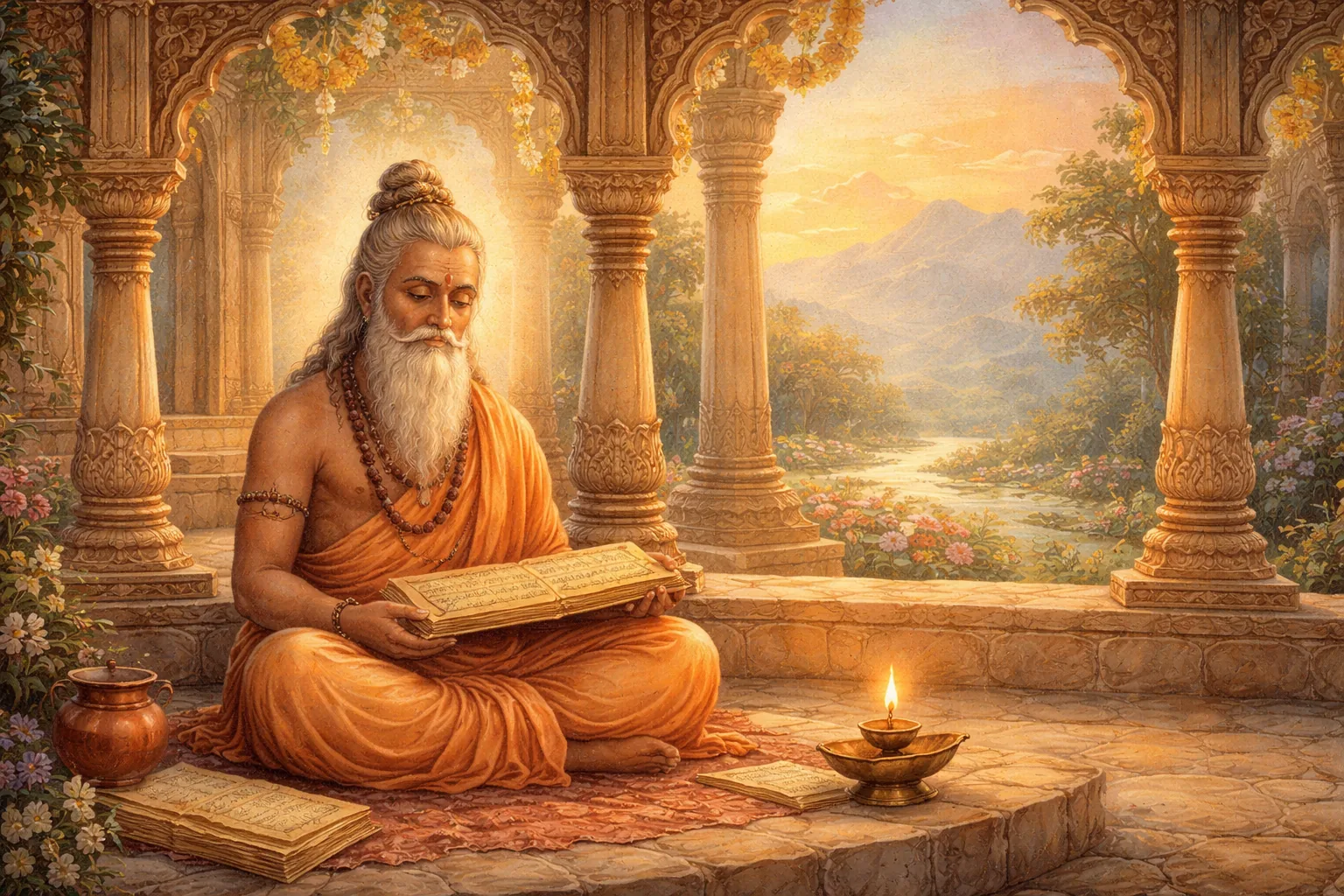
Divine grandeur, or divya-bhāva (Skt. divya-bhāva), is an exalted state of purity, sacred dignity, and inner proximity to God. In the tradition of Laya Yoga, it is associated with deva-bhāvanā (Skt. deva-bhāvanā), "divine contemplation," "divine pride," or "cultivating the state of a deity," where the sadhaka learns to see themselves, the world, and all phenomena from the space of the Atman.
The word "pride" here can easily be misleading. In ordinary speech, it is often associated with self-assertion, touchiness, and the need to prove one's significance. In the teaching of divine grandeur, we are talking about a different dimension: the dignity of the spirit that remembers its original purity. Egoic pride requires an audience. Divine grandeur remains calm even when a person is washing the floor, performing service, receiving a reprimand, or remaining unnoticed.
The scriptures state:
The Atman permeates everything, like butter hidden in milk. It is the source of self-knowledge and ascetic fervor.
Yajurveda
From this arises the main mood of divya-bhāva: a divine depth is hidden within every being. It may be obscured by karma, habits, fear, or crude self-perception, but its nature remains pure.
Etymology and Key Terms
Divya-bhāva (Skt. divya-bhāva) consists of two words: divya — "divine," "radiant," "celestial"; bhāva — "state," "feeling," "inner attitude." Therefore, divya-bhāva is a divine state of consciousness, a pure and exalted attitude toward oneself, the world, the Guru, the deities, and life itself.
Deva-bhāvanā (Skt. deva-bhāvanā) reveals the practical side of this teaching. Deva means "deity," "radiant being"; bhāvanā — "contemplative education," "cultivation," "inner formation." When a sadhaka develops deva-bhāvanā, they train their karmic vision: instead of the narrow image of "I am weak, separate, and conditioned," the image of a sacred being living in God's mandala gradually strengthens in the consciousness.
Divine Pride and Humility
Divine pride is correctly revealed only alongside humility. For the Atman — grandeur. For the ahamkāra (Skt. ahaṁkāra), the egoic knot — simplicity, service, softness, and the readiness to yield. If these levels are mixed, the practice quickly turns into spiritual narcissism.
Swami Vishnudevananda Giri explains:
It is precisely the one who possesses great divine pride who can behave very humbly, because they do not need to prove their greatness to anyone.
Swami Vishnudevananda Giri
This is a subtle distinction. The Atman is like a king, and the ego is like a minister. When the minister forgets his place, he begins to rule in the king's name, arguing, taking offense, and demanding honors. When power returns to the Atman, the ego becomes a servant of Dharma: it performs work, accepts discipline, learns to listen, and does not claim the light for itself.
Therefore, a person established in divine dignity does not need a special pose. They do not need to look important. They can sit on a pedestal if that is the will of service, and they can sweep the yard if a broom is needed now. Their inner height does not depend on the role.
Pure Vision
Deva-bhāvanā is closely linked to pure vision. Pure vision is the perception of reality as a manifestation of the Divine, as a mandala of consciousness. At first, it is trained through intention, faith, contemplation, and worship. Then it becomes natural recognition: the world was always permeated by God; the mind simply looked at it through the film of habit.
An ordinary person sees themselves as a small figure among alien circumstances. Their mood changes based on praise, criticism, success, or failure. Today they are confident, tomorrow they are crushed. This is how karmic vision works.
In deva-bhāvanā, a different foundation appears. You remember the Guru, the deity, the saints, the altar, and moments of reverence. Then you transfer this sacred feeling inside yourself: the principles of the deity must come alive in your body, speech, mind, and actions. Even if it seems like an exercise at first, repetition gradually changes the subtle body. Bhāva enters deeper than thought.
Divya-bhāva as Grace
In the Guru's teaching, divya-bhāva is connected with anugraha (Skt. anugraha), the descending grace of the Divine. It is a state of happiness, love for God, devotion, self-surrender, inner purity, and grandeur. It purifies by elevating the entire structure of consciousness.
Just as a strong fragrance displaces a musty smell from a room, divine bhāva displaces heavy states of mind. Envy, despondency, irritation, and resentment lose their former power when consciousness is filled with the grandeur of the Source. One no longer needs to conduct endless negotiations with them. Their energy dissolves in a higher space.
Consistency is vital here. A flash of inspiration is useful, but the path begins when the sadhaka returns to divine bhāva again and again: during meditation, in the temple, in conversation, in service, and in difficult situations. Gradually, this becomes their new karmic vision.
Brahma-bhāvanā
Deva-bhāvanā leads to brahma-bhāvanā (Skt. brahma-bhāvanā), the contemplative state of absoluteness. If deva-bhāvanā is associated with the dignity of a deity, purity, sanctity, and grandeur, then brahma-bhāvanā raises consciousness to the mahāvākya "ahaṁ brahmāsmi" — "I am Brahman."
At this level, the sadhaka recognizes themselves as the unborn Source, as boundless consciousness. All small bhāvas born of the kleshas become too cramped. Anger, fear, greed, and self-pity lose their persuasiveness. Just as a puddle disappears under the sun, the limited "I" dries up in the light of contemplation.
But the path to this state requires maturity. The words "I am Brahman" must grow out of recognition. Ambition quickly spoils their meaning: a person speaks of the highest but reacts like a wounded personality. When contemplation utters them, simplicity, strength, compassion, and inner freedom emerge.
How to Develop Divine Grandeur
First — upāsanā (Skt. upāsanā), worship and approach to the Deity. The altar, mantra, prostrations, bhajans, and temple discipline purify the feeling. They teach the heart to revere.
Second — Guru Yoga. The student remembers the qualities of the Guru, his consciousness, his pure vision, and then tries to recognize these principles within themselves. Loyalty to the lineage is needed here; fantasies of personal greatness quickly lead astray.
Third — sevā (Skt. sevā), service. Service quickly shows where divine pride has become a pose. If a person loses their grandeur from simple work, it means they were clinging to an image. If they become calmer, deeper, and more joyful in service, the bhāva is taking root correctly.
Fourth — contemplation. One must return again and again to the sensation of the Atman: spacious, luminous, untouched. External action continues, but the inner anchor is transferred to the source of consciousness.
Signs of Correct Development
When divine grandeur develops correctly, a person becomes freer from the evaluations of others. There is less fuss and more dignity. They admit mistakes more easily because their true "Self" does not collapse from a remark. They are capable of respecting others because they see the same divine foundation in them.
Love, compassion, creative power, and inner composure appear. A natural desire to serve the Dharma arises. A person no longer seeks confirmation of their value in every conversation. They remember: their kingdom is within.
There is also a danger. The mind may put on the mask of a deity. Then an air of importance, coldness, contempt, and spiritual theatricality appear. This is immediately visible in one's attitude toward people: the less humility there is, the more ahamkāra there is in the practice.
True deva-bhāvanā makes a person softer and stronger at the same time. There is no weakness in it. There is no rudeness. There is an inner posture of the soul.
Significance for the Sadhaka
For the sadhaka, divine grandeur is a practical method of changing destiny. A person becomes what they deeply contemplate about themselves. If for years they feed the image of a weak, offended, helpless being, this image begins to control the prana, speech, and decisions. If they patiently establish themselves in the Atman, their life gradually enters a different channel.
Divya-bhāva does not cancel discipline. It gives it a sacred center. Deva-bhāvanā does not lead away from the world. It allows one to see the world as a field of practice. Brahma-bhāvanā does not make a person indifferent. It opens up action from a space where there is less fear and more freedom.
This is how mature spiritual dignity is born. You remember your divine nature and therefore can be simple. You serve because service does not diminish the Atman. You contemplate because without contemplation, grandeur quickly becomes a thought about grandeur. You love God, the Guru, the Dharma, and all beings — and this love gradually changes the very fabric of your vision.
Divine grandeur begins with the right remembrance: inside you, there is a light that is older than all roles, stronger than all karmas, and quieter than all proofs. One must return to it. One must live in it.
