

Modern man is accustomed to perceiving himself as a physical body—visible and tangible. The teaching of yoga, as set forth in the Upanishads, Tantric texts, and Agamas, asserts otherwise: the physical shell is merely the outer, gross manifestation of a multi-level system. Behind it lie the subtle and causal bodies—invisible, yet no less real. It is within them that karma is stored, health is formed, and the spiritual potential of the practitioner is shaped.
The Three Bodies of Man
According to classical Advaita Vedanta, as expounded in Adi Shankaracharya’s "Viveka-chudamani" (788–820 AD), a human being possesses three bodies.
First — sthula-sharira (Skt. sthūla-śarīra), the "gross body." This is the physical form perceived by the senses: skin, bones, muscles, and internal organs. It arises at birth and is destroyed after death.
Second — sukshma-sharira (Skt. sūkṣma-śarīra), the "subtle body," also called the linga-sharira. This is the energy-mental shell, including the pranas, mind, and intellect. After the death of the physical body, the sukshma-sharira remains and carries all accumulated habits, character traits, and karmic imprints into the next incarnation. It is the subtle body that determines the state of health and lifespan: the physical body is entirely dependent upon it.
Third — karana-sharira (Skt. kāraṇa-śarīra), the "causal body." The word kāraṇa means "cause": this body is the source of the other two. Within it are stored the deep karmic seeds — vasanas — which determine the very birth of a being. In the state of deep dreamless sleep (sushupti), consciousness resides specifically in this body.
The gross body present clearly, the subtle body which is invisible, and the causal body which appears as a result — all disappear when they merge into one at the feet of Shiva.
— Tirumantiram
The three bodies correspond to the three states of consciousness: waking (jagrat), dreaming (svapna), and deep sleep (sushupti). Spiritual practice is aimed at the sequential purification of all three bodies and, ultimately, their transcendence through the realization of the Atman in the fourth state — turiya.
The Five Sheaths — Pancha-kosha
The sukshma-sharira in the Advaita Vedanta system is described through the concept of pancha-kosha (Skt. pañca-kośa) — "five sheaths" that conceal the true Self. This teaching is set forth in the "Taittiriya Upanishad" (approx. VII–VI centuries BC) and expanded by Shankaracharya in the "Viveka-chudamani."
1. Annamaya-kosha (annamaya-kośa) — the "sheath composed of food" — is the physical body, nourished by food and returning to the earth after death.
2. Pranamaya-kosha (prāṇamaya-kośa) — the "sheath composed of prana" — is the energy body that permeates and enlivens the physical form. It can be felt during focused pranayama: sensations of heat, vibration, or a flow moving through the channels. The pranamaya-kosha has neither attachments nor desires — it follows the mind. When the lifestyle is harmonious and sattvic, its strength increases; when consciousness is scattered and addictions dominate, it becomes depleted.
3. Manomaya-kosha (manomaya-kośa) — the "mind sheath" (manas) — is the layer of thinking, perception, emotions, and memory. This is what most people identify with, mistaking the flow of thoughts and feelings for their "self."
4. Vijnanamaya-kosha (vijñānamaya-kośa) — the "sheath of discerning knowledge" — is the intellect capable of spiritual discrimination (viveka): separating the eternal from the transient, the Atman from the non-Atman.
5. Anandamaya-kosha (ānandamaya-kośa) — the "bliss sheath" — the subtlest covering, colored by the experience of impersonal joy in deep sleep. It is often mistaken for the Atman, yet it too is merely a sheath concealing pure Consciousness.
Know the Atman as separate from the body, senses, mind, intellect, and causal body. Know It as the witness of all states — waking, dreaming, and deep sleep.
— "Viveka-chudamani," Adi Shankaracharya, verse 94
The System of Energy Channels — Nadis
The subtle body is permeated by a network of energy channels — nadis (Skt. nāḍī, from the root nad — "flow," "motion"). The "Hatha Yoga Pradipika" (15th century) counts 72,000 nadis; the "Goraksha Shataka" names 10 main ones, and the "Shiva Swarodaya" mentions 350,000. The difference is explained by different levels of detail rather than a contradiction in understanding the system.
All channels originate from a central plexus — the kanda-sthana, located in the pelvic region — and diverge throughout the body. Where three or more nadis intersect, energy nodes are formed — chakras and granthis (blocking knots).
In yoga, three main nadis are of particular importance.
Ida (iḍā) — the left channel, associated with the Moon and cooling energy. It begins at the base of the spine and ends in the left nostril.
Pingala (piṅgalā) — the right channel, solar, warming, and activating. It ends in the right nostril.
Sushumna (suṣumnā) — the central channel, running along the axis of the spine. According to the Laya Yoga tradition, sushumna is the "prana of non-dual wisdom": when prana flows through it, ida and pingala are balanced, the breath slows down, the body is experienced as weightless, and perception shifts from dual to non-dual. This is the path of Kundalini-shakti to the higher centers.
In most people, the sushumna is not awakened: prana actively circulates through the side channels, maintaining an ordinary dual existence. Awakening the central channel is one of the key tasks of yogic practice.
According to the "Tirumantiram," within the sushumna, three nested channels are distinguished: vajra-nadi, chitrini-nadi, and brahma-nadi. The movement of Kundalini through each of these corresponds to the experience of different states of consciousness — from the subtle body to the causal and beyond to turiya.
Energy Centers — Chakras
The word chakra (Skt. cakra) means "wheel" or "disk." Where several nadis converge, they form a vortex-like center — a chakra. This is simultaneously a center for the accumulation and distribution of prana and a center of consciousness, the activity of which determines both physical health and the quality of spiritual experience.
Tirumular's "Tirumantiram" (6th–7th centuries AD) — one of the most authoritative texts of Shaivite Tantra — lists nine main chakras:
- Muladhara (mūlādhāra) — "root support" — at the base of the spine; associated with the element of earth, survival instinct, and vital stability.
- Svadhisthana (svādhiṣṭhāna) — "one's own abode" — in the pelvic area; associated with the element of water, creativity, and vital force.
- Manipura (maṇipūra) — "city of jewels" — at the level of the navel; associated with the element of fire, will, and the power of transformation.
- Anahata (anāhata) — "unstruck" — in the heart region; associated with the element of air, love, and compassion.
- Vishuddha (viśuddha) — "purest" — in the throat; associated with the element of space and purity of speech and intention.
- Ajna (ājñā) — "command center" — between the eyebrows; the center of intuition and higher discrimination, associated with the mind (manas).
- Hrikuti — between Ajna and Sahasrara; in the Shaivite tradition, associated with the realization of the contemplative state.
- Trikuti — the region of transition into the transpersonal; the gateway to the causal dimension.
- Sahasrara (sahasrāra) — "thousand-petaled lotus" — at the crown of the head; the place where individual prana merges with cosmic Consciousness.
In various texts, the number of chakras varies: the "Shat-chakra-nirupana" (16th century) describes six main centers, while other sources include additional ones. The difference is determined by tradition and the context of practice.
Each chakra functions as a "gate": when it is open and clear, prana moves freely. At the moment of death, according to tradition, eight of the nine gates close — and consciousness leaves the body through only one.
The Five Types of Prana — Pancha-vayu
Prana (Skt. prāṇa) is the universal life force, the manifestation of Shakti in the subtle body. In Kashmiri Shaivism, prana is understood as the activity of God Himself, permeating all levels of being — from the cosmic to the individual.
In the human body, prana manifests in five main forms — pancha-vayu (Skt. pañca-vāyu), described in the "Prashna Upanishad" (4th–3rd centuries BC):
- Prana-vayu — prana in the narrow sense, acting in the chest area: governs breathing and heart rhythm.
- Apana-vayu (apāna) — the descending prana of the lower body: governs the processes of elimination and grounding.
- Samana-vayu (samāna) — prana in the abdominal area: governs digestion and the balance of the organism.
- Udana-vayu (udāna) — the ascending prana of the neck and head: governs speech and, at the moment of death, determines through which center consciousness leaves the body.
- Vyana-vayu (vyāna) — the all-pervading prana circulating throughout the body: maintains the integrity of all systems.
When all five vayus are in balance, the person is healthy, the senses work clearly, and life is long. Imbalance in any of the flows is reflected in the corresponding organs and mental state.
Kundalini-shakti — The Dormant Power
At the base of the spine, in the muladhara chakra, a special form of prana is concentrated — kundalini-shakti (Skt. kuṇḍalinī-śakti), the "coiled power." Tradition describes it symbolically: a serpent with three and a half coils, wrapped around the svayambhu-lingam and closing the entrance to the brahma-nadi with its face.
According to the "Tirumantiram," upon awakening, Kundalini "hisses and straightens, entering the sushumna — the central axis of the body, opening the door of Brahman." Its movement up the sushumna through the chakras is accompanied by increasing experiences of bliss, inner light, and expansion of consciousness. Upon reaching the sahasrara, Kundalini gives rise to turiya — the fourth state, in which only pure awareness remains awake.
The awakening of Kundalini is not an instantaneous event. For most practitioners, this process takes years and decades: karmic impurities "foam up" in the channels and require processing. Hasty forcing without the appropriate readiness of the body, mind, and a guiding transmission (shaktipat) is considered undesirable.
Methods of Working with the Subtle Body
The yoga tradition offers a system of methods aimed at purifying the nadis and harmonizing the pranas. They are described in Swatmarama's "Hatha Yoga Pradipika" (15th century), the "Gheranda Samhita" (17th century), and the Tantric Agamas.
Asanas (āsana) — yogic postures — open the nadis and improve the circulation of prana-vayu. The "Hatha Yoga Pradipika" directly states: stability of posture is the basis for stability of energy.
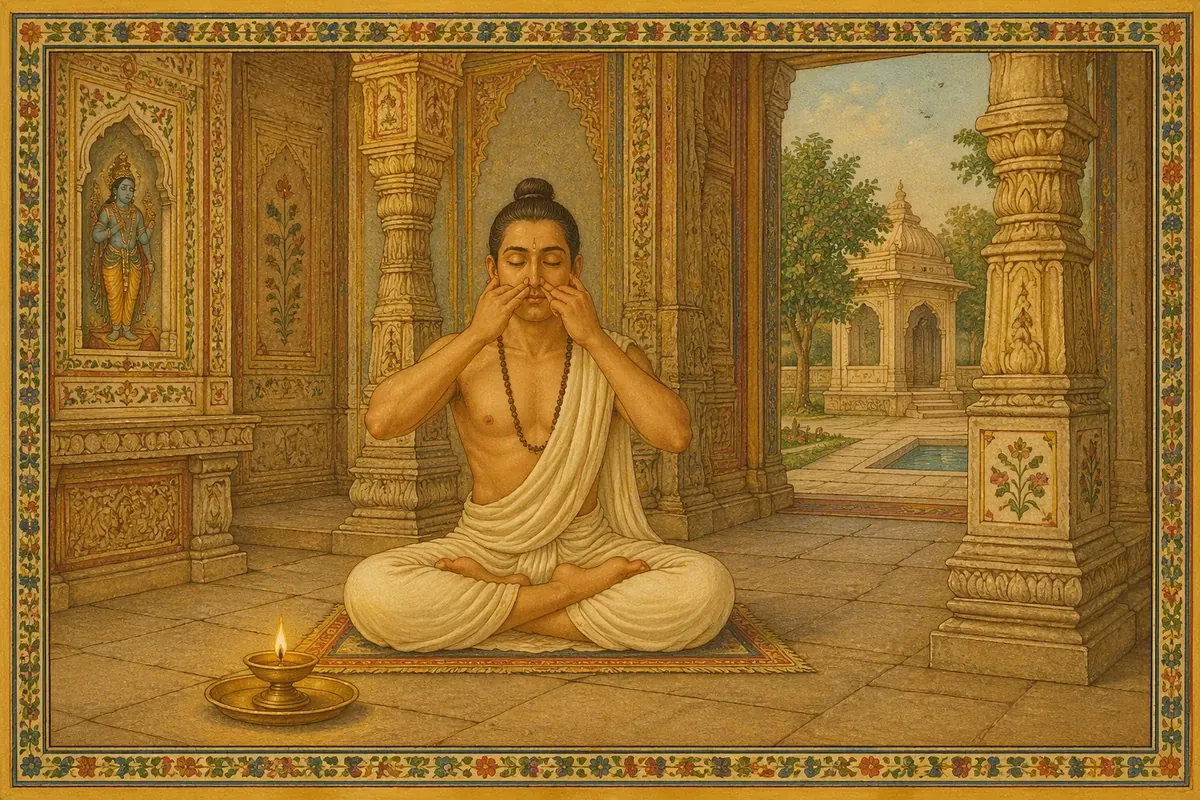
Pranayama (prāṇāyāma) — the central method of working with the pranamaya-kosha. A special role is played by nadi shodhana (alternate nostril breathing) and kumbhaka (breath retention): they balance ida and pingala, creating the conditions for prana to enter the sushumna.
Bandhas (bandha) — "locks," muscular contractions — are used in tandem with pranayama. Mula-bandha directs apana-vayu upward; jalandhara-bandha controls udana-vayu; uddiyana-bandha strengthens samana. Their combined application — maha-bandha — creates the conditions for awakening Kundalini.
Concentration on the Chakras — the practice of holding attention on a specific energy center. According to the "Vijnana Bhairava Tantra" (slokas 28–32), steady concentration on the heart center is sufficient to experience the unity of consciousness.
Mantra (mantra) — sacred sound — acts on the subtle body through vibration. Each chakra resonates with its own bija-mantra: Muladhara — LAM, Svadhisthana — VAM, Manipura — RAM, Anahata — YAM, Vishuddha — HAM, Ajna — OM.
Contemplation (dhyana, nididhyasana) — working with the subtle body at the level of the vijnanamaya-kosha and above: the practice of abiding in awareness of one's true nature, through which the subtle bodies are purified by the descending light of the Atman.
The Subtle Body in the Siddha Teaching
In the tradition of Sanatana Dharma, as transmitted by Swami Vishnudevananda Giri, the teaching on the subtle body is viewed in inseparable connection with the practice of Laya Yoga and Shakti Yantra.
The subtle body is not a static object. Just as physical muscles can be trained, the energy body can also be trained: strengthening prana, activating chakras. Strong prana means health, clarity of perception, authority of the word, and protection from unwholesome influences.
According to the concept of prana, we are energetic beings. We are not the body. We are consciousness in an energy body.
— Swami Vishnudevananda Giri
When prana flows through the sushumna and the central channel is clear, dual perception is replaced by non-dual: "it is experienced that nothing exists, but there is only consciousness." Working with the subtle body in this tradition is not an end in itself, but a means: a tool that allows one to disidentify from the sheaths and realize one's primordial nature as Brahman.
The practice of the three bodies — tri-deha sadhana — is aimed at bringing the light of the Atman into all three dimensions. Then the physical body is transformed into siddha-kaya — a body perfected and subject to the divine will; the subtle body into pranava-kaya, an illusory body filled with the light of non-duality; and the causal body into jnana-kaya, the space of pure wisdom.
The teaching of the subtle body in Yoga and Sanatana Dharma is a description of how the practicing being is structured: where karma is stored, how the life force moves, and why certain states of consciousness are inaccessible without the preliminary purification of the channels. The map, of course, is not the territory. But without a map, it is much harder.
