

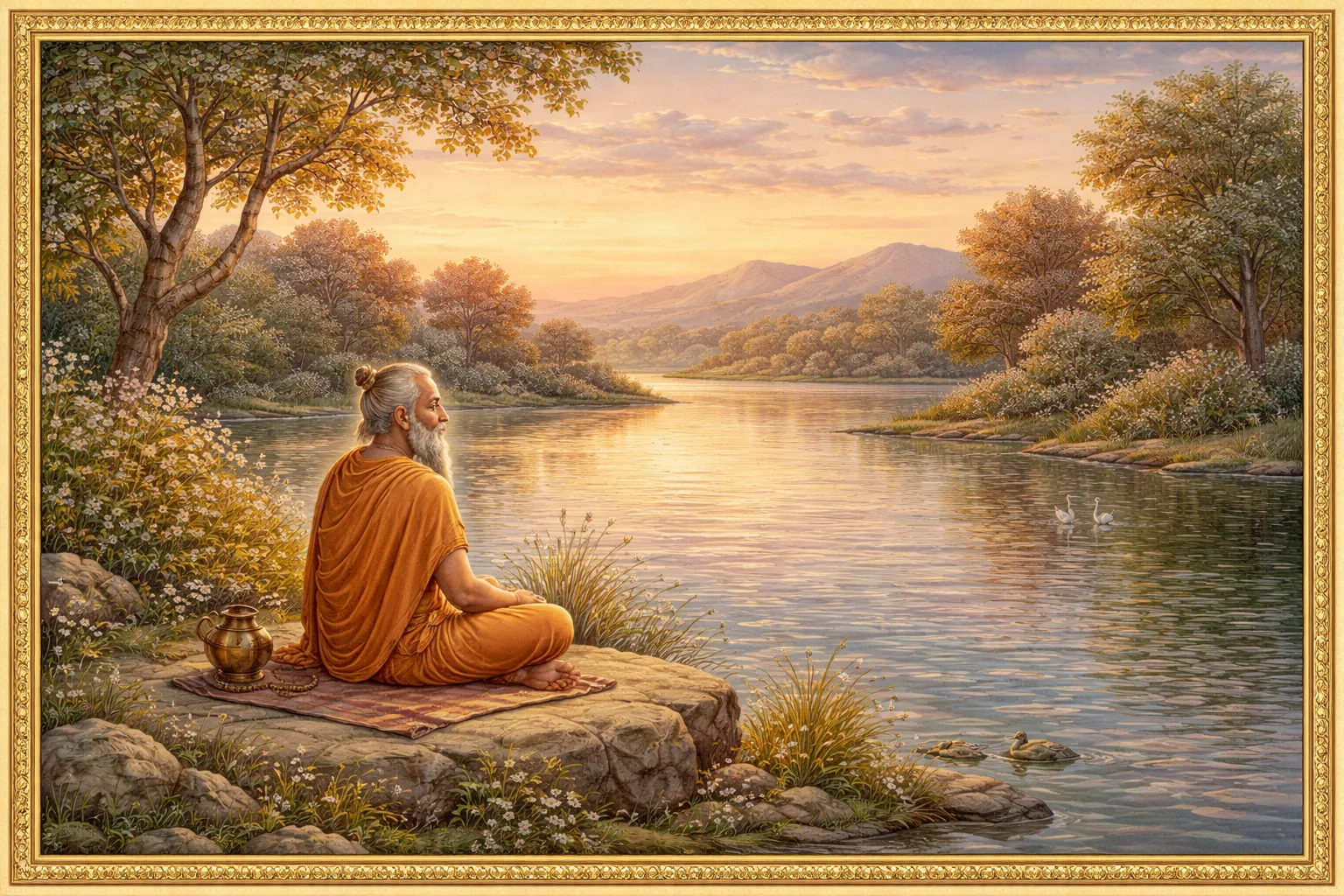
Most people perceive nature as the backdrop of life—beautiful, but external. A mountain simply stands. A river simply flows. Fire simply burns. Tattva-vidya offers a different understanding: the five great elements of the world are the same five elements from which the human body is composed. The boundary between "outside" and "inside" exists only in the dualistic mind.
What is Tattva-vidya?
The word tattva (Skt. tattva) is formed from the pronoun tat—"that," "this"—with the suffix tva, which forms abstract concepts. The literal translation is "suchness" or "the true nature of a thing." The word vidya (vidyā) means "knowledge" or "science." Tattva-vidya is the knowledge of the nature of the elements obtained through direct experience rather than through the study of texts.
In the Sanatana Dharma tradition, the word "tattva" covers a wide semantic range. In Kashmir Shaivism, thirty-six tattvas are distinguished—all levels of the manifestation of consciousness from Shiva to gross matter. In the context of Tattva-vidya, we are talking about the five great elements—pancha-mahabhuta (Skt. pañca-mahābhūta): earth (prithivi), water (apas), fire (agni), air (vayu), and space (akasha). These are tattvas thirty-two through thirty-six in the Kashmiri system—the densest ones, directly constituting the human physical body.
The difference between theoretical knowledge of the five elements and Tattva-vidya as a practice is fundamental. Descriptions of the elements are found in many sources of Sanatana Dharma. Tattva-vidya, however, is an applied science: a yogi learns to feel the tattvas in the body, recognize their state, intentionally work with their flows, and unite internal elements with external forces. According to Swami Vishnudevananda Giri:
"The free operation of tattvas can be achieved when the elements of the body are completely dissolved, when contemplative presence is fully realized."
> — Swami Vishnudevananda Giri, lecture, 2005
Place in the System of Energetic Practices
Tattva-vidya is part of the shakti-yantra—a set of practices for mastering the principle of prana. This system includes prana-vidya (the science of life force), svara-vidya (the science of breath cycles), kundalini yoga, and shat-chakra yoga. Among these, Tattva-vidya works with the very matter of the manifested world.
The connection with svara-yoga is direct: each tattva is active in the body during specific breath cycles. The "Shiva Swarodaya"—one of the main sources for both disciplines—contains methods for determining the active tattva by the nature of the breath: its shape, direction, and length. A practitioner who has mastered Kundalini yoga arrives at Tattva-vidya as the next step—moving from working with channels to working with the elements that move through those channels.
The Five Great Elements: Characteristics and Connections
Each of the five elements has specific characteristics: location in the body, corresponding chakra, type of prana (vayu), bija mantra, geometric shape, and color. Knowledge of these correspondences is the foundation of the practice.
Prithivi (earth) occupies the zone from the feet to the hips and corresponds to the muladhara chakra. Its qualities are hardness and stability; it is associated with the sense of smell and apana-vayu (downward-moving prana). Bija mantra: LAM. Shape: square; color: yellow.
Apas (water) is located from the hips to the navel and corresponds to the svadhisthana chakra. Its qualities are fluidity and flexibility; it is associated with taste and apana-vayu. Bija mantra: VAM. Shape: crescent; color: white.
Agni (fire) occupies the area from the navel to the heart and corresponds to the manipura chakra. Its qualities are heat and transformation; it is associated with sight and samana-vayu (balancing prana). Bija mantra: RAM. Shape: triangle; color: red.
Vayu (air) is located from the heart to the eyebrows and corresponds to the anahata chakra. Its qualities are mobility and lightness; it is associated with touch and prana-vayu (upward-moving prana). Bija mantra: YAM. Shape: hexagon; color: gray-green.
Akasha (space) occupies the area above the eyebrows and corresponds to the vishuddha chakra. Its quality is all-pervasiveness; it is associated with hearing and udana-vayu (prana of the upper space). Bija mantra: HAM. Shape: circle; color: blue.
In different texts, the arrangement of elements in the body is described with variations. The "Shiva Swarodaya" indicates different zones:
"Between the two shoulders is fire, at the base of the navel is air, in the knees is earth, in the feet is water, in the forehead is ether. Water is white, earth is yellow, fire is red, air is dark blue, and ether possesses all colors."
> — Shiva Swarodaya
The principle of correspondence "element—chakra—vayu—sense organ" is preserved in all sources; differences concern only the details of localization.
Four Stages of Working with the Elements
The teaching identifies four sequential stages of mastering Tattva-vidya. None can be skipped.
Discernment. The practitioner learns to recognize the active element in the body. One classical method is to direct the breath onto the surface of a mirror: a square mark corresponds to earth, a wavy one to water, and a triangular one to fire. Simultaneously, the quality of the mind is observed: earth gives stability, water brings emotionality, fire brings sharpness, air brings mobility of thoughts, and space brings dissolution into silence.
Activation. Once discernment is mastered, the practitioner learns to intentionally strengthen the desired element through breathing techniques, concentration on the corresponding chakra, and the use of a bija mantra. This is a subtle adjustment, not forced pumping: the flow of prana shifts slightly into the required zone.
Unification with External Tattvas. Here the key work begins: the practitioner connects the internal elements of the body with their external manifestations in nature. A mountain yields the stability of earth. A river transmits the fluidity of water. The open sky provides the boundlessness of akasha.
Management. At this stage, the yogi is able to attract necessary tattvas and disperse excessive ones, maintaining their balance. This is the natural result of long practice, not some special ability.
Integration with External Forces
At the heart of working with external elements is the principle of non-duality (advaita): external forces and the internal elements of the body are manifestations of a single Shakti. The separation of "outside—inside" is real only for a mind that is not established in contemplation.
The classical method of integration includes three phases.
Visarga (emission): consciousness and prana are directed toward an external object—a mountain, a body of water, a flame, the wind, or the open sky. This is not visualization. The boundaries of the "I" are intentionally softened, and consciousness expands to begin being present within the object.
Akarshana (drawing in): the quality of the external element is drawn inward, filling the corresponding chakra. The mountain transmits stability. Water transmits the ability to take shape without losing its nature. Fire transmits the heat of transformation. Wind transmits lightness. Akasha transmits an opening without edges.
Samarasya (abiding in unity): the boundary between the internal and external dissolves. Not as an experience of two separate things merging, but as the realization that there was no separation to begin with.
The practice is conducted in the direct presence of the external element: by a river, by a campfire, on a mountain peak, in the open wind, or under the night sky. No complex rituals are required. What is needed is openness, a stable posture, and preliminary purification of the channels through alternate nostril breathing (nadi shodhana pranayama).
Working with akasha stands apart—it goes beyond the practice with individual forces and becomes an independent contemplation. Its goal is the merging of the internal space of the body (antah-akasha) with the space of the universe (bahya-akasha):
"Inner space is our inner Shiva. Outer space is our outer Shiva, the great, universal Shiva. And the task is to achieve their union."
> — Swami Vishnudevananda Giri, lecture, 2019
In the Upanishads, this experience is described as the realization of the identity of atman and Brahman—the comprehension of the "single secret space" (ekam guham). Practically, it is approached through shambhavi mudra, akasha dharana, and meditation on infinite space.
Special attention should be paid to the issue of balance. Ayurveda describes the three doshas—vata (air + space), pitta (fire + water), kapha (earth + water)—as indicators of the state of the elements in the body. An excess of any element entails specific consequences: excess earth brings inertia, water brings mental vagueness, fire brings aggression and impatience, air brings absent-mindedness, and space brings a detachment from reality. Practicing with external forces without understanding one's current state is more likely to increase imbalance than eliminate it.
Five Wisdoms and the Fruit of Practice
As the elements are purified and harmonized, pranas begin to enter the central channel (sushumna nadi)—a key condition for the awakening of Kundalini. Along with this, five types of wisdom (vidya) corresponding to each of the elements are revealed.
The Wisdom of Equanimity (samata-vidya) is revealed through earth in the muladhara chakra. Pain and joy, pure and impure are perceived as phenomena of a single field—without evaluation or reaction. Contemplation becomes stable, like a mountain.
Mirror-like Wisdom (pratibimba-vidya) is revealed through water in the svadhisthana chakra. Just as water takes the shape of any vessel without losing its nature, this wisdom allows one to integrate into any situation without losing presence.
Discriminating Wisdom (viveka-vidya) is revealed through fire in the manipura chakra. Clarity of intellect, the ability to see subtle nuances of phenomena and distinguish the true from the false.
All-Accomplishing Wisdom (kriya-vidya) is revealed through air in the anahata chakra. The ability to act quickly and accurately, to embody intentions without leaving contemplative presence.
All-Pervading Wisdom (ekarasa-vidya) is revealed through space in the vishuddha chakra. A synthetic vision—the ability to encompass the whole and grasp the essence of disparate phenomena intuitively.
The highest fruit of Tattva-vidya in the Laya Yoga tradition is pancha-bhuta-laya-chintana (Skt. pañcabhūta-laya-cintana): the dissolution of the five physical elements of the body into the light of consciousness. The teaching calls this the "great transition" (kaya-vyuha)—the final process of liberation, in which the physical body is transformed into a body of light. It is preceded by the dissolution of the subtle body (antahkarana-laya); together, these two processes constitute complete liberation.
Tattva-vidya is a long journey. Recognizing the tattvas in the body itself requires months of attentive practice. Without this foundation, the transition to integration with external forces is premature. Nevertheless, the direction is clear: daily contact with mountains, rivers, fire, wind, and sky turns from the unconscious background of life into subtle, meaningful work with energy—step by step, element by element.
