

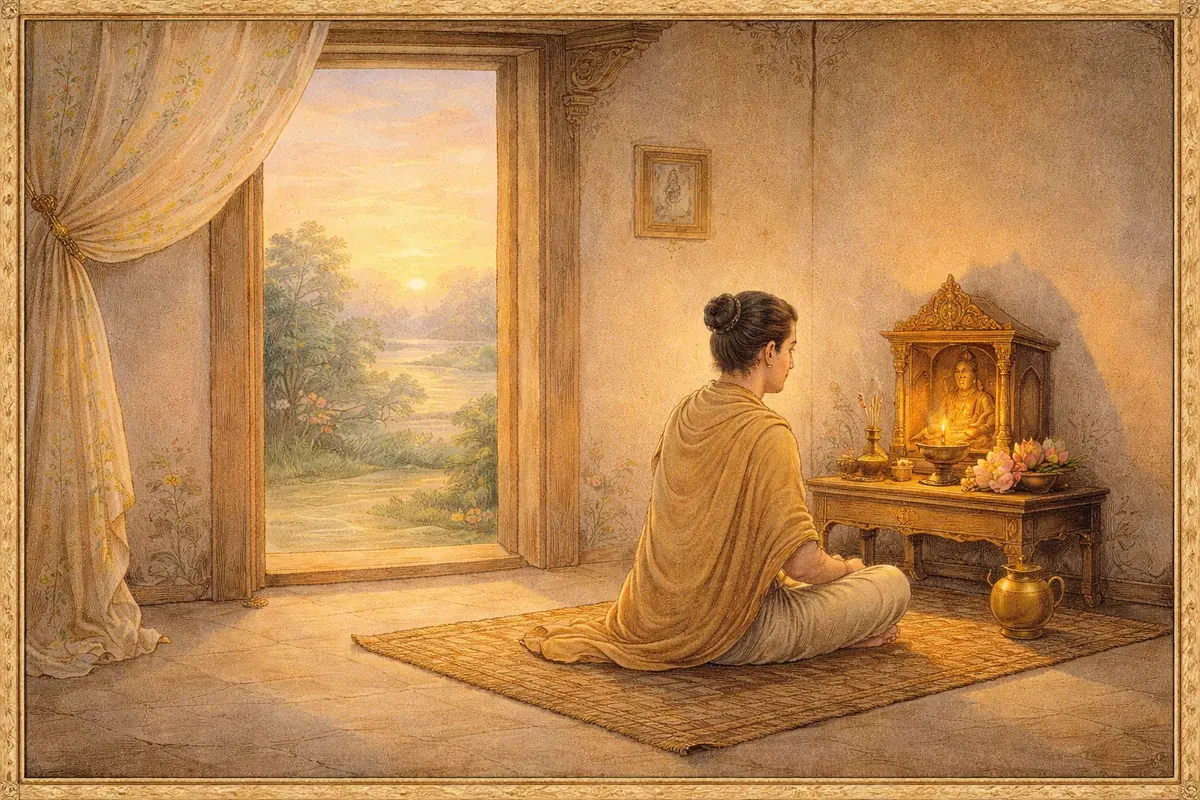
Before dawn, in the silence of the last fifth of the night, the practitioner performs ablutions, puts on clean clothes, and sits before the altar. A lamp is lit. A mantra is recited. This moment is not accidental—it is intentionally chosen and intentionally repeated day after day. This is what upasana looks like from the inside: not a state to be sought, but a discipline to be performed.
Etymology and Meaning
The word upasana (Skt. upāsanā) is formed from the prefix upa — "near, close" — and the root ās — "to sit, to dwell." Literally: "sitting nearby." In the context of spiritual life, it means dwelling near God, a conscious and regular approach to Him through devotion.
It is important to distinguish upasana from a one-time religious act. A single puja, a single pilgrimage, a single meditation—these are not yet upasana. Upasana is precisely about regularity: a practice performed every day regardless of circumstances, weather, mood, or business. It is consistency that makes it a "dwelling" rather than a "visit."
In Sanatana Dharma, upasana is one of the five obligatory practices of a householder — pancha nitya karma (pañca-nitya-karma). Along with dharma (righteous conduct), utsava (festivals), tirthayatra (pilgrimage), and samskaras (rites of passage), it forms the foundation of a dharmic life. Upasana in this series is the only practice performed without a community, without a priest, in solitude. It is a personal, invisible foundation.
Sandhya Vandana: Three Times of Prayer
Historically, the central form of upasana in most schools of Sanatana Dharma is sandhya vandana (sandhyā-vandanā, "worship of the twilight"). This is a prayer performed at the three junctions of the daily cycle: dawn, noon, and sunset. Each of these transitions — sandhya — is considered a special time when the boundary between the ordinary and the sacred thins.
It is during these times that the Gayatri Mantra is recited—one of the most ancient prayers of the Vedic tradition:
"Aum. O terrestrial sphere! O cosmic sphere! O celestial sphere! May we contemplate the brilliance of the Solar Spirit, the Divine Creator. May He guide our minds."
Rigveda, Gayatri Mantra (3.62.10)
Reciting the Gayatri at three moments of the day establishes a vertical axis that permeates the entire daily cycle: dawn is the dedication of the day to God, noon is the maintenance of this dedication in the midst of activity, and sunset is the return to Him before the night.
Sandhya vandana is an obligatory practice for those who have undergone upanayana and received the sacred thread. Through daily, thrice-repeated turning toward God, consciousness gradually acquires a different quality: the ability to maintain spiritual orientation even in the flow of worldly affairs.
What Upasana Consists Of
In a broad sense, upasana encompasses several forms of personal practice. The practitioner builds their daily ritual from these elements in accordance with the instructions of their guru and the tradition of their school.
Puja (pūjā) — the ritual worship of God, Goddess, or a chosen deity before a home altar. Lighting a lamp, offering flowers, burning incense, and reciting mantras. This is a form of bhakti yoga, in which the body, hands, and voice are involved in worship. Puja before the home altar is the foundation of upasana for most householders.
Japa (japa) — the rhythmic repetition of a mantra or the name of God, usually counted on beads made of rudraksha or tulsi seeds. The Kularnava Tantra describes its effect directly: "Japa successfully grants joy, salvation, and the desire for self-realization. All defects... committed consciously and unconsciously, are erased by japa." In the Agamic tradition, japa yoga is the first step on the path to jnana.
Dhyana (dhyāna) — meditation. In the structure of upasana, it follows japa: the mantra calms the mind, and meditation immerses it in silence. The Brahma Muhurta period—the hour-and-a-half interval before dawn—is considered particularly favorable for deep dhyana. The Shastras describe this as "listening to the inner flow of sounds and contemplating the moon-like inner light."
Svadhyaya (svādhyāya) — self-study of the scriptures. Daily reading of Shastras, commentaries, and hymns. This is the part of upasana that nourishes understanding and prevents the practice from becoming mechanical repetition without meaning. The Yama-Niyama described in the Shaiva tradition explicitly includes svadhyaya among daily obligations.
Upasana in Different Schools of Sanatana Dharma
Upasana is a concept common to all of Sanatana Dharma, but its form depends on the school, lineage, and personal initiation.
In Vaishnava schools, the central place is occupied by the japa of the chosen name of God, the singing of bhajans and kirtans, and the daily reading of the Bhagavad Gita or Bhagavata Purana. The main object of worship is Vishnu in His various manifestations.
In Shakta schools, upasana is built around the puja of the Goddess, the recitation of Her names and hymns—such as the Lalita Sahasranama or Devi Mahatmya. The emphasis is on invoking power (shakti) through ritual worship.
In Shaiva schools, the foundation consists of sandhya vandana, japa of Shaiva mantras—primarily Namah Shivaya—and meditation. The Agamic tradition provides detailed regulations for the order of daily worship.
In Vedantic and Yogic schools, upasana often takes the form of meditation on the attribute-less Brahman or contemplation of the Aum. Here, external puja gradually transitions into internal worship.
Despite all differences, the key elements—daily frequency, ritual purity before practice, turning to God with intention, and mantra—remain constant across all schools.
Upasana in the System of Pancha Nitya Karma
In the system of pancha nitya karma, upasana occupies the place of the internal axis. Dharma determines behavior in society, samskaras sanctify life transitions, utsava connects one with the community, and tirthayatra leads beyond the familiar space. Upasana is the only one of the five practices performed daily and in solitude.
"The earnest practitioner performs daily worship, called sandhya upasana, usually before dawn. This sacred time of puja, japa, recitation, chanting, meditation, and scriptural study is the foundation of personal life."
Satguru Sivaya Subramuniyaswami, "Dancing with Siva"
"The foundation of personal life" is a precise formulation. External rituals—puja in a temple, festivals, pilgrimage—may be performed from time to time. Upasana is performed every day: in an ashram and in a city apartment, on holidays and on weekdays, in youth and in old age.
The Shiva Purana puts this relationship directly: "Perfect knowledge never descends upon a person who is not inclined toward worship."
Fruits of Regular Practice
The Shastras do not promise immediate results. The fruits of upasana are described as gradual changes in the quality of consciousness—those visible only after years of practice.
The mind becomes purer. Daily turning toward God reduces the power of instinctive reactions and cluttered thoughts. "The mind, indeed, is the transitory world. Therefore, it should be purified with great effort. A man becomes that which is his consciousness," says the Yajur Veda. Upasana is a daily purification.
Stability emerges. A practitioner who has a regular upasana undergoes difficulties differently: the spiritual orientation built over the years does not vanish at the first encounter with crisis or loss.
The main fruit described by the Shastras is closeness to God. The word upasana itself speaks of this: every day of "dwelling nearby" adds something to an intimacy that cannot be obtained through a one-time effort. The Kularnava Tantra formulates this as a law: "A mantra brings success quickly if practice was performed in a previous life."
Upasana in the Life of a Practitioner
Upasana starts small. A few minutes before the altar, one mantra, one offering—this is enough to begin. The main condition is consistency. Five minutes every day is more valuable than an hour once a month.
As the practice deepens, upasana expands naturally: elements are added, time increases, and the structure of morning sadhana is established. The practitioner learns to maintain a prayerful state not only during upasana but throughout the day—in moments of karma yoga and selfless service.
The place for practice is not critical. "A riverbank, a cave, a hilltop, a seashore, one’s own home—all these are places wonderful for the sadhana of mantra-japa," lists the Kularnava Tantra. The place is secondary. Intention and regularity are primary.
In Sanatana Dharma communities living outside of India, upasana is a particularly important element. It does not require a temple, a priest, or special conditions. An altar in the corner of a room, ten minutes before the start of the day—and the connection with tradition is preserved.
