

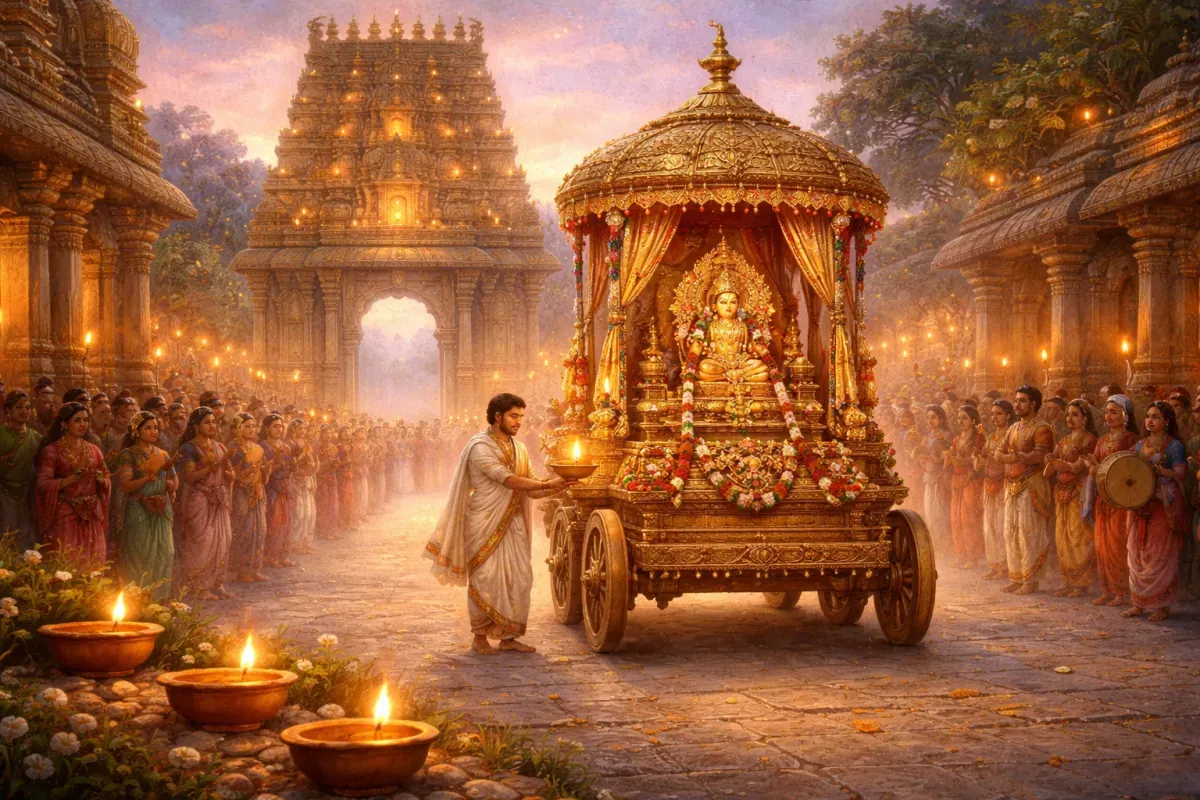
The sounds of the drum echo through the streets long before dawn. Oil lamps illuminate the procession in which priests carry the image of the Lord on festive litters. The faithful line the path of the chariot, offering flowers and chanting the names of Shiva. All of this is utsava: not merely a celebration, but a meeting of worlds, where the Divine visibly descends into the space of human life.
Utsava (Sanskrit: utsava) is a sacred festival, a holy day, or a period of special veneration for God and the gods. In the tradition of Sanatana Dharma, utsava is one of the mandatory spiritual practices, established in the shastras as an integral part of a righteous life.
Etymology and Definition
The word utsava in Sanskrit is formed from two roots: ud — "upward, forward, supreme" and sava — "inspiration, incitement, life-giving force" (from the root su — "to enliven, to set in motion"). Utsava literally means "elevation of the spirit," "ascent," or "that which lifts one up."
This etymology is not accidental. In the understanding of Sanatana Dharma, a festival is not a break from spiritual practice, but an intensification of it. During the days of utsava, a person rises above the ordinary rhythm of life and enters the expanded space of sacred time.
The word itself covers a wide range of phenomena: from daily ritual actions in the temple to multi-day community celebrations with processions, the bathing of images of the gods, and the singing of sacred hymns.
Utsava in the Pancha-nitya-karma System
In the tradition of Sanatana Dharma, righteous conduct (sadachara) is defined by five mandatory deeds — pancha-nitya-karma (Sanskrit: pañca-nitya-karma, "five constant actions"):
- Dharma (dharma) — a virtuous life in accordance with dharmic principles
- Upasana (upāsanā) — daily worship, prayer, and spiritual practice
- Utsava (utsava) — observance of sacred days and festivals
- Tirthayatra (tīrthayātrā) — pilgrimage to holy places
- Samskara (saṃskāra) — performance of sacraments sanctifying the most important stages of life
Without utsava, the life of a follower of the tradition is considered incomplete, just as it would be without daily worship or the observance of dharma.
Types and Forms of Utsava
Several levels of the festive cycle are distinguished:
By periodicity:
Nityotsava (nityotsava*) — daily ritual actions in the temple: puja, arati, abhisheka. In large South Indian temples, puja is performed seven times a day — from early morning until night. In this sense, every day is an utsava. Saptahotsava (saptāhotsava*) — a weekly sacred day. In North India, Monday (the day of Shiva) is especially revered; in the South, it is Friday. On these days, it is customary to visit the temple, decorate the home altar, and engage more deeply in sadhana. Masotsava (māsotsava) — monthly festivals timed to certain lunar days (tithis) and stars (nakshatras*). For devotees of Shiva, this is Pradosha (the thirteenth day of each half of the lunar month); for devotees of Ganesha, Chaturthi (the fourth day); for devotees of Karttikeya, Krittika nakshatra and Shashthi. Varshikotsava (vārṣikotsava*) — annual great festivals associated with specific events of the sacred year. Maha-utsava* — particularly solemn multi-day events, such as Brahmotsava, which usually lasts ten days.
By location:
Temple utsava* — the primary form, organized by the priesthood in accordance with the Agamas. It includes ritual bathing (abhisheka), decoration (alankara), offering (naivedya), procession (yatra), and other elements. Home utsava* — celebrated at the family altar with puja, lighting lamps, and prayer. Community utsava* — unites the local community or all followers of the tradition.
Festivals of Shiva
The main festival of the Shaivite tradition is Maha Shivaratri (Mahāśivarātri), the "Great Night of Shiva." It falls on the night before the new moon in February-March. On this night, the practitioner observes a strict fast and stays awake, chanting the 1,008 names of Shiva, reciting the Shri Rudram, and bathing the Shivalingam. This is a crucial moment of spiritual effort when the subtle connection between worlds is particularly palpable.
Of the monthly practices, a special place is held by Pradosha (Pradoṣa) — the evening time of the thirteenth lunar day (triodashi), considered especially auspicious for prayer to Shiva. Pradosha occurs twice a month: on the thirteenth day of the waxing and waning moon. The tradition recommends visiting the temple at this time, performing abhisheka to the Shivalingam, and reciting the Shri Rudram.
Festivals of Ganesha
Ganesha Chaturthi (Gaṇeśa Caturthī) is the main festival of Ganapati, celebrated in August-September. Elaborate pujas are performed in temples, and believers make or acquire an image of Ganesha for their home altar. The culmination is the visarjana procession: thousands of people carry images of Ganesha to a body of water, immersing them as a symbol of the God's return to universal consciousness. The festival lasts from one to ten days, depending on the region and family tradition.
Festivals of Saraswati
Vasant Panchami (Vasanta Pañcamī) is the fifth day of the bright half of the month of Magha (January-February), the first day of spring according to the traditional calendar. It is dedicated to the Goddess Saraswati — the patroness of knowledge, wisdom, speech, and the arts. On this day, it is customary to wear yellow garments: the mustard flower, already blooming in the fields, is the image of spring and awakening. Books, musical instruments, and the tools of craftsmen are placed at the altar — thus the student entrusts their work to the patronage of the Goddess. A special tradition is vidya-arambha (vidyāraṃbha): on this day, children are given a slate or pen for the first time and taught their first letters. Beginning one's education on the day of Saraswati is considered particularly auspicious.
Festivals of Shakti
Navaratri (Navarātrī, "nine nights") is one of the main festivals of the year, dedicated to the veneration of Devi in three aspects: Durga (the first three nights — the aspect of power and protection), Lakshmi (the middle three nights — the aspect of prosperity and abundance), and Saraswati (the last three nights — the aspect of wisdom and knowledge). It is celebrated twice a year: Chaitra Navaratri in March-April and Sharada Navaratri in September-October. The autumn cycle is the most solemn. Over nine nights, practitioners observe a fast, perform pujas, sing the Devi Mahatmyam (Durga Saptashati), and hold night vigils. The festival concludes with Vijayadashami (Vijayādaśamī), the day of Devi's victory over the asura Mahisha — a symbol of the triumph of spiritual light over ignorance.
Other Important Utsavas
Deepavali (Dīpāvalī), the "festival of light," in October-November, is a day of solidarity for all followers of Sanatana Dharma. Family bonds are strengthened, debts are forgiven, and rows of oil lamps are lit across the country. On this day, it is customary to ask for forgiveness from one another.
Guru Purnima (Guru-Pūrṇimā) on the July full moon is the day of honoring the Teacher. Tradition links this day with Veda Vyasa, the great compiler of the Vedas and Puranas, which is why honoring the Guru on this day is also called Vyasa Puja (Vyāsa-pūjā). Students pay homage to their Sadguru as the living embodiment of Vyasa and the entire chain of parampara — offering flowers, performing arati at the sacred feet or shri-padukas, and receiving blessings. In the Shaivite tradition, the Guru is seen as a direct manifestation of Shiva, making Vyasa Puja one of the most intimate practices within the guru-shishya relationship.
Kumbh Mela (Kumbha Melā) is the greatest pilgrimage gathering of the tradition, held alternately in four centers: Prayagraj, Haridwar, Nashik, and Ujjain. On the culminating days, tens of millions of people gather at the waters of the sacred rivers. Essentially, Kumbh Mela combines the features of utsava and tirthayatra: it is simultaneously a festival and a pilgrimage.
The Sacred Meaning of the Festival
Utsava is not merely a celebration with external attributes. According to the teachings of the tradition, during the days of great festivals, the three worlds — the world of humans (manushya-loka), the world of gods (deva-loka), and the highest world (Shiva-loka) — touch in a special way. The Shakti of the Deity in the temple reaches its greatest strength precisely during the days of utsava.
Participation in utsava is not a passive presence. Fasting, night vigils, prayer, meditation, the singing of hymns, and the giving of alms are all elements of the festival, each helping the practitioner to enter a state of special concentration and openness.
"Annual festivals and pilgrimages provide an opportunity to completely free oneself from worldly concerns," the tradition states. Utsava breaks the monotony of everyday life and introduces a person to the rhythm of the sacred year — a rhythm in which every season and every position of the celestial bodies becomes an occasion for renewing one's relationship with God.
The communal dimension of utsava is also fundamental. The festival unites the family and the community, creating a shared field of devotion and memory. The Tirumurai laments the desolation of a city deprived of festivals:
"Bereft of sanctity is the city where there is no temple, the city where festive canopies and white flags are not seen, the city where devotees do not gather flowers for the ritual of worship. Such a city is not a city. It is merely a wilderness."
> Tirumurai
Practice of Observance
In the tradition of Sanatana Dharma, utsava is a living connection with the cosmic rhythm. Festivals are observed in accordance with the sacred calendar, which combines solar and lunar cycles. The practitioner visits the temple at least once a week, and during the days of the great utsavas — especially Maha Shivaratri — attends the night service in person.
The home utsava emphasizes the role of the family altar as an extension of the temple. The tradition teaches that the home should be filled with the sound of sacred music, decorated with religious images and signs. Mantra and prayer sanctify even simple daily actions — waking up, eating, meetings. During the days of utsava, this sanctification is intensified: additional lamps are lit, special pujas are performed, and ritual food is prepared.
In the conditions of modern life — in different countries, far from India — followers of the tradition adapt the festive rhythm to local circumstances. The essence remains: fasting, prayer, community gathering, and special attention to God during the days when sacred time is open in a special way.
"Let us turn for help to the Lord of speech, the disposer of all existing things, the inspirer of wisdom! May He, who is invariably good, look kindly upon our prayers, and may He, whose deeds are kindness, grant us His blessing!"
> Rigveda
