

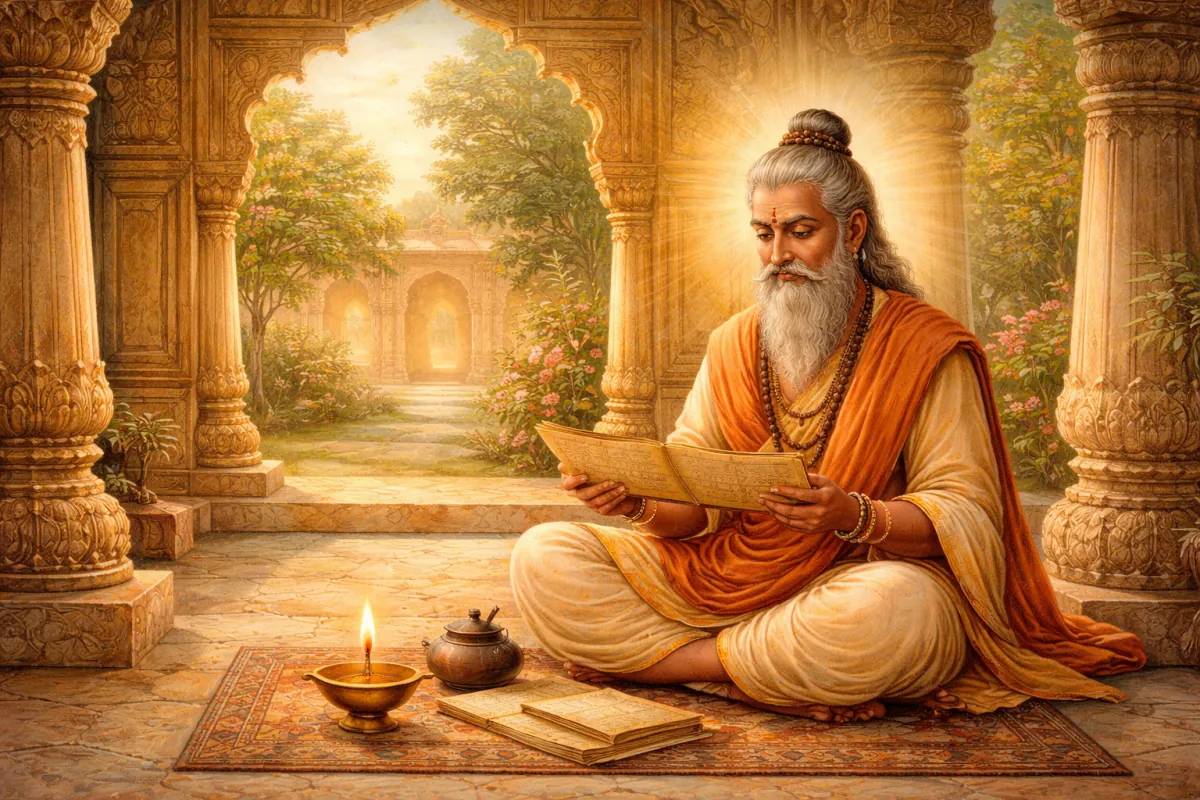
Advaita Vedanta (advaita vedānta) is one of the most influential schools of Indian philosophy and a subtradition within the broader philosophical system of Vedanta (vedānta). The term "advaita" literally means "non-duality" or "not two," pointing to the fundamental principle of this school—the metaphysical unity of all that exists. According to Advaita, the ultimate reality, known as Brahman (brahman), is the single, indivisible, eternal, and immutable foundation of all being, while the multiplicity of objects and phenomena perceived by us in everyday experience is the result of avidya (avidyā)—cosmic ignorance.
Advaita Vedanta occupies a central place among the six classical systems of Indian philosophy (darshanas (darśana)), being the most thoroughly developed interpretation of the philosophy of the Upanishads. Its fundamental assertion is the identity of individual consciousness (Atman (ātman)) and the cosmic Absolute (Brahman), expressed in the famous saying "tat tvam asi"—"You are That."
Historical Development
Origins and Formation
The philosophical roots of Advaita can be traced to the earliest layers of Indian spiritual literature—the Vedas (veda), and especially the Upanishads (upaniṣad), dating approximately from the 8th to the 6th centuries BCE. Advaita's most important metaphysical postulates are found in such key Upanishads as the Brihadaranyaka Upanishad (Bṛhadāraṇyaka Upaniṣad), Chandogya Upanishad (Chāndogya Upaniṣad), Mundaka Upanishad (Muṇḍaka Upaniṣad), and Katha Upanishad (Kaṭha Upaniṣad).
The systematic formation of Advaita Vedanta as a philosophical school is associated with Gaudapada (Gauḍapāda, approximately 6th–7th centuries CE), the author of the Mandukya Karika (Māṇḍūkya-kārikā)—a commentary on the Mandukya Upanishad (Māṇḍūkya Upaniṣad). This text provides the first systematic exposition of the doctrine of the non-duality of reality and the illusory nature of multiplicity.
Shankara and the Classical Period
The most significant figure in the history of Advaita is Adi Shankara (Ādi Śaṅkara, approximately 788–820 CE), who is traditionally regarded as the founder of Advaita Vedanta as a comprehensive philosophical system. Shankara produced an extensive body of works, including commentaries on the principal Upanishads, the Bhagavad Gita (Bhagavad-gītā), and the Brahma Sutras (Brahma-sūtra). His foundational text, the Brahma Sutra Bhashya (Brahma-sūtra-bhāṣya), systematized Advaita as a philosophical doctrine.
Among Shankara's principal contributions was the development of the doctrine of two levels of truth: vyavaharika-satya (vyāvahārika-satya, the relative truth of everyday reality) and paramarthika-satya (pāramārthika-satya, the absolute truth of non-dual Brahman).
Post-Shankara Period
After Shankara, the development of Advaita was continued by his disciples and followers, who established several subtraditions. The most prominent representatives of this period were:
Sureshvara (Sureśvara, 9th century), a direct disciple of Shankara and author of the Naishkarmya Siddhi (Naiṣkarmya-siddhi)
Padmapada (Padmapāda, 9th century), author of the Panchapadika (Pañcapādikā)
Vachaspati Mishra (Vācaspati Miśra, 10th century), author of the Bhamati (Bhāmatī)
Sarvajnatman (Sarvajñātman, 10th century), who wrote the Sankshepa Shariraka (Saṃkṣepa-śārīraka)
Significant contributions to the development of Advaita were also made by Prakashatman (Prakāśātman, 11th century), Vidyaranya (Vidyāraṇya, 14th century), Madhusudana Sarasvati (Madhusūdana Sarasvatī, 16th century), and Appayya Dikshita (Appayya Dīkṣita, 16th century).
Philosophical Foundations
Core Principles
The metaphysics of Advaita Vedanta is based on several key principles:
Brahman—the one, absolute, non-dual reality, devoid of qualities (nirguna) and attributes, eternal and immutable.
Atman—the true Self, identical to Brahman. The identity of Atman and Brahman is expressed in the mahavakyas (mahāvākya) of the Upanishads, such as "ayam atma brahma" (ayam ātmā brahma)—"this Atman is Brahman."
Maya (māyā)—the cosmic illusion, the creative power that produces the appearance of multiplicity and distinctions within non-dual reality. Maya is indescribable (anirvacanīya), being neither real nor unreal.
Levels of reality (avidyā) — ignorance or lack of knowledge of the true nature of reality, which causes the illusory multiplicity to be perceived.
Sat-chit-ananda (sat-cit-ānanda) — the nature of Brahman as being-consciousness-bliss.
Epistemology
Advaita epistemology distinguishes several pramāṇas — means of valid knowledge:
Pratyaksha (pratyakṣa) — direct perception
Anumana (anumāna) — inference
Shabda (śabda) — testimony of authoritative texts, especially shruti
Upamana (upamāna) — comparison or analogy
Arthapatti (arthāpatti) — postulation
Anupalabdhi (anupalabdhi) — non-perception
At the same time, Advaita distinguishes two levels of knowledge:
Apara-vidya (aparā-vidyā) — lower knowledge relating to the empirical world
Para-vidya (parā-vidyā) — higher knowledge, the realization of nondual Brahman
Theory of erroneous superimposition
The central explanatory principle of Advaita is the concept of adhyasa (adhyāsa) — erroneous superimposition. According to Shankara, we perceive the world of multiplicity because the qualities of one object are superimposed on another, particularly material qualities on pure consciousness. The classic example is mistaking a rope for a snake in dim light, illustrating the mechanism of erroneous perception.
Cosmology
Levels of reality
Advaita postulates three levels of reality:
Paramarthika-satya (pāramārthika-satya) — absolute reality, represented by nondual Brahman.
Vyavaharika-satya (vyāvahārika-satya) — conventional or empirical reality of everyday experience, including the physical world and mental phenomena.
Pratibhasika-satya (prātibhāsika-satya) — illusory reality, including hallucinations, dreams, and false perceptions (such as a rope mistaken for a snake).
Cosmological evolution
Advaita cosmology describes the manifestation of the universe as the result of maya, the cosmic power that projects the illusion of multiplicity. This process of manifestation includes:
Ishvara (īśvara) — Brahman viewed as possessing attributes (saguna), is the first manifestation and the cosmic ruler.
Hiranyagarbha (hiraṇyagarbha) — the "golden embryo," the subtle body of the universe, the totality of all subtle bodies.
Virat (virāṭ) — the gross, physical manifestation of the cosmos.
Cyclical nature of the cosmos
Advaita accepts the Hindu concept of cyclical time, which posits an infinite succession of creation (srishti (sṛṣṭi)), preservation (sthiti (sthiti)), and dissolution (pralaya (pralaya)) of the universe. These cosmic cycles have neither beginning nor end, like the alternation of sleep and wakefulness.
Key schools/traditions
Within Advaita Vedanta, several significant subtraditions emerged after Shankara, differing in their interpretation of key concepts:
Bhamati and Vivarana
The two main subtraditions of Advaita:
Bhamati (bhāmatī) — founded by Vachaspati Mishra, emphasizes the role of individual avidya as the cause of the illusory perception of multiplicity.
Vivarana (vivaraṇa) — founded by Prakashatman, emphasizes the role of cosmic maya and regards avidya as inherent in Brahman.
Drishti-srishti-vada and Srishti-drishti-vada
Two schools offering different views on the relationship between perception and creation:
Drishti-srishti-vada (dṛṣṭi-sṛṣṭi-vāda) — the “doctrine according to which perception precedes creation,” asserting that the world exists only at the moment it is perceived.
Srishti-drishti-vada (sṛṣṭi-dṛṣṭi-vāda) — the “doctrine according to which creation precedes perception,” acknowledging the existence of the empirical world independently of individual perception.
Regional Subtraditions
Regional schools of Advaita emerged in different parts of India:
Sungamneru (Sungamneru) in Tamil Nadu
Kavaledurga (Kavaleḍurga) in Karnataka
Puruvatanku (Puruvatanku) in Andhra Pradesh
Naduvil (Naḍuvil) in Kerala
Practical Aspects
Sadhana-chatushtaya
Advaita prescribes four preliminary qualifications for a spiritual seeker, known as sadhana-chatushtaya (sādhana-catuṣṭaya):
Viveka (viveka) — discrimination between the eternal and the transient, the real and the unreal.
Vairagya (vairāgya) — dispassion or detachment from worldly pleasures.
Shatsampatti (ṣaṭsampatti) — six virtues: control of the mind (shama (śama)), control of the senses (dama (dama)), withdrawal from activity (uparati (uparati)), forbearance (titiksha (titikṣā)), concentration (samadhana (samādhāna)), and faith (shraddha (śraddhā)).
Mumukshutva (mumukṣutva) — an ardent desire for liberation.
Paths to Liberation
Advaita recognizes several paths to liberation:
Jnana yoga (jñāna-yoga) — the path of knowledge, regarded as the highest and most direct path to liberation.
Bhakti yoga (bhakti-yoga) — the path of devotion, regarded as preparatory to jnana yoga.
Karma yoga (karma-yoga) — the path of selfless action.
Raja yoga (rāja-yoga) — the path of meditation and mental control.
Three Stages of Realization
The process of spiritual realization in Advaita is traditionally described in three stages:
Shravana (śravaṇa) — listening to the teaching from authoritative sources.
Manana (manana) — deep reflection on what has been heard in order to dispel doubts.
Nididhyasana (nididhyāsana) — meditative contemplation leading to the direct realization of truth.
Jnana and Jivanmukti
The ultimate goal of Advaita is jnana (jñāna) — the direct and irreversible realization of the identity of Atman and Brahman. This realization leads to the state of jivanmukti (jīvanmukti) — liberation while living, in which one who has realized their true nature continues to live in the body but no longer identifies with it, acting spontaneously from a state of nondual consciousness.
After the death of the physical body, the jivanmukta attains videhamukti (videhamukti) — final liberation without a body.
Relationship to Other Traditions
Advaita differs from other schools of Vedanta in its strict nondualism:
Vishishta Advaita (viśiṣṭādvaita) of Ramanuja recognizes Brahman with attributes and regards individual souls as real, though inseparable from Brahman.
Dvaita (dvaita) of Madhva postulates a fundamental distinction between God, souls, and matter.
Dvaita Advaita (dvaitādvaita) of Nimbarka and Bhedabheda (bhedābheda) represent different versions of a philosophy combining aspects of dualism and nondualism.
Advaita and Buddhism
There are both similarities and differences between Advaita and Madhyamaka, a school of Mahayana Buddhism:
Both traditions deny the substantiality of the phenomenal world and criticize conceptual thought.
However, while Buddhism denies the existence of an eternal self (anātman), Advaita affirms the reality of Atman as identical to Brahman.
The opponents of Gaudapada and Shankara often accused them of crypto-Buddhism because they used certain arguments similar to Buddhist ones.
Advaita and Kashmir Shaivism
Kashmir Shaivism (kāśmīra śaivism) and Advaita Vedanta have much in common, including a non-dualistic view of reality, but there are significant differences between them:
Kashmir Shaivism views the ultimate reality as the dynamic Shiva-Shakti, while Advaita sees Brahman as static, unchanging consciousness.
Kashmir Shaivism considers the world a real manifestation of the divine, whereas Advaita regards it as an illusion.
Current State
Advaita Vedanta continues to exist within the traditional mathas (maṭha)—monasteries founded by Shankara:
Sringeri Sharada Peetham (śṛṅgeri śāradā pīṭham) in Karnataka
Dwarka Sharada Peetham (dvārakā śāradā pīṭham) in Gujarat
Puri Govardhana Peetham (purī govardhana pīṭham) in Odisha
Jyotirmath (jyotirmaṭh) in Uttarakhand
The spiritual heads of these mathas, known as Shankaracharyas (śaṅkarācārya), are regarded as custodians of the tradition.
Modern Representatives
In the 19th and 20th centuries, Advaita was represented by such prominent teachers as:
Ramakrishna Paramahamsa (1836–1886)
Swami Vivekananda (1863–1902)
Ramana Maharshi (1879–1950)
Swami Sivananda (1887–1963)
Swami Chinmayananda (1916–1993)
Nisargadatta Maharaj (1897–1981)
Global Spread
In the 20th century, Advaita Vedanta became widespread beyond India through the activities of organizations such as the Ramakrishna Mission, the Vedanta Society, and the Chinmaya Mission.
Advaita Vedanta is one of the most elaborately developed and intellectually sophisticated schools of Indian philosophy. Its influence extends far beyond India and continues to grow in the modern world. Its unique synthesis of metaphysical depth, psychological insight, and practical orientation makes Advaita relevant both to philosophical research and to spiritual seekers.
Advaita’s central thesis concerning the non-duality of reality and the identity of Atman and Brahman continues to inspire both traditional followers and modern thinkers seeking a holistic understanding of consciousness and reality. Advaita’s rich terminology and methodology offer a profound and systematic approach to investigating the nature of being, consciousness, and human experience.
Despite changes in the cultural and intellectual landscape, the fundamental questions raised by Advaita—about the nature of the self, consciousness, and reality—continue to occupy a central place in philosophical discourse, making this ancient tradition remarkably modern and relevant.
