

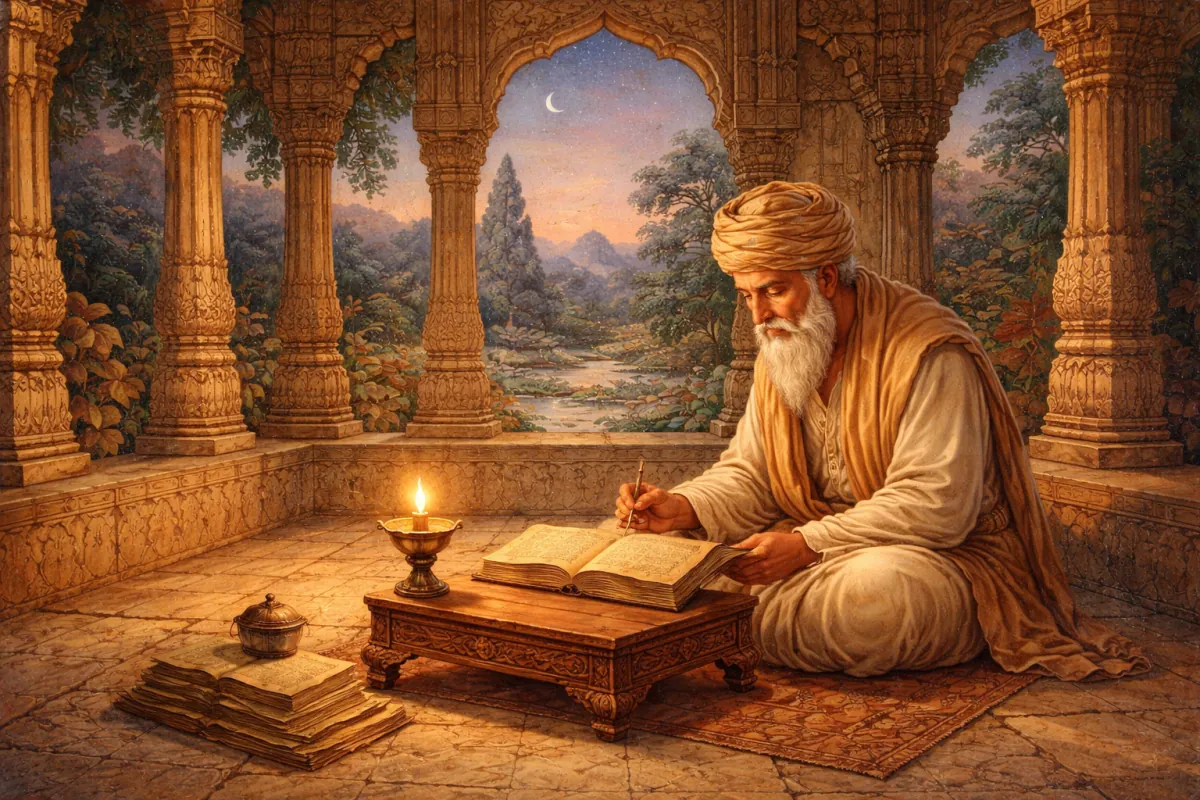
Brahman (brahman) is the central and fundamental concept of the philosophical thought of Sanātana Dharma, attaining its fullest and most systematic expression in the tradition of Advaita Vedānta (advaita-vedānta). In this tradition, Brahman is understood as the absolute, ultimate, and only true reality, which simultaneously transcends all forms of manifest existence and is present within them.
According to the classical formulations of Advaita philosophers, Brahman is Sat-Cit-Ānanda (sat-cit-ānanda)—the indivisible unity of pure being, pure consciousness, and pure bliss, which cannot be fragmented or divided. Brahman is infinite, eternal, immutable, self-sufficient, and self-evident. It is the foundation and substratum of all changing phenomena, while itself remaining untouched by change, just as a screen remains unchanged while the images displayed upon it alternate.
The uniqueness of the concept of Brahman lies in the fact that it is understood not as some supreme entity among other entities, but as being itself, in which all dualities and divisions disappear: subject and object, knower and known, inner and outer. Brahman is neither the personal deity of the Abrahamic religions, nor a philosophical abstraction, nor a metaphysical principle in the Western sense, although it contains elements of all these concepts.
Etymology
The word brahman derives from the Sanskrit root √bṛh (बृह्), meaning “to grow,” “to expand,” “to increase,” and “to become great.”
The noun brahman is derived from this root and originally meant:
- a sacred word,
- a prayer,
- the power of a mantra,
- a sacred formula possessing spiritual power.
In the Vedic tradition, this word denoted the power of sacred speech capable of revealing and sustaining the cosmic order.
Later, in the philosophy of the Upaniṣads, the meaning of the term deepened. Brahman came to be understood as:
- absolute reality,
- infinite being,
- the first principle of all that exists,
- the foundation from which the world arises and in which it abides.
Thus, from the standpoint of etymology and philosophy, brahman can be understood as that which expands infinitely and transcends all limits—the supreme, all-encompassing reality.
In the tradition of Advaita Vedānta (advaita-vedānta), this idea receives its most radical expression:
Brahman is the only reality, and everything else is its manifestation.
This is why the Upaniṣads say:
“sarvaṃ khalvidaṃ brahma”
“truly, everything is Brahman.”
The renowned medieval commentator Śaṅkara (Śaṅkara, 8th century CE), in his Brahma-sūtra-bhāṣya, emphasizes:
“bṛhatvād bṛhaṇatvāc ca brahma”
“Brahman is that which transcends everything and expands itself without limit.”
This definition reveals not only Brahman’s infinity, but also its dynamic nature as a self-revealing reality.
Historical Evolution of the Concept
The concept of Brahman underwent significant evolution in the history of Indian philosophical thought:
In the early Vedas (veda), especially the Ṛgveda, the term “brahman” had a considerably more modest meaning, denoting a sacred utterance or magical incantation, as well as the sacred power inherent in ritual action and prayer. During this period, its understanding was closely associated with the concept of ṛta—cosmic order and its ritual maintenance.
In the Brāhmaṇas (Brāhmaṇa) and Āraṇyakas (Āraṇyaka), the meaning of ritual was gradually reinterpreted, and along with it the concept of Brahman, which began to be associated with the inner knowledge underlying external rites. Here, a transition from ritualism to the internalization of spiritual practice begins to emerge.
A radical transformation of the concept of Brahman occurs in the Upaniṣads (Upaniṣad), where it evolves to denote the supreme cosmic reality and becomes a central philosophical category.
In the Chāndogya Upaniṣad (Chāndogya Upaniṣad, 6.2.1), the famous formula appears: “sad eva, saumya, idam agra āsīt” (“Only being, dear one, existed in the beginning”), laying the monistic foundation for all subsequent Vedānta.
In the Bṛhadāraṇyaka Upaniṣad (Bṛhadāraṇyaka Upaniṣad, 3.8.8), the sage Yājñavalkya characterizes Brahman as “neti, neti” (“not this, not this”), indicating its transcendence of any definitions or limitations.
The Taittirīya Upaniṣad (Taittirīya Upaniṣad, 2.1) defines Brahman as "satyaṃ jñānam anantaṃ brahma" ("Brahman is truth, knowledge, infinity"), which became one of the classical formulations.
The Brahma Sūtras (Brahma-sūtra), or Vedānta Sūtras (Vedānta-sūtra), attributed to the sage Bādarāyaṇa, present the first systematic exposition of the doctrine of Brahman. This text, consisting of concise aphorisms, serves as the foundation for the various interpretations of Vedānta that emerged in subsequent eras.
The opening statement of the Brahma Sūtras:
"athāto brahma-jijñāsā"
“Now, therefore, the inquiry into Brahman,”
establishes the investigation of the nature of Brahman as the principal subject of Vedānta philosophy.
The Metaphysical Status of Brahman
One of the key distinctions in understanding Brahman is the distinction between its nirguṇa and saguṇa aspects:
Nirguṇa Brahman (nirguṇa-brahman, "Brahman without attributes") is Brahman regarded as devoid of any definitions, qualities, attributes, or characteristics. It is the absolute reality that lies beyond any description or definition.
Nirguṇa Brahman is incomprehensible to ordinary reason, since thought itself operates through categories and distinctions that do not apply to absolute reality. It cannot be expressed in ordinary language, which is likewise structured around duality. The only way to indicate it is through the method of neti neti ("not this, not this"), successively negating everything that can be defined, limited, or conceptualized.
As Śaṅkara explains in the Upadeśa Sāhasrī (Upadeśa-sāhasrī, "A Thousand Teachings"): "Brahman does not exist as substance or quality, action or relation, universal concept or particular characteristic. It is not emptiness, not absence, and is not defined through negation. It is that which remains when everything that can be negated has been negated."
Saguṇa Brahman (saguṇa-brahman, "Brahman with attributes") is Brahman regarded as possessing certain qualities or attributes. It is the relative aspect of absolute reality, manifesting as Īśvara, the cosmic creator, preserver, and destroyer of the universe.
Saguṇa Brahman is accessible to worship, visualization, and understanding. It is personified in various divine forms of Hinduism: Viṣṇu, Śiva, Devī, and others. From the absolute point of view, however, these forms are merely conditional manifestations of undifferentiated Brahman.
In his commentary on the Brahma Sūtra (1.1.20), Śaṅkara explains that saguṇa Brahman is Brahman seen through the prism of māyā, the cosmic illusion, and therefore endowed with qualities and attributes. These qualities are not inherent in Brahman itself but are projected onto it by our limited perception.
The Dialectic of the Nirguṇa and Saguṇa Aspects
It is important to understand that the distinction between the nirguṇa and saguṇa aspects of Brahman does not imply the existence of two separate entities. They are merely two ways of viewing one and the same reality—from the absolute (pāramārthika-satya) and relative (vyāvahārika-satya) points of view.
As Śaṅkara notes, Brahman as such remains immutable and one, while multiplicity and distinctions arise only at the level of superimpositions (adhyāsa) or illusory projections.
Brahman as Sat-Cit-Ānanda
The nature of Brahman is traditionally described through the triad of Sat-cit-ānanda, in which each element indicates a fundamental aspect of absolute reality:
Sat means pure being or existence as such, without any limitations or determinations. This is not "existence" in the sense of the opposite of nonexistence, but being that precedes this very distinction.
The Chāndogya Upaniṣad (6.2.1) states:
"sat eva, saumya, idam agra āsīt, ekam eva advitīyam"
“Being alone, dear one, was in the beginning, one without a second”
This indicates that Brahman as sat is the sole and self-sufficient reality.
Sat also means truth or reality as opposed to the unreal or illusory (asat). In his Viveka Cūḍāmaṇi (Viveka-cūḍāmaṇi), Śaṅkara explains that sat is that which remains unchanged in all three times (past, present, and future) and is therefore absolutely real.
Chit (cit) means pure consciousness or knowledge, which is not a function or property of something else but constitutes the very nature of Brahman. This is not consciousness in the psychological sense of awareness of objects, but the self-luminous nature of reality.
In his commentary on the Brihadaranyaka Upanishad (4.3.30), Shankara characterizes chit as svaprakasha (svaprakāśa, “self-evident,” “self-luminous”), that is, as not requiring another consciousness to illuminate or know it.
An important feature of chit is its non-duality: there is no division within it into the knower, the known, and the process of knowing. As Shankara explains, when we speak of Brahman’s “consciousness,” we do not mean that Brahman “possesses” consciousness—Brahman is consciousness.
Ananda (ānanda) denotes absolute bliss or infinite fullness, which constitute the inherent nature of Brahman. This is not an emotional state or subjective experience, but an essential characteristic of absolute reality.
The Taittiriya Upanishad (2.5) proclaims Brahman as “raso vai sah” (raso vai saḥ, “He, indeed, is the essence, the sweetness”), indicating its nature as the primordial source of all forms of happiness or satisfaction that we experience in the world.
The Brihadaranyaka Upanishad (4.3.32) also states that Brahman is “vijnanaghana, anandaghana” (vijñānaghana, ānandaghana, “a mass of consciousness, a mass of bliss”), emphasizing the fullness and intensity of these qualities.
It is important to understand that the triad of sat-chit-ananda does not imply that Brahman is “composed” of three separate components or aspects. Rather, it is an attempt to indicate the indivisible unity of being, consciousness, and bliss that constitutes the very essence of Brahman.
As Shankara explains, when we speak of Brahman as sat-chit-ananda, we are not making a real distinction within Brahman, but are merely attempting to indicate its nature through different aspects of one and the same indivisible reality.
In his Upadesha Sahasri (1.13), Shankara describes Brahman as “nityashuddhabuddhamuktasatyasvarupa” (nityaśuddhabuddhamuktasatyasvarūpa, “whose nature is eternity, purity, enlightenment, freedom, and truth”), emphasizing the integral unity of all these aspects.
Brahman’s Relationship to the Manifest World
A key question in Advaita metaphysics is the relationship between absolute, undifferentiated Brahman and the manifold world of manifestations (prapancha, prapañca). This relationship is explained through the concept of vivarta (vivarta).
Beginning with Shankara, Advaita philosophers developed the theory of vivarta (vivarta, “apparent change”) to explain the relationship between Brahman and the world of manifestations. According to this theory, Brahman undergoes no real change when the world arises, but only appears to change.
This is contrasted with the theory of parinama (pariṇāma, “real transformation”), accepted in other schools such as Samkhya (sāṃkhya), in which the original substance actually transforms into various products.
Shankara illustrates the concept of vivarta through the metaphor of the sun’s reflection in water: the sun undergoes no real change, although its reflection may ripple and fragment as the water moves. Similarly, Brahman remains unchanged despite the apparent diversity of its manifestations.
How to Know Brahman
Knowing Brahman is not merely a theoretical inquiry, but a profound transformative process with its own specific methods.
In the philosophy of Sanatana Dharma, pramanas (pramāṇa) in Advaita are valid means or instruments of knowledge. Advaita Vedanta traditionally recognizes six pramanas, but the following play a special role in knowing Brahman:
- Shabda (śabda, “verbal testimony”)—authoritative texts, especially the Upanishads, which are regarded as apaurusheya (apauruṣeya, “not of human authorship”) and therefore as absolutely reliable in matters concerning transcendent reality.
- Anumana (anumāna, “logical inference”)—although Brahman cannot be apprehended directly through logic, rational reasoning plays an important role in eliminating erroneous notions and preparing the ground for direct experience.
- Pratyaksha (pratyakṣa, “direct perception”)—in the case of knowing Brahman, this is not ordinary sensory perception, but direct intuitive apprehension, or anubhava (anubhava), which arises as a result of deep meditation and self-inquiry.
Shankara emphasizes the primacy of shabda-pramana for the knowledge of Brahman, since this reality lies beyond ordinary experience and cannot be comprehended by conventional means of knowledge. However, he also acknowledges the complementary role of reasoning (yukti) and direct experience (anubhava) in the process of realization.
Paroksha and Aparoksha Jnana
Central to Advaita epistemology is the distinction between two kinds of knowledge of Brahman:
Paroksha-jnana (parokṣa-jñāna) is mediated, indirect, conceptual knowledge about Brahman, obtained through the study of scripture, logical reasoning, or a teacher’s instruction. It is knowledge characterized by duality between the knowing subject and the known object.
Aparoksha-jnana (aparokṣa-jñāna) is immediate, direct, intuitive knowledge-realization of Brahman, arising from deep meditation and self-inquiry. It is knowledge in which the duality between the knower and the known is transcended, and subject and object merge into an undifferentiated unity.
As Shankara explains in the Vivekachudamani (verse 56): “The Atman (Brahman) cannot be realized through the study of scripture, logical reasoning, or a multitude of teachings. It is attainable only by the one to whom it reveals itself. Only through its grace can its true nature be realized.”
Only aparoksha-jnana leads to genuine liberation (Moksha in Advaita Vedanta, mokṣa), whereas paroksha-jnana, although valuable at certain stages of the path, remains within the framework of dualistic perception and therefore cannot lead to final realization.
Adhyasa and Its Transcendence
The knowledge of Brahman is closely linked to transcending adhyasa (adhyāsa, “imposition” or “superimposition”)—the projection of the characteristics of one object onto another, which is the fundamental mechanism of illusion in Advaita.
Shankara begins his commentary on the Brahma Sutras with an analysis of adhyasa, defining it as “the apparent manifestation of one thing in another.” The original adhyasa underlying all others is the superimposition of the unreal “self” (ego, body, mind) upon the real “Self” (Atman/Brahman).
Transcending adhyasa through discrimination (viveka) between the real and the unreal, and realizing the true nature of Atman as Brahman, constitutes the essence of the process of knowledge in Advaita. As Shankara explains, this is not the acquisition of new knowledge in the ordinary sense, but the removal of ignorance (avidya, avidyā) that conceals the truth, which is always already present.
Brahman in the Context of Schools and Interpretations
Within Advaita Vedanta, several significant subschools emerged, offering different nuances in their interpretations of the nature of Brahman and its relationship to the world:
The two main subtraditions of Advaita—Bhamati (Bhāmatī) and Vivarana (Vivaraṇa)—are named after the commentaries of the same names on Shankara’s works:
- Bhamati, founded by Vachaspati Mishra (Vācaspati Miśra, 9th–10th centuries), emphasizes the role of the individual jiva (jīva) and its ignorance in projecting the world. According to this school, maya is a power inherent in each individual soul.
- Vivarana, founded by Prakashatman (Prakāśātman, 11th–12th centuries), emphasizes cosmic ignorance and the central role of Ishvara. According to this school, maya is a power inherent in Brahman itself, while individual ignorance is merely its manifestation.
These subschools also differ in their understanding of the nature and status of avidya (avidyā, “ignorance”), which affects their interpretation of the relationship between Brahman and the phenomenal world.
Drishti-Srishti-Vada and Srishti-Drishti-Vada
Another important distinction concerns cosmological views:
- Drishti-srishti-vada (Dṛṣṭi-sṛṣṭi-vāda, “the doctrine of creation through perception”) is a radical interpretation asserting that the world arises only at the moment it is perceived and has no independent existence. According to this doctrine, there is no real creation—the world exists only as the content of consciousness.
- Srishti-drishti-vada (Sṛṣṭi-dṛṣṭi-vāda, “the doctrine of the perception of the created”) is a more moderate position that acknowledges the relative reality of the world and holds that its creation precedes its perception. According to this doctrine, the world manifests from Brahman through maya and is then perceived by individual consciousnesses.
These doctrines offer different models of the relationship between the absolute reality of Brahman and the relative reality of the manifested world, but they agree in recognizing Brahman as the sole ultimate reality.
Brahman in Comparison with Other Philosophical Systems
The understanding of Brahman in Advaita differs from the interpretations of other Vedanta schools:
- In Ramanuja's Vishishtadvaita (viśiṣṭādvaita) (11th–12th centuries), Brahman is understood as a personal God (Vishnu-Narayana) possessing attributes, while individual souls (jivas) and matter (prakriti) are regarded as his real attributes or modes, retaining a certain degree of distinctness even after liberation.
- In Madhva's Dvaita (dvaita) (13th century), Brahman (identified with Vishnu) and individual souls are regarded as ontologically distinct entities, and this distinction is understood to be eternal and insurmountable.
- In Nimbarka's Dvaitadvaita (dvaitādvaita) (12th–13th centuries) and Chaitanya's Achintya Bheda Abheda (acintya-bheda-abheda) (15th–16th centuries), various forms of dualistic non-dualism are developed, combining elements of Advaita and Dvaita.
Unlike these schools, Advaita upholds the absolute unity of reality, as well as the illusory nature of all distinctions and multiplicity.
Kashmir Shaivism (kāśmīra śaivism), particularly in the form of Pratyabhijna (pratyabhijñā), has much in common with Advaita in its understanding of ultimate reality, but also differs from it significantly:
- In Kashmir Shaivism, ultimate reality—Paramashiva (Paramaśiva), or Paramabrahman—has a dynamic aspect (Shakti, Śakti), which is not regarded as external or illusory but is integrated into the very concept of the Absolute.
- Unlike Advaita, where maya is understood as the power that conceals the true nature of Brahman, in Kashmir Shaivism maya is regarded as Shiva's creative energy, through which he manifests his greatness.
- Kashmir Shaivism emphasizes the dynamic aspects of the Absolute: spanda (vibration), prakasha (light), and vimarsha (self-reflection), whereas Advaita emphasizes its static aspects: sat (being), chit (consciousness), and ananda (bliss).
The relationship between Advaita and Buddhist schools, particularly Madhyamaka (madhyamaka) and Yogachara (yogācāra), has been the subject of intense debate and mutual enrichment:
- The concept of shunyata (śūnyatā, "emptiness") in Nagarjuna's Madhyamaka has parallels with Advaita's nirguna Brahman, although their methods of argumentation and certain metaphysical premises differ.
- Vijnaptimatrata (vijñaptimātratā, "consciousness-only") in Yogachara resembles the understanding of pure consciousness (chit) in Advaita, but differs in affirming the absence of an enduring self (anatman) and the dynamic nature of consciousness.
- Advaita was significantly influenced by Buddhist logic and methods of cognition, especially in the works of Gaudapada, whose Mandukya Karika is often regarded as an attempt to synthesize Advaita and Buddhist Madhyamaka.
Practical Aspects: The Path to Knowing Brahman
In Advaita Vedanta, the process of knowing Brahman requires careful preparation, systematized in the concept of sadhana-chatushtaya (sādhana-catuṣṭaya, "the fourfold sadhana")—four prerequisites or qualities necessary for successful progress along the path:
- Viveka (viveka)—the ability to discriminate between the permanent and the impermanent, the real and the unreal, Atman and non-Atman. This is a fundamental intellectual quality that makes it possible to distinguish eternal truths from transient phenomena.
- Vairagya (vairāgya)—dispassion, detachment from worldly objects and the results of actions. This is not a passive rejection of the world, but an inner freedom from attachment and aversion that makes it possible to focus on the highest goal.
- Shatsampatti (ṣaṭsampatti)—six virtues or inner attainments:
- Shama (śama)—tranquility or control of the mind;
- Dama (dama)—restraint or control of the external senses;
- Uparati (uparati)—abstention from excessive activity;
- Titiksha (titikṣā)—patience, endurance;
- Shraddha (śraddhā)—faith in the teaching and the teacher;
- Samadhana (samādhāna)—concentration or one-pointedness of mind.
- Mumukshutva (mumukṣutva)—an ardent aspiration for liberation (moksha) that surpasses all other desires and aspirations.
As Shankara explains in the Vivekachudamani, these qualities constitute the necessary foundation for the study of Vedanta and the realization of Brahman. Without them, philosophical knowledge remains merely theoretical and does not lead to transformative experience.
The Role of the Guru in Knowing Brahman
In the Advaita tradition, the Guru (guru, "teacher") plays a central role in the process of knowing Brahman. The Guru does not merely convey information but serves as a living embodiment of the teaching and a catalyst for the transformation of the disciple's consciousness.
The Mundaka Upanishad (1.2.12) states:
“To know this [Brahman], one should approach a guru who is established in Brahman and well versed in the scriptures.”
In his works, Shankara repeatedly emphasizes the indispensable role of the guru, who must possess not only theoretical knowledge of the scriptures but also direct realization of Brahman. Only such a teacher can effectively guide the disciple (shishya, śiṣya) through the obstacles of the spiritual path.
The traditional guru-shishya relationship in Advaita is characterized by deep trust, respect, and devotion on the part of the disciple, and compassion, wisdom, and selflessness on the part of the teacher. This relationship is regarded not merely as a pedagogical bond, but as an essential element of the very process of knowing Brahman.
Brahman in Classical Advaita Texts
The Upanishads contain numerous descriptions and definitions of Brahman, often in the form of poetic and metaphorical expressions. Here are some of the most significant:
- Taittiriya Upanishad (3.1): “Brahman is that from which these beings are born, by which they live after birth, and into which they enter upon dissolution. Seek to know that.” This definition, known as “tatastha-lakshana” (taṭastha-lakṣaṇa, “indirect definition”), indicates Brahman through its relation to the world without addressing its intrinsic essence.
- Chandogya Upanishad (3.14.1): “All this, indeed, is Brahman. It consists of mind; its body is the vital breath; its form is light; its resolve is truth; its nature is space.” Here Brahman is described through cosmological correspondences.
- Mundaka Upanishad (2.1.2): “Luminous, formless, all-pervading, dwelling within all things and outside them, unborn, without breath, without mind, pure, beyond the highest imperishable.” This is a description of Brahman through apophatic characterization (the negation of all limitations).
In his commentaries on the Upanishads, Shankara develops a detailed hermeneutics that makes it possible to interpret these diverse descriptions within the context of Advaita’s nondual metaphysics. He distinguishes two types of definitions of Brahman:
- Tatastha-lakshana (taṭastha-lakṣaṇa, “indirect definition”)—a definition through external relations or functions, for example, “Brahman is the cause, support, and ultimate dissolution of the universe.”
- Svarupa-lakshana (svarūpa-lakṣaṇa, “essential definition”)—a definition through intrinsic nature, for example, “Brahman is sat-chit-ananda” or “Brahman is pure consciousness.”
Systematization in the Brahma Sutras
The Brahma Sutras (Brahma-sūtra), also known as the Vedanta Sutras (Vedānta-sūtra), are a systematization of the Upanishadic teaching on Brahman in the form of concise aphorisms. This text is traditionally attributed to the sage Badarayana (Vyāsa) and is dated approximately to the 2nd century BCE–2nd century CE.
The Brahma Sutras are organized into four chapters (adhyāya), each divided into four sections (pāda). The first chapter (Samanvaya, samanvaya, “harmonization”) is devoted to demonstrating that the Upanishads consistently point to Brahman as the supreme reality and the cause of the world.
Key propositions concerning the nature of Brahman in the Brahma Sutras include:
- Brahman is the omniscient, omnipotent first cause of the universe (1.1.2).
- Brahman is the source of the Vedas (1.1.3).
- Brahman is not an object of perception or logical inference, but is known only through shruti (1.1.4).
- Brahman is identical with Atman (1.4.6).
- Brahman is both the material and the efficient cause of the world (1.4.23).
In his Brahma-sutra-bhashya (Brahma-sūtra-bhāṣya), Shankara interprets these sutras within the context of nondual metaphysics, showing that they support the Advaitic understanding of Brahman as the sole reality and of the world as its illusory manifestation.
The concept of Brahman in Advaita Vedanta is one of the most sophisticated and profound metaphysical constructs in the history of world philosophical thought. It transcends the limitations of dualistic thinking, offering a radically nondual understanding of reality in which subject and object, the individual and the cosmic, being and consciousness prove to be fundamentally one.
In its historical development from its Vedic roots through its systematization in the Upanishads and the Brahma Sutras to Shankara’s classical formulations, the teaching on Brahman demonstrates remarkable consistency and continuity, while remaining open to new interpretations and applications.
The methods of knowing Brahman developed in Advaita offer a unique approach to the problem of knowledge, one that transcends the limitations of both naive empiricism and abstract rationalism and points to the possibility of a direct, intuitive apprehension of reality.
The practical methods leading to the realization of Brahman constitute a systematic program for the transformation of consciousness, integrating various aspects of human experience.
Through the realization of the true nature of reality as Brahman, one transcends the limitations of egocentric existence and discovers a dimension of being characterized by unity, wholeness, and transcendent freedom—a dimension that, according to Advaita, is always already present as our deepest identity, merely temporarily concealed by the veils of ignorance.
The Advaita tradition, with its profound understanding of the nature of Brahman, continues to evolve as a living philosophical and spiritual system, offering a profound answer to the timeless questions concerning the nature of reality, consciousness, and human destiny.
See also:
- Advaita Vedanta: the philosophy of non-duality
- Atman: the true Self
- Brahman without attributes
- Brahman with attributes
- Cosmic creator and ruler
- Being-Consciousness-Bliss
- Cosmic illusion
Categories:
Fundamental Principles and Concepts Metaphysics of Advaita Paths of Knowledge in Advaita
