

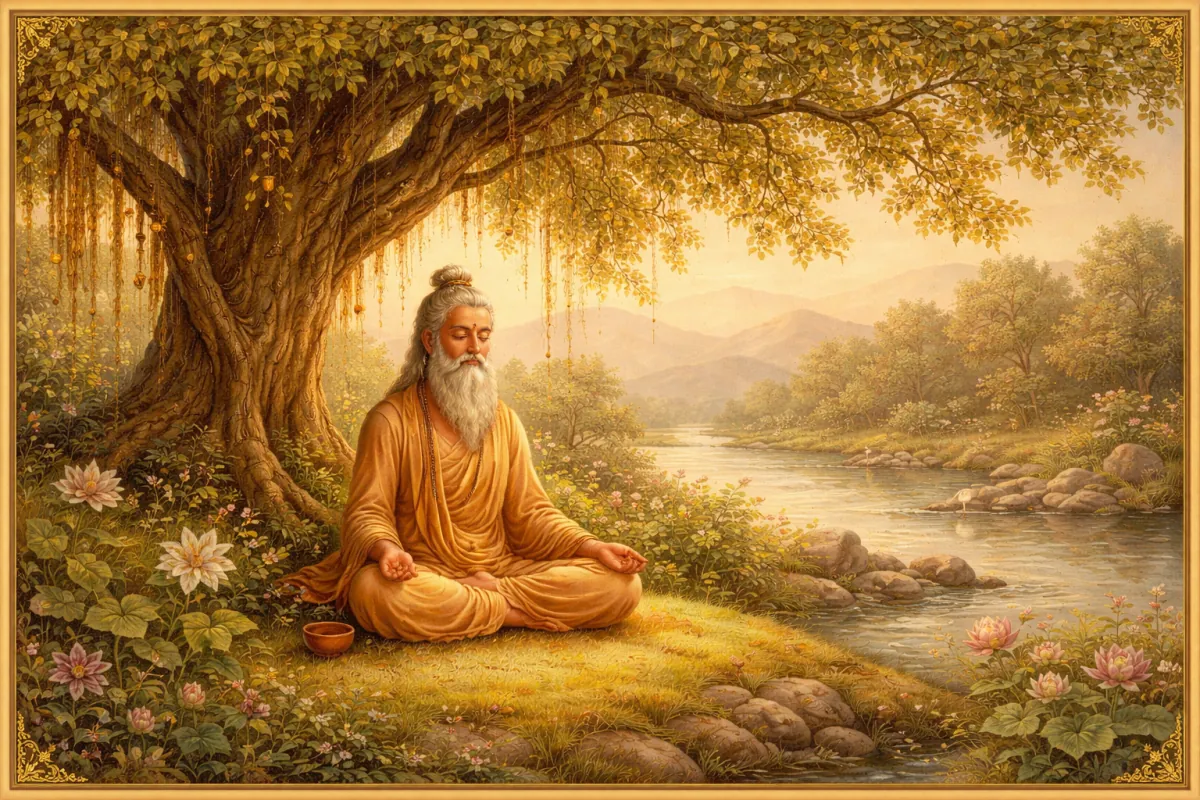
Chitta (citta) is the function of memory and the repository of subconscious impressions within the structure of the antahkarana in Advaita Vedanta. Chitta contains vasanas (latent tendencies) and samskaras (mental impressions), and serves as the basis for the formation of the jiva’s character, predispositions, and unconscious reactions to life situations.
Etymology
The Sanskrit term “chitta” (citta) derives from the root “chit” (cit), meaning “to perceive,” “to notice,” “to be conscious,” and “to understand.” The same root forms the fundamental term “Chit” (cit)—consciousness as one of the aspects of Sat-Chit-Ananda. The suffix “-ta” (-ta) forms past participles indicating a completed action or state.
Thus, chitta literally means “that which has been perceived,” “accumulated consciousness,” or “the repository of what has been perceived.” In a philosophical context, chitta represents the aspect of the antahkarana that preserves and integrates all past experiences, forming the basis for future cognitive processes.
Philosophical Significance
Chitta occupies a unique position within the structure of the antahkarana, functioning as memory and as the subconscious foundation of all mental processes. Adi Shankara and his tradition regard chitta as the aspect of the inner instrument that ensures the continuity of personality and experience across different states of consciousness and even across different lives.
The primary function of chitta is smarana (smaraṇa) or smriti (smṛti)—memory in its broadest sense. This includes not only the conscious recollection of past events, but also the unconscious preservation of all impressions, emotions, thoughts, and experiences.
Repository of vasanas—subtle impressions or “fragrances” of past experience that remain in the subconscious. Vasanas are like seeds that sprout as desires, inclinations, fears, or attachments.
Repository of samskaras (saṃskāra)—deep mental impressions that shape habitual patterns of response and character (svabhava).
Bearer of karmic impressions—according to Advaita Vedanta, it is chitta that passes from one incarnation to another, ensuring the continuity of individual evolution and innate tendencies.
Connection with avidya (ignorance)—chitta is where fundamental false beliefs about the nature of reality (mula-avidya), which sustain the illusion of separation from Brahman, are rooted.
Capacity for modification—through the process of chitta-shuddhi (purification of chitta), vasanas and samskaras can be transformed or weakened.
Formation of dreams—in the state of svapna, the contents of chitta become the material of dreams.
Manifestation in states of consciousness:
In jagrat (wakefulness), it actively interacts with the sense organs.
In svapna (the dream state), it creates experience based on accumulated material.
In sushupti (deep sleep), it dissolves into the causal state while preserving the individuality of the person.
Practical Application
Working with chitta is an integral part of spiritual practice, since its purification leads to stable realization:
Sadhana Chatushtaya: purification of chitta supports the development of Viveka (discrimination) and Vairagya (detachment).
Shat-sampatti: these are aimed at creating favorable samskaras: Shama (inner calm), Dama (self-control), Uparati (renunciation), Titiksha (forbearance), Shraddha (faith), and Samadhana (one-pointedness).
Practice of japa: repetition of sacred mantras creates powerful spiritual samskaras that displace worldly vasanas.
Atma-vichara: the technique of self-inquiry directs the attention of chitta toward its source, dissolving false identifications.
In the Texts
The concept of chitta is discussed in detail in the sacred scriptures:
Atharvaveda: mentions chitta as the source of mental activity (19.58.2) and as the power that remembers the past and foresees the future (11.8.32).
Chandogya Upanishad: establishes a connection between purity of food, purity of chitta, and steadiness of memory, which leads to liberation (7.26.2–3).
Brihadaranyaka Upanishad: describes chitta as a repository of impressions that determine a person's future destiny according to their actions (4.4.19).
Katha Upanishad: points to the necessity of knowing Purusha, who stands above the unmanifest foundation of chitta (2.3.7).
Mundaka Upanishad: speaks of purifying chitta from dualistic vasanas (good and evil) in order to attain supreme unity (3.1.9).
Bhagavad Gita:
Krishna describes chitta as restless and powerful (6.34), yet controllable through practice (abhyasa) and detachment (vairagya) (6.35).
A tranquil chitta leads to steadiness of intellect (buddhi) (2.65).
The state of chitta at the moment of death determines the next incarnation (8.6).
Adi Shankara:
In the Tattvabodha, he defines it as the faculty of memory.
In the Vivekachudamani, he compares chitta to an actor playing roles under the influence of vasanas (181) and calls for replacing impure vasanas (ashuddha) with pure ones (shuddha) (424–425).
Yoga Vasishtha: states that chitta consists of vasanas and that their disappearance is liberation (6.1.59).
Panchadashi: Vidyaranya explains the manifestations of chitta in different states of consciousness (4.25) and compares it to a lake in which the "winds of vasanas" make it difficult to see the Atman (7.101).
Madhusudana Saraswati: in the Gudhartha Dipika, compares chitta to wax that takes the form of any impression.
Appayya Dikshita: identifies three methods of purification: proper diet, righteous actions, and spiritual fellowship.
Ramana Maharshi: defined the mind and chitta as a bundle of thoughts and vasanas, suggesting that they be calmed through the question, "Who am I?"
See also:
Antahkarana — the inner instrument of cognition
Vasana — latent impressions
Samskara — mental imprints
Manas — the perceptive mind
Avidya — ignorance
Karma — the law of cause and effect
Chitta-shuddhi — purification of the mind
Categories:
Psychological concepts and the structure of the mind
The structure of the human being
Sadhana practices and methods
Liberation and its aspects
