

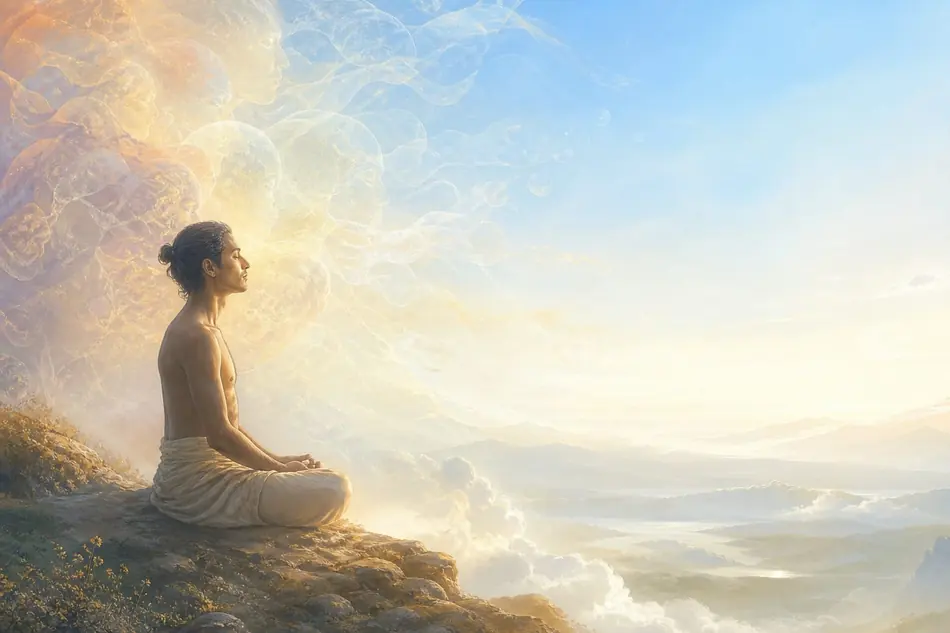
When a person first hears the word “meditation,” they usually imagine closed eyes and an attempt not to think about anything. In Advaita Vedanta—the nondual philosophy of Sanatana Dharma—the word has a different meaning. It is not about a relaxation technique, but about abiding in the awareness that a person essentially is, yet which is usually obscured by identification with the body and thoughts. A beginner should distinguish between these things from the outset: by mistaking someone else’s method for the essence of the practice, it is easy to become disappointed when the promised result does not materialize.
Dhyana: the Meaning of the Word and Its Place on the Path
The Sanskrit word dhyana (dhyāna) is translated as “contemplation” or “focused recollection.” In the tradition, the spiritual path is commonly explained through three components:
jnana (jñāna)—the view, a perspective on the nature of reality;
dhyana—meditation, that is, the inner state in which this view is sustained;
kriya (kriyā)—conduct, the application of what has been understood in everyday life.
One may hold the correct nondual view and have theoretical knowledge of Advaita, yet in practice live in complete duality—if that view is not sustained inwardly as a living experience. This is precisely the task fulfilled by dhyana: it transforms intellectual agreement with nonduality into a continuous flow of awareness.
Meditation in Advaita differs both from the familiar practice of concentrating on an object for the sake of calm and from visualizing light or images—although such techniques do exist in the tradition as aids. The focus here is not on what the mind is concentrating on, but on the one who is concentrating.
Atma-vichara: the Self-Inquiry “Who Am I?”
The central method through which Advaita presents its meditative practice is atma-vichara (ātma-vicāra), or self-inquiry. It is associated primarily with Sri Ramana Maharshi, whose teaching is extensively discussed within the tradition. The essence of the method is not thinking about oneself, but directing attention straight toward the one who thinks and acts.
Atma-vichara is often confused with ordinary reflection—a mental repetition of the question “Who am I?” and a sequence of answers such as “This is me” and “But what is this ‘I’?” Such an inner dialogue is acceptable only as a preliminary exercise. The practice itself consists of something else: sustained concentration on the very sense of “I,” without further reasoning. Attention does not investigate an object—it returns to its source.
Ramana Maharshi called this method a universal remedy for all disturbances of the mind:
The self-inquiry “Who am I?” is the only remedy for all the afflictions of the world. It is also perfect bliss.
A common misconception among beginners is to look for some hidden, luminous object inside the body. But the true “Self” is not an object that can be found and examined: it is the very luminous nature of the one who seeks. Vichara therefore shifts attention away from questioning in the third person and toward directly abiding in the position of the subject.
The Witness That Dissolves
The second key reference point in Advaitic meditation is the practice of witnessing, sakshi-bhavana (sākṣī-bhāvana). One learns to observe thoughts and inner states without identifying with them—remaining the one who sees rather than what is seen. At the initial stage, this gives rise to a natural duality: there is an observer and there is what the observer observes.
But the culmination of the practice is not becoming permanently established in the role of an eternal observer, but the dissolution of this very duality. When attention remains focused on the Atman—the supreme Consciousness—for a long time, it gradually becomes permeated by it. The distinction between “I observe” and “that which is observed” is erased: what remains is not “I observe the Atman,” but simply “I am the Atman.” In the tradition, such steady abidance is called atma-nishtha (ātma-niṣṭhā). It cannot be forced through effort—it is, rather, the natural outcome of prolonged contemplation, arising of its own accord.
Types of Meditation in the Tradition
There are different forms of meditation, and not all of them are identical to Advaitic dhyana proper. There is meditation with a support—a sacred sound, a mantra, a saying from the Upanishads (for example, the mahavakya “Aham Brahmasmi”), or an image of a deity; such a practice keeps the mind from becoming distracted by working with form. There is also meditation without a support—nirguna meditation (nirguṇa), which is formless and objectless, with neither an object of concentration nor visualization, but only pure presence. It is the second form that comes closest to the heart of the Advaitic approach, although the first often serves as a preparatory stage for those who still find it difficult to abide in a formless state.
For example, in Laya Yoga, contemplative practice is combined with work on inner energy, yet even there the ultimate aim is not mystical experience in itself, but the recognition of the nondual nature of consciousness underlying all experience.
Meditation in the Broader Context of Sanatana Dharma
In the Dharmic tradition as a whole, meditation is not regarded as an isolated technique but is integrated into the overall path of spiritual growth. The sacred texts describe this path as a sequence: service leads to understanding, understanding to deep and focused meditation, and meditation to renunciation in God:
Matter is perishable. Immortal and eternal is the Lord, who alone governs both the perishable and the soul. By meditating on Him, uniting with Him, and becoming more and more like Him, a person is finally freed from the illusion of the world.
“Yajurveda”
Meditation here is not a stress-relief technique. It is a link in a long process leading to Self-realization and liberation from repeated births. Advaita Vedanta takes the next step in the same line of reasoning, pointing out that the object of meditation and the meditator are ultimately indistinguishable.
Practical Significance for Beginners
It is important for a beginning practitioner to understand that Advaitic meditation does not promise a rapid mystical experience, and it would be dishonest to present it that way. Initial attempts at self-inquiry usually encounter resistance from the mind, which prefers to analyze its problems rather than seek their source. Steadiness does not come in a single sitting, but through regular practice, preferably under the guidance of a teacher who can correct one’s understanding on the spot.
In practical terms, one can start small: several times a day, ask oneself, “Who is experiencing this state?”—in order to turn attention back toward oneself for a moment. Over time, this is complemented by the ability to observe one’s own thoughts and emotions without identifying with them—that is, the practice of witnessing. In the Advaitic understanding, dhyana gradually ceases to be a separate exercise performed on a mat and becomes an underlying state that accompanies everyday activities.
Related Concepts
The subject of meditation in Advaita Vedanta is closely connected with other concepts of the tradition: Atma Vichara as a method of self-inquiry, Sakshi Bhava—the practice of witnessing, Jnana Yoga—the path of discriminative knowledge, as well as samadhi—states of concentrated consciousness that dhyana reveals as the practice deepens.
