

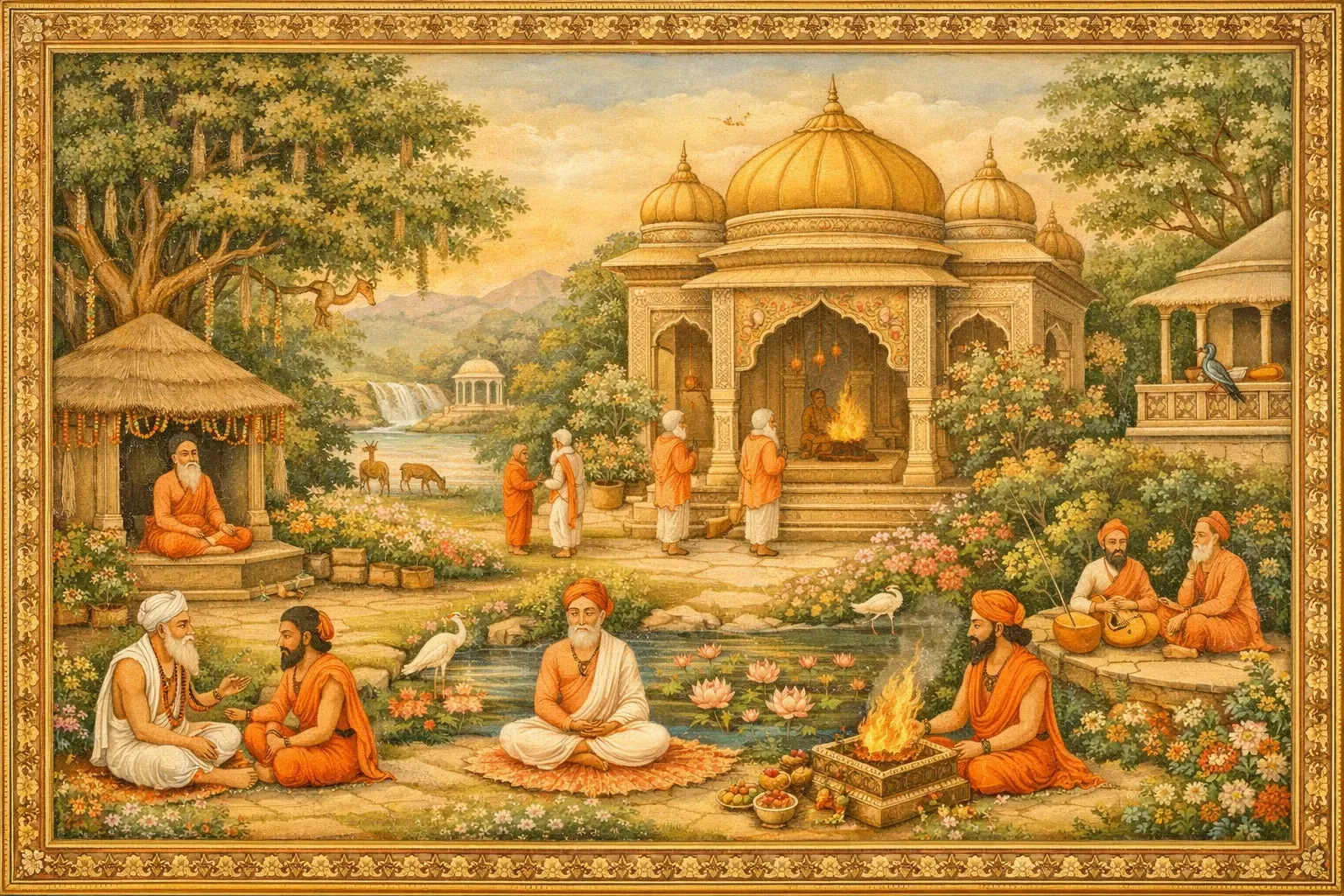
Ashrama (āśrama) is a Sanskrit term denoting a sacred place of spiritual endeavor, an abode for hermits and seekers of Truth.
In traditional Sanskrit dictionaries, an ashrama is defined as the "abode of sages" (ṛṣi-nivāsa), "place of austerity" (tapovana), or "house of the Guru" (guru-gṛha). It is a space hallowed by the presence of a realized Teacher and filled with the energy of continuous spiritual practice by generations of sadhus.
An ashram is not merely a building or a geographical point. It is a living spiritual organism, a sacred space where all dimensions of the religious life of Sanatana Dharma intersect. It is inhabited by those who have dedicated their lives to spiritual search: sannyasis (fully renounced monks), brahmacharis (celibate students), karma-sannyasis (servants of Dharma), and swamis (spiritual teachers). It is the Guru’s house (guru-gṛha)—a place sanctified by the presence of a realized mentor or their authorized representative.
Grihasthas (householders) come to the ashram for spiritual support, guidance, and blessing (darśana). Here, they gather for satsang (satsaṅga, "association with Truth")—meetings where sacred texts are studied, philosophical debates (śāstrārtha) are held, and a living transmission of teaching occurs from heart to heart. Vanaprasthas—householders who have retired from worldly concerns for the sake of spiritual practice—often settle near ashrams.
The ashram fulfills many interconnected functions. It is a center for the transmission of knowledge: here, students receive oral instructions (upadeśa), study scriptures, and undergo systematic training in yoga and meditation. It is a place of initiations: it is in the ashram that the sacred sacrament of diksha (dīkṣā) is performed—an initiation that grants access to the esoteric practices of the lineage (paramparā).
It is a liturgical center: the ashram contains an altar (pūjā-sthāna) with images and murti (icons) of the deities of the lineage, where daily rituals of worship are performed. Morning service (prātaḥ-pūjā, arati), evening bhajan chanting, and daily meditation are marked by the clear sound of the temple bell (ghaṇṭā), calling the community to spiritual work. Mysteries and theurgies (tantra-karma) are conducted here—rituals that invoke the blessings of the deities and saints of the tradition.
It is a space of tapas: the ashram provides conditions for intensive ascetic practice and retreats (niṣkāmya-sādhanā)—periods of secluded, concentrated sadhana. It is a center of service: every member of the community contributes to the service of Dharma through seva (sevā)—selfless action that purifies the ego and cultivates devotion.
In the ashram, there are material symbols and practices with profound spiritual meaning. Prasad (prasāda)—food sanctified on the altar and offered to the deities—is distributed to all present, purifying the mind and refining consciousness. Lineage relics and sacred images create a powerful energy field (kṣetra-śakti) that "charges" spiritual seekers, accelerating their inner transformation.
The ashram is a repository of secret teachings (guhya-vidyā) passed orally from teacher to worthy student. Here, the secrets of internal alchemy, methods of working with subtle energies, and practices for realizing non-duality are preserved. For the Western seeker, an ashram represents a gateway into a living tradition, a place where abstract philosophy becomes concrete experience, and where the support of the spiritual community (saṅgha) and the blessing of the lineage create optimal conditions for inner awakening.
How to visit the ashrams of the World Community of Sanatana Dharma
The World Community of Sanatana Dharma invites sincere seekers to visit the tradition's ashrams for training, participation in practices, performing seva, and attending satsangs and worship services.
Visiting Conditions
To visit the WCSD ashrams, it is necessary to beforehand:
- Familiarize yourself with the tradition and philosophy of the school—study the foundational materials presented on the portal and answer traditional questions on the teaching.
- Fill out the application form—send the completed form to the email of the respective ashram.
- Coordinate the conditions of stay—discuss arrival details through personal communication or correspondence.
WCSD Ashram Contacts
Shiva Prema Sagar Ashram (Italy): Telegram
Sadhu Tapovan (Russia): Telegram
Shivadatta-Satchitananda Ashram (Ukraine): Telegram
Creating a Home Ashram
For those who strive to create a sacred space for practice in their own home (gṛha-āśrama), the community offers consultative support.
Visiting an ashram is not a tourist activity, but a pilgrimage to a living source of spiritual power, a step on the path of inner transformation, an opportunity to touch the timeless tradition of the sages and find a foundation on the path to liberation.
