

On the eleventh day after the birth of a child, the father takes him in his arms, leans toward the right ear, and whispers a name—the very one that the astrologer chose according to the birth nakshatra. At this moment, the infant officially enters the tradition: he is linked with the name of God, with the parampara, and with the community. This is namakarana—one of the sixteen samskaras, sacred rites that accompany a person from conception to burial.
Samskara (Skt. saṃskāra), in the sense of a rite of passage, is the ritual sanctification of key biological and social milestones in human life. Each such milestone—birth, the first meal, the beginning of studies, marriage, death—receives a sacred dimension through mantras, fire, the presence of the community, and the invocation of the gods.
Etymology and Definition
The word saṃskāra is formed from the prefix sam—"together, completely, in a perfect way"—and the root kāra, derived from kṛ—"to do, to create." Literally: "perfect creation," "that which forms entirely." In the context of rites of passage, samskara means a ritual action that forms a person—purifying, sanctifying, and preparing them for the next stage of life.
In the tradition, the word samskara has several meanings. Here, we are referring exclusively to life-cycle rites—rather than the psychological concept of samskara as a karmic impression in the subconscious.
The classical tradition counts sixteen samskaras (shodasha-samskara, Skt. ṣoḍaśa-saṃskāra), although their list and order may vary across different regional and school traditions. Covering the entire journey from conception to death, the samskaras provide a sacred framework for every life transition.
Samskara in the Pancha-nitya-karma System
Samskara is one of the five mandatory dharmic practices, pancha-nitya-karma: dharma, upasana, utsava, tirthayatra, and samskara. This places rites of passage on par with daily worship and pilgrimage. A person living within the tradition undergoes samskaras not by choice, but because they are what form him as a member of the community and a spiritual being.
The Manu-dharma-shastra explicitly states:
"With the sacred rituals prescribed by the Vedas, the ceremony of conception and other rites must be performed for twice-born men—for the sanctification of the body and for purification in this life and after death."
Manu-dharma-shastra
Shastric Sources
The teaching on samskaras is laid out in several categories of texts. The Grihya-sutras—domestic ritual manuals belonging to the Kalpa-sutra corpus—provide the most detailed description of how each rite is performed. The Paraskara-grihya-sutra, Apastamba-grihya-sutra, and Ashvalayana-grihya-sutra are among the most authoritative. The Manu-dharma-shastra establishes samskaras as a legal and religious norm. The Vedas—especially the Rig- and Yajur-veda—contain mantras recited during the rites. Specific samskaras are also described in the Atharva-veda, where rites related to birth and marriage occupy a special place.
Structure of a Samskara
Despite differences in detail, each samskara is built on a single logic. The rite begins with sankalpa (saṅkalpa)—a solemn intention pronounced by the head of the household or a priest: the goal is announced, and the names of the participants and the time of performance are mentioned. This is followed by homa (homa)—a fire sacrifice through which the prayer reaches the gods. The key actions of the rite are accompanied by mantras from the Vedas. The samskara concludes with ashirvada (āśīrvāda)—the blessing of the elders and the priest.
The family and community gather for each samskara, providing support, offering advice, and sharing the moment of transition. A samskara is not a private matter. It belongs to the entire community.
Samskaras Before Birth
Life is sanctified even before birth. Three samskaras cover the period from conception to labor.
Garbhadhana (garbhādhāna, "placing the seed")—the rite of conception. The physical union of the spouses is sanctified by prayer, mantra, and conscious intention: to invite a high soul to be born. The tradition views conception not as a biological act, but as a spiritual event—the invocation of the incarnating jiva.
Pumsavana (puṃsavana, "quickening a male child") is performed at the first signs of life in the womb—usually in the third month of pregnancy. Special prayers are recited for the protection of the fetus and the health of the mother.
Simantonnayana (sīmantonnayana, "parting the hair")—a rite between the fourth and seventh months. The husband lovingly combs his wife's hair, gives jewelry, and speaks words of support. The task of the rite is to protect the mother and child during a vulnerable period.
The Rig-veda instructs:
"Let universal life protect and surround you. May Pushan protect you, and may he precede you on the path! May Savitri lead you to that place where those who do good deeds go and dwell!"
Rig-veda
Childhood Samskaras
Jatakarma (jātakarma, "birth rite") is performed immediately after the child is born, before the umbilical cord is cut. The father touches the newborn's tongue with honey and clarified butter (ghee), praying for long life, intelligence, and well-being. With this gesture, the father is the first to come into contact with the new life and accepts it under the protection of the tradition.
Namakarana (nāmakaraṇa, "naming ceremony")—one of the most significant rites. It is conducted at a temple or at home from the eleventh to the forty-first day of life. The name is chosen astrologically, considering the birth nakshatra: encoded within it is the spiritual purpose and patronage of a specific devata. The Manu-dharma-shastra requires that female names be "easy to pronounce, have a clear meaning, be melodious and auspicious, and end in long vowels."
Anna-prashana (annāprāśana, "first feeding of solid food")—a rite at five to six months when the child receives solid food for the first time. The father or family guru feeds him sweet rice. The rite marks the transition from the mother's milk to the food of the earth.
Chudakarana (cūḍākaraṇa, "tonsure"), also known as mundan, is performed in a temple between the thirty-first day and the fourth year. The childhood hair, brought from past lives, is removed—the child begins life in a new body with a "clean slate." The Paraskara-grihya-sutra specifies: "When the son is one year old, the rite of chudakarana should be performed, or it may be done before the end of the third year."
Karnavedha (karṇavedha, "ear piercing") is performed for both children—boys and girls—in the first, third, or fifth year of life. According to tradition, gold earrings are linked to health protection and the flow of vital energy through specific points of the body.
Samskara of Youth: Upanayana
Upanayana (upanayana, "bringing near [to the Guru]," "second birth")—the most important of the samskaras, marking a boy's entry into the stage of a student (brahmacharya). Through this rite, he receives the sacred thread (yajnopavita) and the status of "twice-born": the first birth is biological, the second is spiritual.
The Manu-dharma-shastra directly contrasts the two types of birth:
"The father and mother give him birth as a result of mutual desire—let that be known as his physical birth. But that birth which is given according to the law, through Savitri, by a teacher who has mastered the Vedas, is the true birth, ageless and immortal."
Manu-dharma-shastra
The sacred thread of three strands symbolizes the debt to the gods, the ancestors, and the teachers. It is worn over the left shoulder. From this moment, the boy bears responsibility for the daily performance of sandhya-vandana—prayer three times a day at sunrise, noon, and sunset.
Samskara of Adult Life: Vivāha
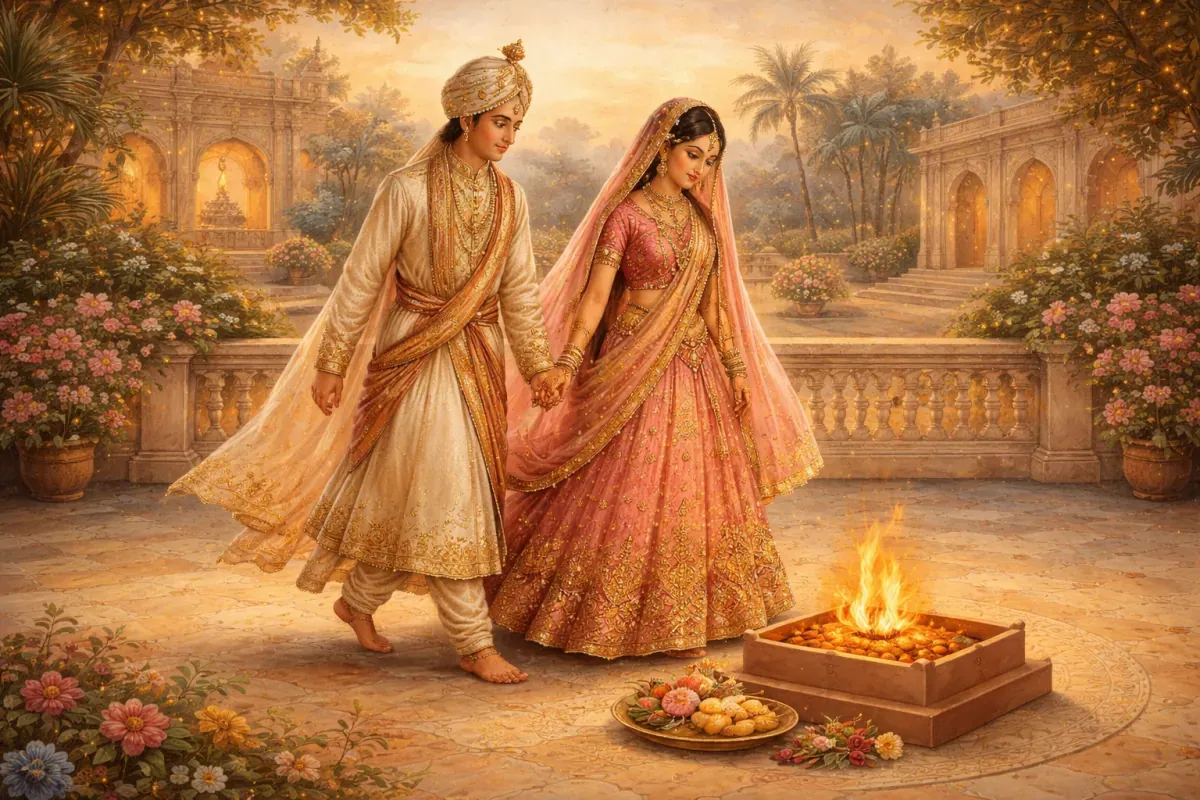
Vivāha (vivāha, "marriage")—a samskara that encompasses three dimensions at once: it is a religious rite, a personal contract, and a social institution. As a rite, it is the conclusion of a spiritual union before God and the gods. As a contract, it involves the mutual obligations of husband and wife. As an institution, it is the foundation of the family and community.
The central ritual of vivāha is sapta-padi (sapta-padī, "seven steps"): the spouses take seven steps together before the sacred fire of the homa, pronouncing a specific prayer with each step. The Rig-veda and Shankhayana-grihya-sutra have preserved the words of this vow:
"I take your hand in mine for the sake of happiness, so that you may reach old age with me, your husband. This woman, scattering grains, prays thus: 'May I bring bliss to my relatives. May my husband live a long life.'"
Rig-veda and Shankhayana-grihya-sutra
In the tradition, marriage is jiva-yajna (jīva-yajña), the sacrifice of the small "self" for the good of the family and society.
Antyeshti: The Last Rite
Antyeshti (antyeṣṭi, "the last sacrifice")—the rite of cremation and burial that closes the earthly cycle of life. This is a domestic rite performed by the family with the participation of a priest.
Antyeshti includes several stages: preparation of the body, cremation, collection of ashes and bones, their immersion in sacred waters, purification of the home, and memorial ceremonies—shraddha (śrāddha)—one week, one month, and one year after death. Through the fire of cremation, the soul is released and, as the tradition teaches, reaches the feet of Shiva.
In the understanding of the Shaivite tradition, death is not an end but a transition. This is why the dying person strives to depart at home, surrounded by loved ones, focusing on a mantra. The Agamas say that a conscious death is the ideal for which a practitioner prepares throughout their life.
In the Tradition of Sanatana Dharma
Life in the tradition of Sanatana Dharma is a sacred journey where every major milestone is sanctified. Samskaras form the human soul: they create stable impressions of holiness, responsibility, and connection with the parampara in the subconscious.
Samskaras are planned according to the astrological calendar (muhurta) and performed with the participation of a qualified priest or guru, in the presence of family and community. Where it is not possible to conduct a full rite in the Agamic form, the tradition allows for simplified home versions—but without abandoning the principle of sanctifying the transition itself.
The sixteen samskaras are distributed throughout a person's life so that no significant transition is left without sanctification. Conception, the first name, the first lesson, marriage, death—each milestone receives its own fire, its own mantra, and its own witnesses. This is what distinguishes life in the tradition from a biological cycle: meaning is inscribed into every step, rather than being sought later.
The Yajur-veda describes the very logic of this movement:
"Upon completing the life of a student, let a man become a householder. Upon completing the life of a householder, let him become a forest-dweller, let him renounce everything."
Yajur-veda
