

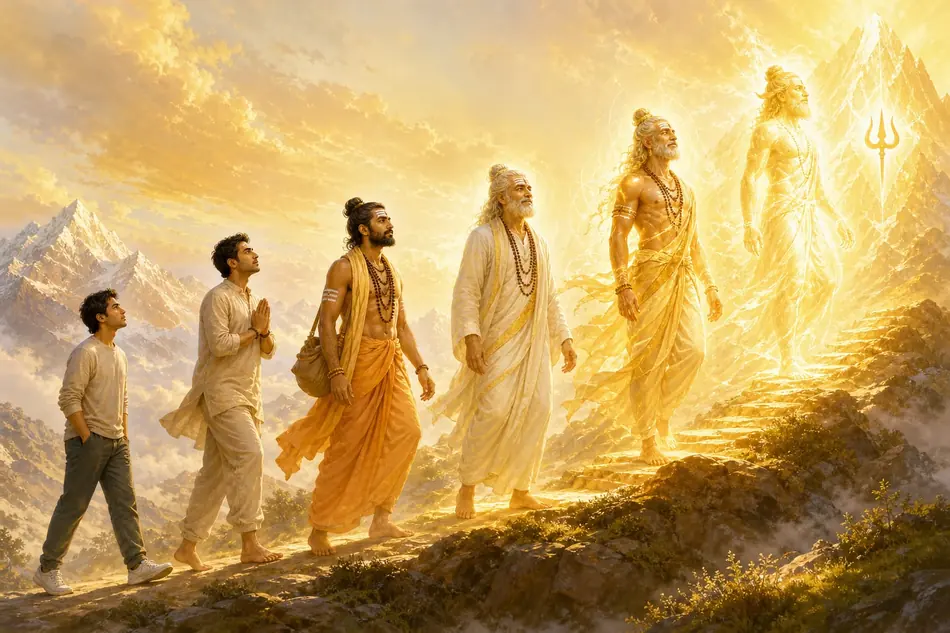
The first course provides the foundation. After that, a long program begins—twelve years of study and practice for those who have decided to go deeper into the tradition.
What Is Studied
The student studies Shaivism: the nature of God Shiva, the structure of the soul, the law of karma, and the path to liberation. They read “Dancing with Siva” by Subramuniyaswami, the “Shiva Purana,” the “Shiva Gita,” and the writings of Swami Sivananda. Later, they move on to Anuttara Tantra and the teachings of Laya Yoga. They study nondual contemplation, the nature of the mind, and the structure of the subtle body. They examine twenty-four topics for analytical meditation: impermanence, karma, and common mistakes in practice. At the end of each course, they take an oral exam and write a treatise of several dozen pages on an assigned topic.
What Practices Are Performed
The student begins with prolonged concentration—on each chakra individually, sometimes for several hours. They repeat a mantra: the count may reach one hundred thousand repetitions. They learn to hold their breath for several minutes. They sit motionless for two or three hours. They walk with a meditative gait and a specific intention (the practice of chankramanam with sankalpa). They master dream yoga: learning to recognize that they are dreaming and to control the dream. They master the yoga of the illusory body: learning to see ordinary life in the same way as a dream.
Texts and Written Work
The student copies a sacred text by hand—several dozen or several hundred pages. They read a prescribed list of books for each course and report on this to their supervisor. Once per course, they write a treatise on an assigned topic drawn from the material covered.
Retreats
Several times a year, the student goes on retreat—from a few days to three months. During the retreat, they perform one practice continuously: contemplation, mantra recitation, breathing, or work with a specific chakra. Some retreats are devoted specifically to studying the teachings, while others focus on meditation.
What Changes Over Twelve Years
Dreams become controllable. Contemplation no longer requires effort: it arises on its own. The mind no longer doubts its own nature—it is now an experience, not a theory. The distinction between pleasant and unpleasant experiences fades. Difficulties become easier to endure. Inner habits and desires weaken. The practitioner can teach others and pass on what they have learned. They develop a desire to serve the tradition and pass the teachings on.
Contact
Apply for training: @vidya_mandala
