

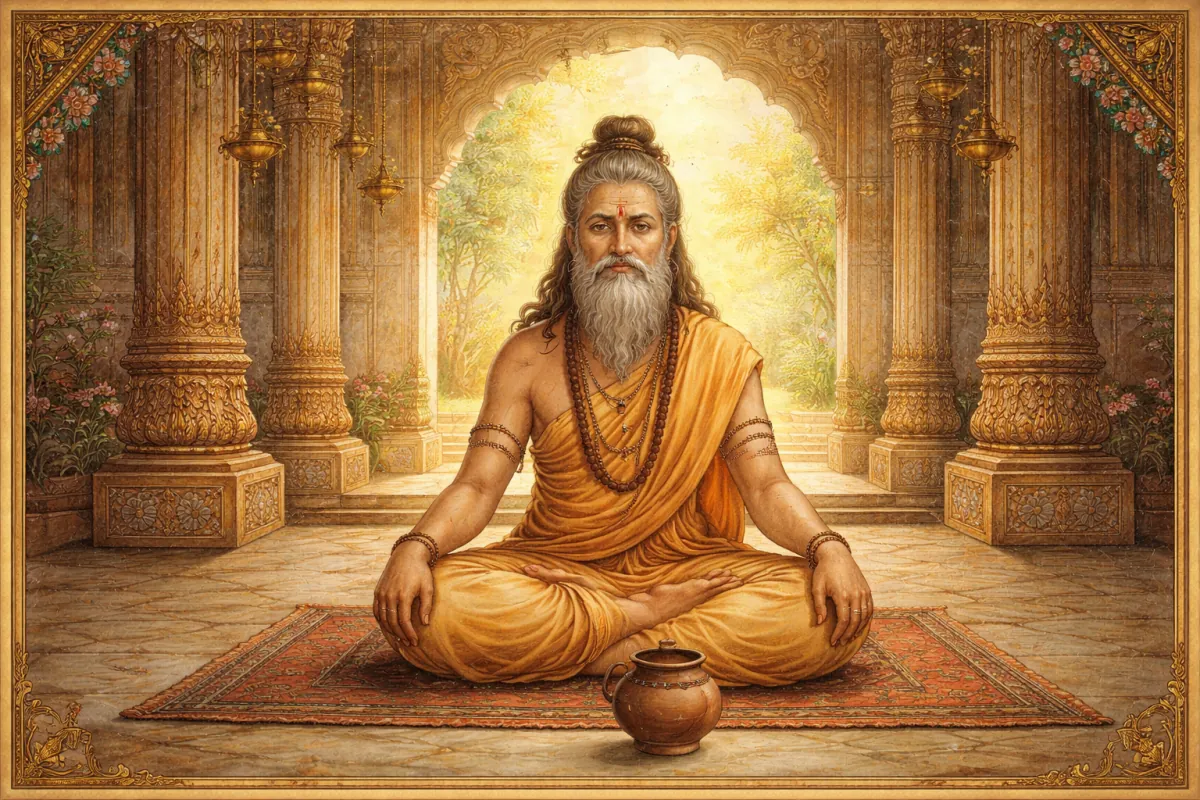
Idam (Sanskrit: इदम्, idam) — “This,” the pole of objectivity in nondual experience, associated with Aham. In the Trika system, it is precisely the polarity of “I — This” that explains the unfolding of the universe and the very act of cognition as the relationship between the knower, the knowable, and the means of knowledge.
Etymology
The term derives from the Sanskrit demonstrative pronoun idam, meaning “this; given, present.” In philosophical usage, a distinction is made between idantā — “this-ness, objectivity” and ahantā — “I-ness, subjectivity.” This pair forms the basis of every experienced field of awareness: “that which is given as this” and “the one who knows as I.”
Philosophical Significance
Idam and consciousness:
Any “This” is not an external thing in itself, but a form of the manifestation of consciousness. In the language of the tradition, one speaks of the light of awareness, Prakāśa (prakāśa), and its self-recognition, Vimarśa (vimarśa). Idam is interpreted as a form of the manifestation of consciousness in which what is perceived appears as an object while nondual unity is preserved. Objects arise as “this thing” or “that object” because they originally abide within consciousness as its own forms.
Śakti acts as the polarizing force which, as Kṣemarāja explains in the Pratyabhijñā-hṛdayam, “polarizes Consciousness into Aham and Idam — subject and object,” while remaining inseparable from Śiva. The classic formula “I see this pot” demonstrates the inseparability of knowledge from the subject; objectivity has no independent existence outside the luminosity of consciousness.
Idam in the system of tattvas
Idam as the pole of objectivity appears only beginning with the third tattva. The first two tattvas represent states of pure subjectivity:
Śiva-tattva — the absolutely pure “I” (aham), without any objective content whatsoever. Consciousness abides in a state of objectless self-luminosity, which Kṣemarāja calls “Anāśrita-Śiva” — Śiva who depends on nothing external.
Śakti-tattva — the dynamic aspect of consciousness as “I am” (aham asmi), the inner pulsation of self-awareness without polarization into subject and object.
Polarization into Aham and idam begins only with Sadāśiva-tattva, where the intention to create first arises and the experience of “this-ness” appears. Thereafter, idam manifests with increasing clarity:
In Sadāśiva-tattva, the subjective aspect predominates: the experience is formulated as “I am this” (aham idam asmi), where “this-ness” remains indistinct.
In Īśvara-tattva, idam becomes distinct: the experience is transformed into “This am I” (idam aham asmi), with the objective aspect coming to the fore.
In Śuddha-vidyā-tattva, equilibrium is attained between aham and idam, like “the two pans of a precisely balanced scale.” This is the level of difference-in-unity (bhedābheda-vimarśana).
Idam and Spanda
In the teaching on vibration, the reciprocal transition “I → This” and “This → I” is understood as Unmeṣa/Nimeṣa (unmeṣa / nimeṣa) — the dual aspect of the pulsation of consciousness. The dissolution of the world as idam is the elevation of I-consciousness, and conversely, the manifestation of idam is the phase in which the predominance of aham diminishes within the single spanda.
Idam and the reality of phenomena
In the tradition of Kashmir Shaivism, manifestations are regarded as ābhāsa (ābhāsa) — real flashes of creation within the consciousness of Paramaśiva (paramaśiva). The world is neither separated from consciousness nor does it destroy its unity: “all this” is the play of the light of a single subject.
Idam and Pratyabhijñā
Pratyabhijñā teaches the recognition of the identity of the subject with all visible forms. That which is called “this” is originally “contained” within the I and can therefore be manifested. As Kṣemarāja explains:
“The universe unfolds upon consciousness’s own screen; multiplicity arises from the correlation of grāhaka/grāhya (the knower and the knowable).”
This is the basis of idam as “objective experience,” inseparable from the subject and generated by its creative freedom. Recognition removes fixation on the object without denying its value.
Practical Application
Observing the moment of perception — noting the flash of “thisness” and observing how it arises in the light of the subject.
Dharana on the formula “I—This.” Sequentially contemplate the three phases of experience: “I am this” (Sadashiva), “This am I” (Ishvara), and equilibrium: “I am I, This is This” (Shuddha Vidya).
The interval between thoughts (unmesha/nimesha). Catch the interval between the departure of one thought and the arrival of another as a flash of self-awareness (unmesha), in which idam has not yet been fixed by a word or image.
Nimilana-samadhi (nimīlana-samādhi). Introversive meditation in which external objectivity is withdrawn into its source; contemplation as a “drawing inward of the gaze.”
In the Texts
Pratyabhijna-hridaya: polarization into Aham and Idam as a means of unfolding multiplicity on the “screen” of consciousness.
Ishvara-pratyabhijna-karika: “all this” is manifested by the power of will because it originally abides in the Self.
Spanda-karika, Spanda-vritti, Spanda-nirnaya: pulsation as the mutual transition between “I” and “This.”
Tantra-sara and the traditional exposition of the three pure tattvas: the “I—This” schema at the levels of Sadashiva, Ishvara, and Shuddha Vidya.
Vijnana-bhairava-tantra: methods of recognition that dissolve fixation on objectivity and reveal its source.
See also:
Abhasa
Ahanta
Idanta
Kula
Maya
Kriya-shakti
Categories:
Philosophical Concepts and Terms
Ontological Categories
Psychology and Epistemology
Trika
Spanda
