

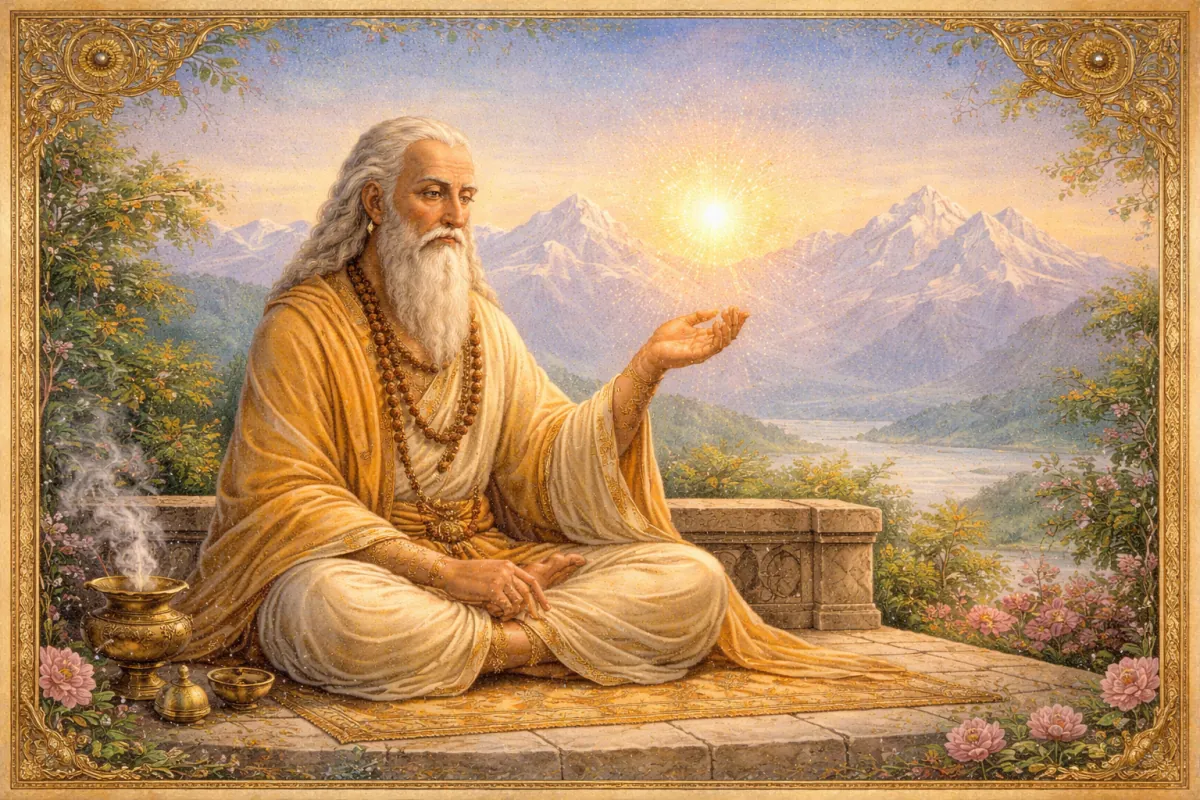
Ishvara-tattva is the fourth of the five pure tattvas (shuddha-tattvas) in the system of 36 Tattvas of Kashmir Shaivism, denoting the level of Divine Consciousness at which the objective aspect of manifestation becomes clearly defined and is experienced in the formula “This is I,” with the energy of pure knowledge (Jnana-shakti) predominating.
Etymology
The term Ishvara (Sanskrit: ईश्वर, Īśvara) derives from the root īś, meaning “to own,” “to rule,” “to be capable,” or “to possess power.” In classical Sanskrit usage, īśvara means “ruler,” “lord,” or “master.” Combined with tattva (“suchness,” “ontological principle,” “reality as it is”), it forms the compound term īśvara-tattva—“the principle of divine sovereignty” or “the principle of consciousness’s mastery over manifestation.”
In the context of Kashmir Shaivism, this term does not refer to an external or transcendent Creator distinct from the world, but denotes a particular aspect of Paramashiva’s self-awareness in which he clearly knows the object of his manifestation as non-different from Himself.
Philosophical Significance
Place in the System of Pure Tattvas
Ishvara-tattva occupies the fourth place in the hierarchy of pure creation (shuddhadhva). These five tattvas constitute the realm of Divine Consciousness that is undifferentiated yet already oriented toward manifestation:
Shiva-tattva
Shakti-tattva
Sadashiva-tattva
Ishvara-tattva
Shuddha-vidya
While Shiva-tattva contains only the non-dual light of consciousness (Prakasha), without any distinction whatsoever, and in Shakti-tattva this light pulsates as creative energy, in Sadashiva-tattva the relation between subject and object first arises in the formula “I am this.” In Ishvara-tattva, a qualitative shift in emphasis occurs: the objective aspect becomes clearly discernible, and the experience takes the form “This is I.”
The Experiential Formula “This Is I”
The classical formula of Ishvara-tattva is idaṃ aham (“this is I”). Unlike Sadashiva’s formula ahaṃ idaṃ (“I am this”), here the object (idam) becomes the focus of divine attention, while the subject (aham) remains implicit but does not disappear.
This means that the universe is already fully formed as a clear thought-image in Shiva’s consciousness. It has not yet manifested outwardly, but exists as complete knowledge of “what is to be.” The object does not stand opposed to the subject but is experienced as its own content. Consciousness knows: “This is what I am in the form of the world.”
Predominance of Jnana-shakti
Ishvara-tattva is characterized by the predominance of jnana-shakti—the power of knowledge.
In Sadashiva-tattva, iccha-shakti (will) predominates
In Ishvara-tattva, jnana-shakti (knowledge) predominates
In Shuddha-vidya, kriya-shakti (action) begins to manifest
Ishvara-tattva represents pure knowledge without the impulse to act. This knowledge is neither discursive nor conceptual. It is direct, total knowledge of the form of the universe as one’s own nature. This is precisely why Ishvara is described in the tradition as “inactive”: there is not yet any movement toward the act of creation, only the perfect clarity of the design.
Unmesha and Spanda
In the terminology of the Spanda school, Ishvara-tattva corresponds to the phase of unmesha—the disclosure and unfolding of the objective aspect of reality. While Sadashiva-tattva is associated with nimesha—the predominance of the subject and concealment of objectivity—Ishvara-tattva is its mirror counterpart, in which objectivity is clearly manifested but not separated.
This stage expresses the inner rhythm of divine pulsation, in which the universe arises as a clear vision within the very Heart of Consciousness.
Ishvara and Pratyabhijna
In Pratyabhijna philosophy, Ishvara-tattva is of fundamental importance because it is precisely here that a rigorous non-dual justification of distinction without separation becomes possible. Ishvara-tattva demonstrates that the distinction between subject and object does not contradict their identity but is a form of consciousness’s self-revelation.
This proposition serves as a key argument against dualistic interpretations of God and the world and makes it possible to affirm the reality of the phenomenal cosmos as a form of Shiva’s self-awareness.
Mantreshvaras
Beings corresponding to the plane of Ishvara-tattva are called Mantreshvaras—“lords of mantras.” They are free from all malas, abide in the realm of pure creation, and possess omniscience at their level. Their experience of the world fully corresponds to the formula “This is I.”
Practical Significance
In the sadhana of Kashmir Shaivism, Ishvara-tattva has special significance for the various levels of practice:
In anavopaya: Ishvara-tattva serves as an ontological reference point.
In shaktopaya: the practitioner learns to recognize all objects of experience as forms of consciousness’s knowledge, becoming established in the experience “this is I.” Here, the discriminative power of the mind is used, but without lapsing into dualism.
In shambhavopaya: Ishvara-tattva is apprehended spontaneously, as the natural clarity of perception in which objectivity is present without effort and without losing the nondual vision.
In anupaya: it dissolves completely in the direct recognition of one’s nature as Paramashiva.
In the Texts
The teaching on Ishvara-tattva is systematically expounded in the following works:
Utpaladeva’s “Ishvara-pratyabhijna-karika” and Abhinavagupta’s commentaries.
Kshemaraja’s “Pratyabhijna-hridaya,” where Ishvara-tattva is described as the level at which knowledge predominates.
Abhinavagupta’s “Tantraloka” and “Tantra-sara,” within the framework of tattva cosmology.
“Spanda-karika” and “Spanda-nirnaya” in the Spanda tradition.
See also:
Shiva-tattva
Shakti-tattva
Sadashiva-tattva
Shuddha-vidya
Pratyabhijna
Spanda
Aham and Idam
Categories:
Kashmir Shaivism
Trika
Pratyabhijna
Shuddha-tattvas
