

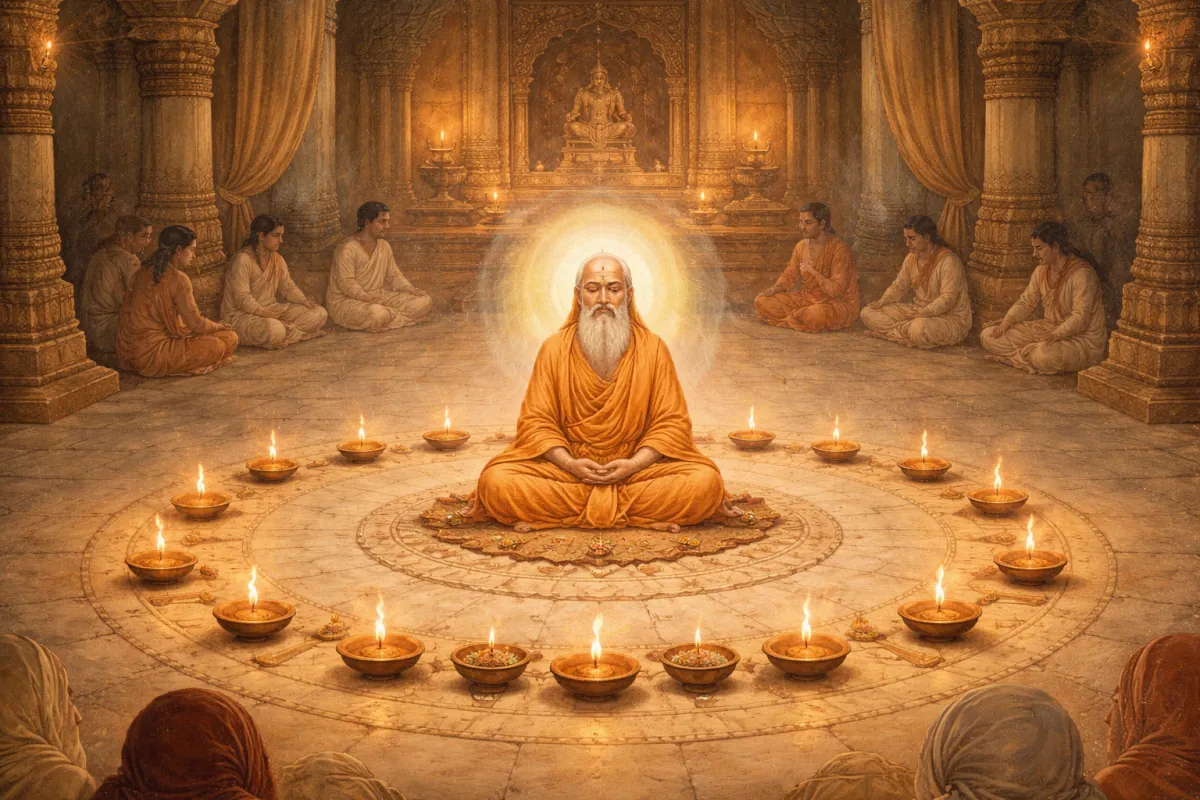
Kula (kula) in the Trika doctrine denotes the wholeness of the manifested multiplicity, a “family” of principles (tattvas) and energies apprehended as a single living whole. The transcendent pole of this wholeness is called akula (ākula), which is identical with Paramaśiva. The traditional path of practice based on these principles is called Kaula.
In short: kula is manifested integral reality; akula is its supremely transcendent source (Paramaśiva); Kaula is the corresponding path and school.
Terminology and Etymology
Etymology. The word “kula” derives from the idea of “gathering/containing” (the root √kul) and in classical dictionaries means “family, clan, group, aggregate; assembly.” It is not merely a list of parts, but that which holds them together, just as an ecosystem sustains many species in a single living balance.
Distinctions:
Kula is the philosophical concept of “wholeness/aggregate/family.”
Akula is “beyond the family,” the transcendent pole, Paramaśiva.
Kaula is the school and path of Kaula-mārga.
Doctrinal Perspective (Trika)
The “kula/akula” pair. In Abhinavagupta’s interpretation, kula is associated with the dynamics of Śakti (manifestation), while akula is associated with Śiva as the transcendent ground. Their inseparability is described through the pairs prakāśa and vimarśa, anuttara and svātantrya-śakti.
Wholeness as a criterion. Kula is conceived as the living integration of all levels of reality (the 36 tattvas) in the light of consciousness. It is more like an “orchestra” than a sum of instruments: what matters is coherence, not merely the presence of parts.
Nonduality. The unity of kula and akula does not erase the distinctions between levels, but reveals them as modes of the one conscious reality of Paramaśiva.
Practical Dimension (Kaula)
Cakra as a “circle” of practice. In Kaula, the term “cakra” primarily denotes a ritual circle or assembly of divine energies and adepts, rather than “the body’s energy centers” by default. The bodily “chakra” theme belongs to other contexts and is treated separately.
Kaulya-yajña. The central practices (described by Abhinavagupta in the Tantrāloka, Chapter 29) include worship of the paired principle Kuleśvara/Kuleśvarī, the goddesses of the circle, and work with the maṇḍala and ritual as a means of recognizing the nondual nature of consciousness.
Contemplative logic. The relationship among the participant, the deity, and the circle is conceived as mutual reflection (pratibimba): each is a mirror of the wholeness of kula.
Texts and Sources
Abhinavagupta, Tantrāloka. A systematic exegesis of Kaula, especially Chapter 29 (Kaulya-yajña). Related teachings are developed in the Parātriśikā-vivaraṇa, where the relationship between kula and akula is formulated.
Kulārṇava-tantra. One of the authoritative śāstras of the Kaula tradition, establishing its ritual and doctrinal corpus.
Commentarial tradition. Jayaratha’s commentaries on the Tantrāloka; the works of Kṣemarāja in the context of Trika, which clarify the terminology and its connections with the broader philosophy.
Historical and Doctrinal Context
Position within Kashmir Shaivism. Kaula is one of the pillars of Kashmir Śaiva Tantra, integrated by Abhinavagupta into the overarching Trika system.
The Kaula pantheon. Traditional accounts describe the pair Kuleśvara/Kuleśvarī, surrounded by the eight Mothers and corresponding circles of deities. This establishes the symbolic “family grammar” of kula as manifested wholeness.
See also:
Kashmir Shaivism
Trika
Śakti
Pratyabhijñā
Spanda
Paramaśiva
Prakāśa
Kuṇḍalinī
Ākula (separate article)
Categories:
Philosophical Schools and Movements
Philosophical Concepts and Terms
Practical Philosophy
Texts and Teachings
