

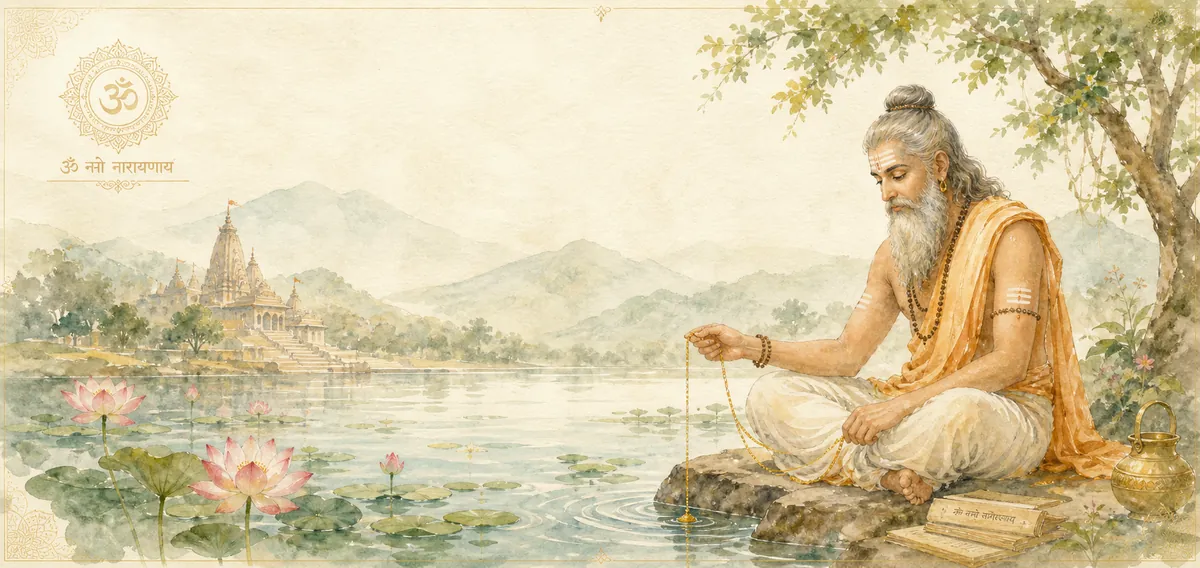
Māyā-tattva (Sanskrit: माया तत्त्व, māyā-tattva) is the threshold tattva through which boundless Consciousness voluntarily assumes “measurability” and allows the experience of difference, so that the one nondual Reality begins to be perceived as a multiplicity of subjects and objects.
In Kashmir Shaivism, māyā is not an “error” or an external enemy of the Absolute—it is Paramaśiva’s own power of self-limitation, which makes possible experience, the path of recognition, and the ultimate revelation of freedom.
Etymology
The word “māyā” derives from the Sanskrit root √mā—“to measure,” “to measure out,” “to proportion,” “to establish a measure.” Hence its principal semantic nuance: māyā is the introduction of measurability and division where, by nature, there is neither measure nor boundary.
For Tantric language, this linguistic key is especially important: māyā means not “unreality,” but “giving form”—the capacity of the one Consciousness to configure specific forms of experience while preserving its immutable fullness.
Philosophical Significance
Place in the System of 36 Tattvas
In the system of 36 tattvas, māyā-tattva comes immediately after Śuddhavidyā-tattva and opens the domain of the “mixed” (transitional) tattvas. Before it are the pure levels, where unity has not yet been lost even amid differentiation; after it begins the distinct formation of limited experience, from which the tattvas of the individual subject and the world gradually unfold.
Māyā marks a qualitative turning point. Whereas in Īśvara-tattva and Śuddhavidyā-tattva the distinction between “Aham” and “Idam” remains transparent and encompassed within unity, in māyā there arises an enduring experience of “I am separate” and “this is separate,” as though the object were truly external and independent.
Māyā as the Power of Differentiation
The essence of māyā-tattva is expressed by a simple principle: it makes difference convincing. Within this differentiation, three main directions can be distinguished (traditionally referred to as the “threefold difference”):
the difference between subject and object;
the difference between one subject and another subject;
the difference between one object and another object.
This differentiation does not negate the nature of Prakāśa, the luminosity of Consciousness; it changes the perspective of experience: Consciousness begins to “look” at its own manifestations as though they existed separately from it.
The Nondual Key of Trika
The Trika school consistently upholds the central point: māyā cannot literally “obscure” Paramaśiva. The Absolute remains the Absolute; only the mode of manifestation and experience changes.
Therefore, it is more accurate to speak of māyā as a free gesture of self-limitation: the Absolute allows the “contraction” of fullness into limited experience—without losing the fullness of existence. This explains why, in Kashmir Shaivism, the world is not declared false; it is real as a manifestation of Śakti and real as a field of recognition.
The Five Kañcukas and the Birth of the Limited Subject
The classical explanation states that māyā “unfolds” into five limiting coverings—the kañcukas—which form the framework of individual experience. These coverings are described as five ways of “measuring” the immeasurable:
Kalā-tattva—the limitation of the power of action (the experience “I can do only a little”);
Vidyā-tattva—the limitation of knowledge (the experience “I know only a little”);
Rāga-tattva—the limitation of fullness (the experience “I lack something”);
Kāla-tattva—the limitation of eternity by time (the experience “I am in time”);
Niyati-tattva—the limitation of omnipresence by order, place, and regularity (the experience “I am bound by conditions”).
Following these coverings, [[Puruṣa-tattva|puruṣa-tattva]]—the principle of the limited subject—manifests, followed by the subsequent levels of the unfolding of the world and the psychophysical structure (down to the gross elements).
Māyā and the Three Malas
Although māyā is a tattva, its operation is revealed with particular clarity in the doctrine of the three malas—the three fundamental modes of constraining experience:
āṇava-mala—the root feeling “I am small,” “I am incomplete”;
maya-mala—the habit of seeing multiplicity as the ultimate reality;
karma-mala—attachment to action, its fruits, and its consequences.
Explaining the mechanism of limitation, Kshemaraja formulates a general principle: “His will and other powers, though unlimited in their essence, undergo limitation” (see “Pratyabhijna-hridayam,” sutra 8).
Thus, maya-tattva becomes the “central nexus” in both ontology and practice: it is here that “measurability” turns into habit, and habit into a stable samsaric perspective.
Different Emphases of the Four Schools
Pratyabhijna places the main emphasis on “recognition”: maya is forgetfulness that can be eliminated by recognizing that both subject and object are manifestations of the one Self-Consciousness.
Spanda emphasizes that under maya, the pulsation of Consciousness ceases to recognize itself and is experienced as a stream of “external” events; the path is to restore recognition of the living vibration of awareness in every perception and action.
Trika regards maya as a natural phase of freedom: it opens up a field of experience in which both concealment and subsequent revelation are possible.
Kula emphasizes a practical “reversal.” The very thing that binds one who fails to recognize becomes a basis for liberation when every form is experienced as a manifestation of Shakti.
Practical Application
Maya-tattva directly concerns sadhana: it manifests not only as a “cosmological stage,” but also as the everyday habit of perceiving the world and oneself as separate. Therefore, practical work begins with the subtle recognition of maya “in the moment”—in the very act of perception.
Basic Diagnosis of Maya in Experience
The simplest guideline is to notice where experience becomes “rigid” and definitive.
“I am incomplete; I lack something”—anava-mala is activated.
“This is definitely alien and separate, and it defines me”—maya-mala is activated.
“I am the doer; I must obtain the result at any cost”—karma-mala is activated.
The task here is not to struggle, but to discern through recognition: to see limitation as a mode of experience rather than as an essence.
In the Texts
Kshemaraja’s “Pratyabhijna-hridayam” — explains how the free will of the Absolute accepts limitation and how this clarifies the malas and the subsequent structure of experience.
“Spanda-karika” and its commentaries (for example, “Spanda-vritti”)—indicate that the three malas obscure recognition of the living spanda and describe the practical turn toward recognizing it.
Abhinavagupta’s “Tantra-sara”—briefly links maya to the sequence in which the 36 tattvas manifest and to the role of self-limitation in the cosmic play.
“Ishvara-pratyabhijna-karika”—reveals the ontological status of limitation and the principle of recognition as liberation.
See also
36 Tattvas
Shuddha-vidya-tattva
Ishvara-tattva
Purusha-tattva
Aham
Idam
Spanda
Categories
36 Tattvas
Kashmir Shaivism
Trika
Pratyabhijna
Spanda
Kula
