

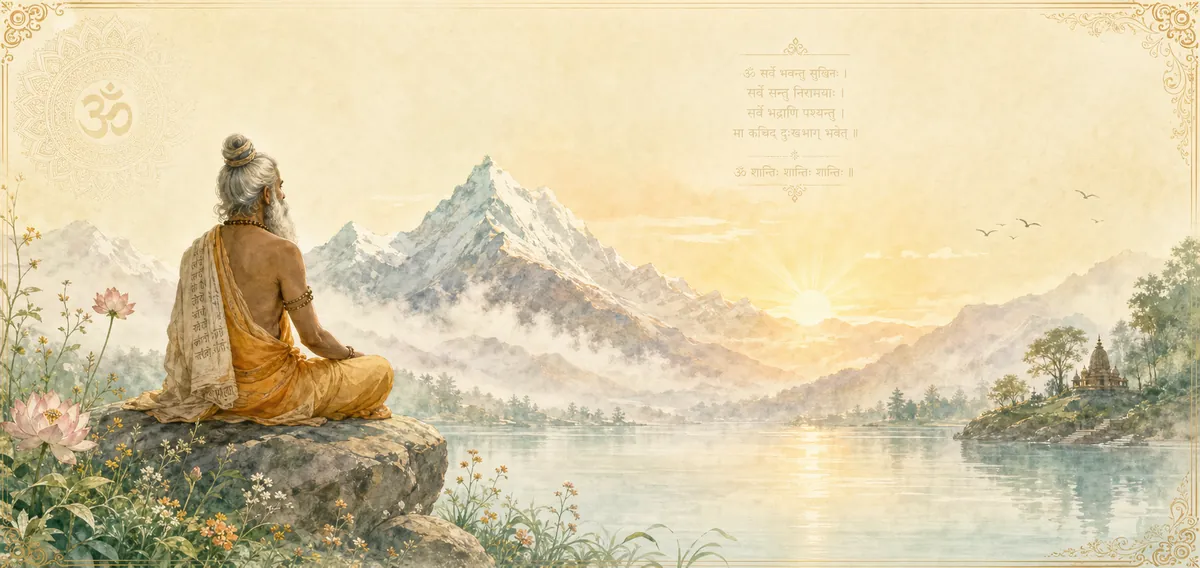
Paramaśiva (Paramaśiva) is the supreme, absolute reality and ultimate metaphysical ground in the philosophy of Kashmir Shaivism, the transcendent and simultaneously immanent aspect of divine consciousness, which is both undifferentiated unity (akhanda) and the source of all manifestations and forms of the universe.
Etymology
The term "Paramaśiva" consists of two Sanskrit words: "parama" — "supreme," "ultimate," "transcendent," and "śiva" — "auspicious," "gracious." Thus, its literal meaning can be translated as "Supreme Shiva" or "Ultimate Auspicious Reality." Linguistically, the root "śiv" goes back to the Vedic tradition and is associated with the principle of blessing and the highest good.
Philosophical Significance
The concept of Paramaśiva is the cornerstone of Trika metaphysics and Kashmir Shaivism as a whole, representing the highest philosophical category and the ultimate ontological ground of reality. Unlike Shiva as a deity of the Hindu pantheon, Paramaśiva in Kashmir Shaivism represents the absolute principle that transcends all attributes and definitions, being both nirguna (without qualities) and saguna (possessing qualities).
In his monumental work, the “Tantrāloka,” Abhinavagupta describes Paramaśiva as the ultimate reality that is simultaneously transcendent (viśvottīrṇa) and immanent (viśvamaya) in the phenomenal world. This dual nature is reflected in the two fundamental aspects of Paramaśiva: Prakāśa—the self-luminous light of consciousness—and Vimarśa—the self-reflective power of self-awareness. Thus, Paramaśiva is the unity of rest and activity, being and becoming, the transcendent and the immanent.
In the Pratyabhijñā system developed by Utpaladeva and his disciple Abhinavagupta, Paramaśiva is presented as the absolute "I" (aham), which, through the act of self-recognition (pratyabhijñā), reveals itself as the sole reality of all manifested phenomena. In the Spanda Shastra, meanwhile, Paramaśiva is described as the primordial vibration or pulsation (spanda), which, without ever departing from its essential nature, manifests as the diversity of the universe.
Of particular importance is the understanding of Paramaśiva through the lens of the concept of Svātantrya—absolute freedom. According to Kashmir Shaivism, Paramaśiva possesses complete freedom to manifest and conceal his nature. This freedom is realized through five fundamental energies or acts (pañcakṛtya): creation (sṛṣṭi), preservation (sthiti), dissolution (saṃhāra), concealment (tirodhāna), and revelation or grace (anugraha).
At the cosmological level, Paramaśiva represents the first and highest of the 36 tattvas (ontological principles) in the Trika system, being the source and substance of all subsequent tattvas and the entire manifested cosmos. It is important to note that although Paramaśiva is designated as the first tattva in the cosmological account, in the absolute sense he transcends the entire system of tattvas, being rather their prerequisite and foundation.
In his work "Pratyabhijñāhṛdayam," Kṣemarāja formulates this in the aphorism: "Citta eva citaḥ padāt saṃkocinī"—"Individual consciousness is nothing other than a contraction of universal consciousness (Paramaśiva)." Thus, any limited consciousness is regarded merely as a contracted form of Paramaśiva's all-encompassing consciousness.
The historical development of the concept of Paramaśiva can be traced from early Tantric texts to the systematic philosophical treatises of Kashmir Shaivism. In the Shiva Sutras, Vasugupta succinctly refers to the supreme reality as "caitanyam ātmā" (consciousness is the Self), an idea that was later developed into more complex metaphysical constructions by Somānanda and Utpaladeva and reached its culmination in Abhinavagupta's synthetic works, especially his Tantrāloka.
In comparison with other Indian philosophical systems, the concept of Paramaśiva in Kashmir Shaivism has close parallels with the concept of Brahman in [[Advaita Vedanta|Advaita Vedanta]], but with a significant difference: whereas Brahman in Advaita is understood primarily as static, immutable consciousness (prakāśa), Paramaśiva in Kashmir Shaivism is endowed with the dynamic aspect of self-awareness (vimarśa), making him simultaneously the subject, the object, and the process of cognition.
Practical Application
Understanding Paramashiva is of fundamental importance to the spiritual practice of Kashmir Shaivism. Unlike many other spiritual traditions, where the Absolute is regarded as something distant and attainable only after prolonged practice, Kashmir Shaivism maintains that Paramashiva is already our true nature, which need only be realized through the process of [[Pratyabhijna|recognition]] (pratyabhijna).
In practical terms, this is achieved through three main methods, or upayas:
Shambhavopaya (Śāmbhavopāya) — the highest method, associated with the direct realization of unity with Paramashiva through pure intention or will (iccha). This method does not require reliance on external objects of meditation or breathing exercises, but involves direct immersion in absolute consciousness. The “Vijnana Bhairava Tantra” describes numerous techniques for such direct recognition.
Shaktopaya (Śāktopāya) — the middle path, in which the practitioner uses various forms of knowledge and contemplation (jnana) to attain a state of unity with Paramashiva. These include meditations on paradoxical states, transitions between phases of consciousness, and similar practices.
Anavopaya (Āṇavopāya) — the lower method, involving work with the breath, visualization, mantras, yogic postures (asanas), and concentration on various parts of the body, especially the energy centers, or chakras.
There is also a fourth, non-method — Anupaya (Anupāya), or “absence of method,” which represents the spontaneous realization of one’s true nature as Paramashiva without any formal practices or effort.
In the Texts
The concept of Paramashiva is elaborated in detail in many key texts of Kashmir Shaivism:
Shiva Sutras: Although the term “Paramashiva” is not used explicitly, the first sutra, “Chaitanyam Atma” (Consciousness is the Self), points to the supreme reality.
Spanda Karika: The text describes Paramashiva as vibration or pulsation (spanda) which, without ever losing its wholeness, manifests as the universe.
Ishvara Pratyabhijna Karika by Utpaladeva: This text develops the philosophical foundation of Paramashiva as the absolute subject who manifests the entire universe through the act of self-recognition.
Pratyabhijna Hridayam by Kshemaraja: The text begins by describing Paramashiva as universal consciousness, which manifests itself in a multiplicity of forms through its free will (svatantrya).
Tantraloka by Abhinavagupta: This monumental work contains the most systematic and profound exposition of the nature of Paramashiva, its aspects, and its cosmological unfolding.
Vijnana Bhairava Tantra: The text describes 112 meditation techniques, many of which are aimed at the direct realization of unity with Paramashiva.
Paramarthasara|Paramarthasara: In this text, attributed to Abhinavagupta, Paramashiva is described as the sole reality manifesting through the play of its energies.
Netra Tantra: An early Tantric text that also discusses the nature of the supreme reality.
See Also
Prakasha (Prakāśa)
Vimarsha (Vimarśa)
Svatantrya (Svātantrya)
Anuttara (Anuttara)
Tattvas (Tattvas)
Shiva-Shakti (Śiva-Śakti)
Purnatva (Pūrṇatva)
Categories
Fundamental Metaphysical Concepts
Philosophical Concepts and Terms
Metaphysical Principles
Theology
