

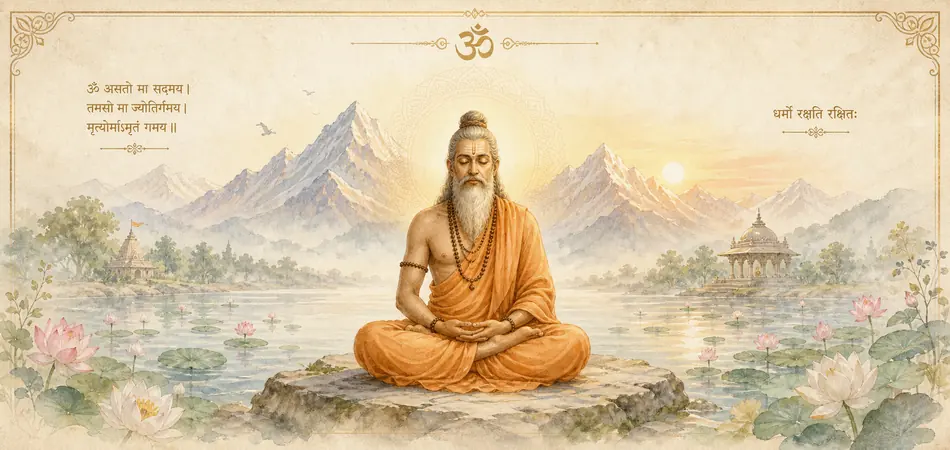
Prakāśa (Sanskrit: प्रकाश, prakāśa) is a fundamental metaphysical category of Kashmir Shaivism denoting the primordial Light of consciousness, the self-luminous aspect of the supreme Reality (Paramaśiva), which serves as the foundation of all manifestation and is inseparable from vimarśa (self-reflection).
Etymology
The term prakāśa derives from the Sanskrit root √kāś (काश्), meaning “to shine,” “to radiate,” or “to manifest,” with the prefix pra- (प्र), which intensifies the meaning and adds the connotation of “forth” or “intensely.” Its literal meanings are “radiance,” “luminosity,” “manifestation,” and “revelation.” In a philosophical context, the term refers to the self-luminous nature of primordial consciousness, which requires no external source for its manifestation.
Philosophical Significance
In the metaphysical system of Kashmir Shaivism, prakāśa represents one of the two fundamental aspects of the supreme Reality (Paramaśiva), inextricably linked with vimarśa. While prakāśa is the aspect of self-luminous Light, vimarśa is the aspect of that Light’s self-awareness. This duality within nonduality is crucial to understanding Trika ontology.
According to the Pratyabhijñā doctrine developed by Utpaladeva and Abhinavagupta, prakāśa represents the masculine, static principle, while vimarśa symbolizes the feminine, dynamic aspect. Their inseparable unity is described as [[Śiva-Śakti]]—two aspects of the one Absolute.
In the context of Kashmir Shaivite cosmogony, Prakāśa is the primordial principle from which, through the dynamic aspect of vimarśa, the entire universe unfolds with its 36 tattvas (categories of reality). In the Tantrāloka, Abhinavagupta describes in detail how all levels of being manifest from the primordial Light of consciousness (Prakāśa) through self-awareness (Vimarśa).
An important aspect of understanding Prakāśa is its all-pervading nature. Even in the state of māyā (cosmic illusion), when apparent multiplicity manifests, Prakāśa remains the unchanging foundation. In the Pratyabhijñā-hṛdayam (Sūtra 10), Kṣemarāja states that recognition of this all-pervading Light is the key to spiritual liberation.
In the Spanda tradition, developed by Vasugupta and his disciple Kallaṭa, Prakāśa is related to the principle of vibration (Spanda) as its unchanging substratum. The Spanda-kārikā emphasizes that pulsation (Spanda) occurs within the space of primordial Light (prakāśa) without altering its essential nature.
Philosophers of the Kula school associate Prakāśa with the concept of Saṃvit (supreme consciousness), regarding it as the basis for the manifestation of Śakti’s energies in the form of the Śakti-cakra (circle of energies). In the Krama tradition, prakāśa is understood as the foundation of the sequential unfolding (krama) of cosmic cycles, ensuring the continuity of experience.
In practical terms, one method of realizing one’s primordial nature is the practice of Haṃsa-dhyāna—meditation on spontaneous breathing, in which inhalation is associated with prakāśa (Śiva) and exhalation with vimarśa (Śakti). Through this practice, the yogin realizes the inseparable unity of these principles in direct experience.
In Texts
The concept of prakāśa appears in many foundational texts of Kashmir Shaivism:
The Śiva Sūtras (I.1) proclaim: “चैतन्यमात्मा” (caitanyamātmā)—“Consciousness is the Self,” which commentators interpret as indicating the self-luminous nature of consciousness (prakāśa).
The Spanda-kārikā (I.1) begins with homage to Śaṅkara, “whose nature is prakāśa,” and who is the foundation of vibration (spanda).
In the Īśvara-pratyabhijñā-kārikā, Utpaladeva systematically establishes the self-luminous nature of consciousness as prakāśa, inseparable from vimarśa.
Abhinavagupta’s Tantrāloka contains extensive discussions of prakāśa, especially in its first three chapters, which elucidate its role in cosmogony and epistemology.
Kṣemarāja’s Pratyabhijñā-hṛdayam provides a concise yet profound description of the nature of prakāśa and the paths to its realization.
The Vijñāna-bhairava-tantra contains numerous meditative techniques aimed at the direct experience of prakāśa.
Abhinavagupta’s Paramārthasāra describes prakāśa as the primordial reality that manifests through various levels of being while retaining its essential nature.
See also
Vimarśa
Paramaśiva
Saṃvit
Spanda
Śiva-Śakti
Svātantrya
Anuttara
Categories
Metaphysical Principles
Fundamental Metaphysical Concepts
Philosophical Concepts and Terms
Ontological Categories
