

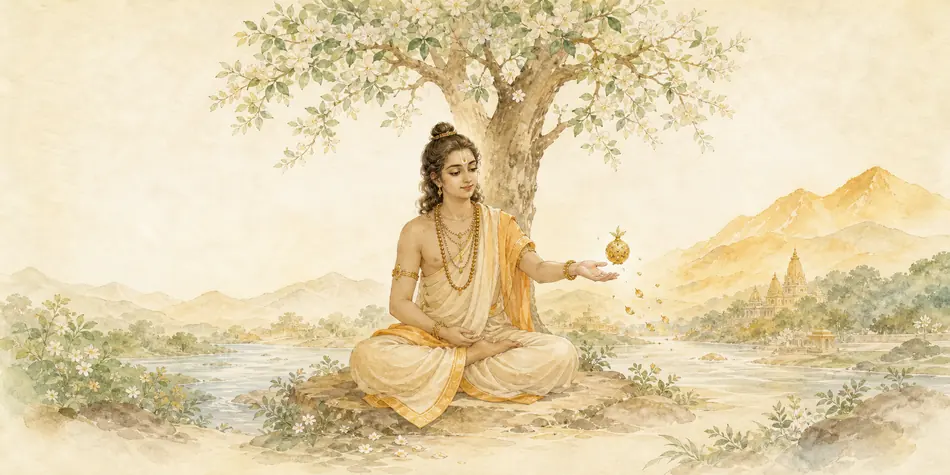
Rāga-tattva (Sanskrit: रागतत्त्व, rāga-tattva) is the ninth tattva in the system of 36 tattvas of Kashmir Shaivism and one of the five kañcukas—the limiting “veils” of Maya through which the boundless fullness of being is experienced as lack and dependence on an object that is supposed to “complete” it.
In lived experience, rāga-tattva manifests as a persistent inner feeling that “I am lacking something,” transforming consciousness’s free self-sufficiency into selective attraction, preference, and attachment, through which Aham—“I”—seeks completion in Idam—“this.”
Etymology
The term “rāga” derives from the Sanskrit root √रञ्ज् (rañj)—“to color,” “to attract,” “to engage,” “to bind,” “to arouse partiality.” In the ontological language of Kashmir Shaivism, this “coloring” is understood as a shift from clear, equanimous self-awareness toward a particular object: consciousness ceases to be equally whole in everything and begins to experience the world through “choice.”
The word “tattva” (Sanskrit: तत्त्व) means “principle of reality,” “suchness.” Therefore, rāga-tattva is not merely a psychological emotion but a cosmic principle that makes possible the very type of experience in which fullness is replaced by the search for fullness.
Philosophical Significance
Rāga-tattva belongs to the group of “śuddha-aśuddha” (mixed) tattvas that form the transition between the pure sphere (from Shiva-tattva to Śuddha-vidyā) and the realm of multiplicity. It is one of the five pañca-kañcukas: Kalā-tattva (limitation of agency), Vidyā-tattva (limitation of knowledge), rāga-tattva (limitation of fullness), Niyati] (limitation by conditioning and order), and Kāla-tattva (limitation by time).
While Maya-tattva creates the very principle of multiplicity, the kañcukas specify exactly how multiplicity “internally” becomes the personal world of a limited subject. Thus, rāga-tattva is one of the fundamental mechanisms through which Puruṣa comes into being as the experiencing “small self.”
Rāga as the Contraction of Fullness
The central meaning of rāga-tattva is the contraction of fullness (pūrṇatva) into a sense of incompleteness. In the pure tattvas, consciousness does not need “anything added,” because fullness is not the result of acquisition: it is the very mode of being of Paramaśiva. Rāga-tattva introduces a different perspective: fullness appears to be something outside one’s current state and something that must be attained through an object, event, recognition, experience, or status.
Hence the twofold formulation that can serve as a key to understanding this entire kañcuka:
fullness as the primordial self-sufficiency of consciousness;
lack as the mistaken perspective of that same consciousness looking at itself “from the object’s point of view.”
Connection with Icchā-śakti and Freedom
At the level of causal meaning, rāga-tattva is revealed as a limitation of the power of will and interest—that aspect of divine energy which the tradition calls Icchā-śakti. In its unlimited form, this power is the free self-sufficiency and independence (svātantrya) of consciousness, in which “desire” is identical with creative freedom.
Under the influence of the kañcuka, the same energy is experienced as a particular, selective interest. The power of attraction does not disappear; what disappears is the sense of wholeness: the impulse of volition becomes a “need,” and freedom becomes a “search.”
The Mechanism by Which Attachment Arises
Rāga-tattva creates an asymmetry in the field of experience: some objects seem especially significant, others neutral, and still others objectionable. In this way, a hierarchy of values and preferences is formed, along with the habit of perceiving reality through the axis of “I want things to be this way.”
It is important to distinguish between:
rāga-tattva as the ontological condition for the possibility of attachment;
and individual emotions/habits of attachment, which unfold later at the levels of mind and psyche.
In other words, rāga-tattva is the “framework” within which the logic of “I need” becomes possible at all; only afterward do specific narratives, forms of passion, and personal scenarios arise.
Interrelation with the Other Kañcukas
Rāga-tattva does not operate in isolation; it is “woven” together with the other kañcukas into a single matrix of limitation.
Connection with kalā-tattva: desire channels limited agency toward actions that seem to “fill the lack,” so activity easily becomes dependent on the outcome.
Connection with vidyā-tattva: knowledge becomes selective—the subject readily knows what serves their interest and fails to see what exposes the illusory nature of the lack.
Connection with kāla-tattva: desire almost always “lives in the future” (when I get it, when I achieve it, when things change), thereby reinforcing the power of time.
Connection with niyati: attachment becomes localized—“this is needed here and in this particular way”—creating a sense that one’s own desires are inevitable and predetermined.
The Narrowing of the Field of Consciousness and the “Tunnel” of Attention
One of the subtle effects of rāga-tattva is the narrowing of attention: instead of equanimous presence in everything, experience is organized around selected goals. A perceptual “tunnel” arises in which everything is evaluated in terms of desire and rejection. This is not an external force but a self-imposed limitation: consciousness voluntarily keeps its focus on what seems likely to bring fullness.
Rāga and the Emergence of Karmic Conditioning
Rāga-tattva is especially evident as the “driving force” of karma: an action imbued with strong attachment leaves a deeper imprint than an action arising from clarity and freedom. Rāga is therefore closely connected with karma-mala: it is precisely the “charge” of desire that makes experience repetitive and binding.
At the same time, in the nondual vision it is important to remember that even this bondage is a form of the play of manifestation. Limitation is real at the level of the paśu’s experience, but it does not affect the nature of Paramaśiva as absolute consciousness.
Different Interpretations in the Four Schools
In Trika, rāga-tattva is understood primarily as a precise ontological mechanism that conceals fullness: freedom of manifestation becomes the experience of “need,” and self-sufficiency becomes the experience of “seeking.” Desire is described not morally but metaphysically: as a form of consciousness’s self-diminishment through which the emergence of the individual subject becomes possible.
Pratyabhijñā
In Pratyabhijñā, the emphasis falls on recognition: desire exists as a phenomenon in the light of consciousness and has no independent power. Rāga-tattva ceases to be a “fact of lack” when the source of desire’s luminosity—[[Prakasha|Prakāśa]] itself—is recognized. The “lack” is then exposed as a perspective rather than an essence.
In the language of Spanda, rāga-tattva can be seen as a persistent displacement of the pulsation toward the external pole: the energy of consciousness seeks release in an object. In this approach, what matters is turning attention from the object to the impulse itself: it then becomes evident that the “power of desire” is the very same power of consciousness experienced in a mode of limitation.
In the Kula tradition, rāga has a dual status. On the one hand, it is a knot of captivity to pleasure. On the other hand, it is precisely the intensity of attraction that reveals where the center is lost. Rāga can therefore be transformed: when attraction is held within nondual recognition, it ceases to be an escape from fullness and becomes direct testimony to the power of Śakti in experience.
Practical Application
Recognizing Rāga-Tattva in Experience
Rāga-tattva is recognized not only in tempestuous passion but also in the “quiet background” of inner dissatisfaction. Its typical forms include:
promising oneself fullness “afterward” (after completing a task, after circumstances change, after attaining a state);
compulsively comparing oneself with others and measuring one’s own worth;
the need for constant validation, novelty, and stimulation;
the feeling that the present moment is “insufficient in itself.”
The philosophical value of such recognition is that desire ceases to be “my essence” and becomes visible as the operation of a kañcuka—a principle of limitation.
Upāyas as a Framework for Understanding Practice
Here the upāyas are presented as a map of possible levels of practice, without reference to specific prescriptions or techniques.
Śāmbhavopāya: rāga weakens when there is direct recognition of the self-sufficient “I”; the “lack” is then revealed as a mistaken perspective.
Shaktopaya: raga is recognized as a wave of thought and interest; attention shifts from the object to the impulse of attraction itself as a manifestation of the energy of consciousness.
Anavopaya: raga manifests as the bodily tension of “attainment” and “control”; therefore, the ability to return attention to the center and balance the impulse is important.
Anupaya: in the ultimate sense, raga dissolves not through effort, but through the simple fact of consciousness, when nothing needs to be added to what already is.
Intense States as a “Magnifying Glass”
When desire arises with particular force, it concentrates energy and makes the very mechanism of raga visible: either attention shifts toward the object, or it becomes possible to recognize attraction directly as the energy of consciousness. In this sense, strong raga can act as a “magnifying glass” for understanding how the sense of lack arises.
In the Texts
“The perfection of Shiva is diminished to raga-tattva” — Abhinavagupta, Paramarthasara.
“The five veils of Maya’s limitation (kanchukas): … Interest (raga) …” — Fundamentals of Kashmir Shaivism]].
“Purusha is purusha because of the kanchukas…” — Abhinavagupta, Paramarthasara.
Additional context for understanding the place of raga-tattva in the descent of the principles:
Spanda Shastra (the dynamics of the pulsation’s shift toward the object);
Ishvara Pratyabhijna Karika (the logic of “recognition” and the nature of the subject);
See Also
Maya-tattva
Kalaa-tattva
Vidya-tattva
Niyati
Kala-tattva
Purusha
Karma-mala
Categories
36 Tattvas
Kashmir Shaivism
Trika
Pratyabhijna
Spanda
Kula
Maya-tattva
