

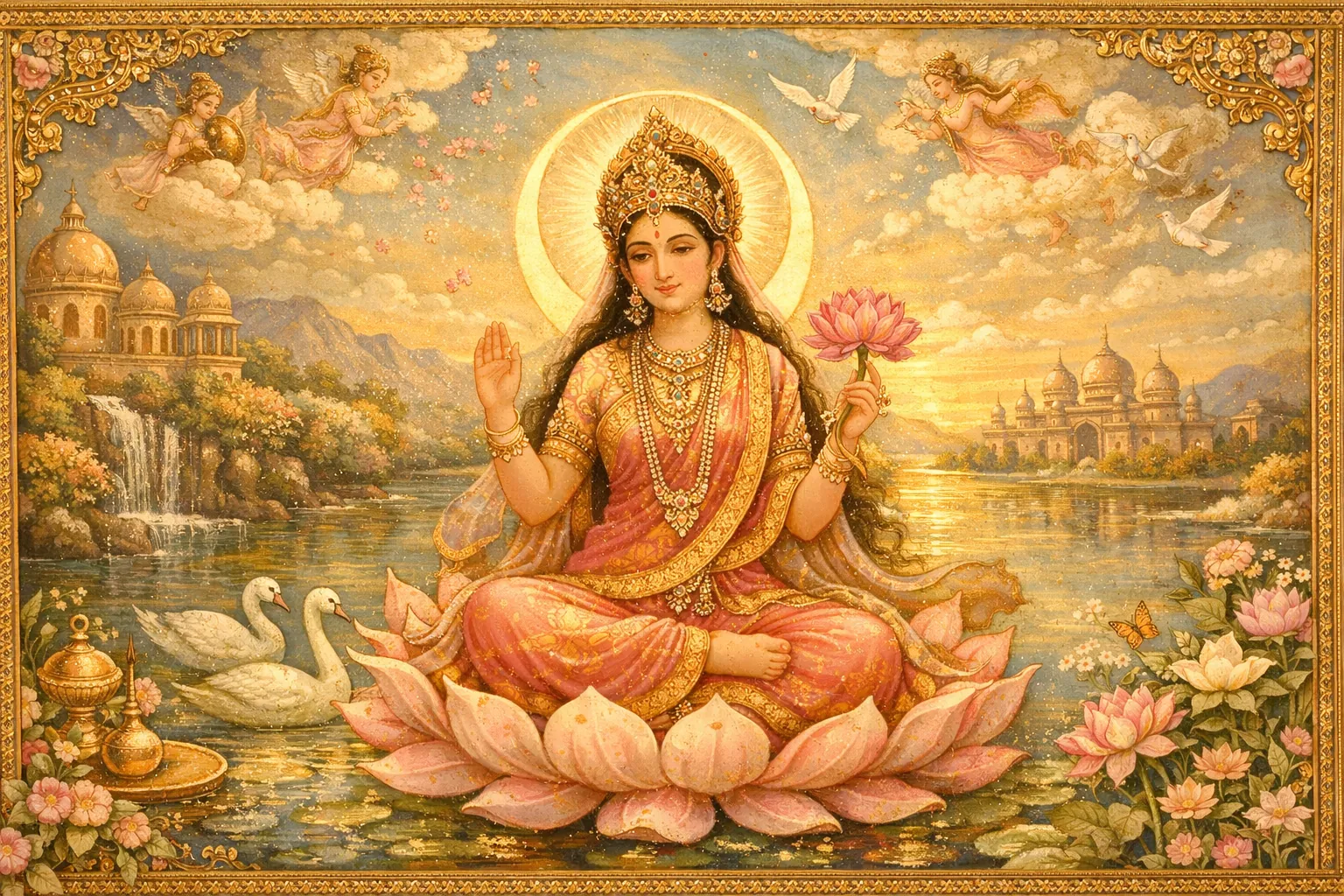
Shakti (śakti) in Kashmir Shaivism is not merely divine energy or power, but the fundamental principle of nondual reality—the dynamic dimension of Shiva's static consciousness. Unlike dualistic traditions, in which Shakti is understood as an entity separate from Shiva, Kashmir Shaivism affirms their absolute unity (śivaśaktyaikātmya), wherein Shakti is the inherent creative power of Paramashiva himself.
This nondual concept of Shakti permeates the entire philosophical system of Kashmir Shaivism, from the metaphysical principles of Trika and the dynamic philosophy of Spanda to the practical methods of Kula and the epistemology of Pratyabhijna. Here, Shakti is not an object of worship or an external force, but the very nature of consciousness as svātantrya—absolute creative freedom manifesting as vimarśa—reflexive self-awareness.
Etymology and Linguistic Foundations
The term śakti derives from the Sanskrit root √śak, which carries the meanings “to be capable,” “to have power,” and “to be mighty.” Grammatically, śakti is the feminine form of the participle śakta (“capable,” “strong”) and literally means “capacity,” “power,” “energy,” or “potency.”
In a philosophical context, its etymology points to Shakti as the Absolute's very capacity for self-manifestation and self-knowledge. In the Tantrāloka, Abhinavagupta defines Shakti as kartṛtā—the “agency” or “authorship” of consciousness, its capacity to be the cause of all manifestations while itself remaining unchanged.
In the Pratyabhijñāhṛdayam, Kshemaraja elucidates Shakti through the concept of svātantrya—absolute freedom, where this freedom itself is Shakti as the dynamic aspect of nondual consciousness.
The Nondual Unity of Shiva and Shakti
The fundamental principle of Kashmir Shaivism is that Shiva and Shakti constitute a single nondual reality (advayavāda), in which it is impossible to conceive of one aspect without the other. Shiva represents the principle of prakāśa—pure, undifferentiated consciousness-light—while Shakti represents the principle of vimarśa—the reflexive self-awareness of this light.
Utpaladeva formulates this unity in the Īśvarapratyabhijñākārikā: “prakāśavimarśamayam tat paradevatā”—“The Supreme Divine is the unity of consciousness-light and self-awareness.” This means that prakāśa without vimarśa would be an inert, unconscious light, while vimarśa without prakāśa would be impossible, since there would be nothing to be aware of.
Development of the Concept in the Spanda School
In the Śivasūtras, Vasugupta laid the foundations for understanding Shakti through the concept of citti as the divine power of consciousness. In the Spandakārikā, Kallata develops this understanding through the concept of spanda—divine vibration. He shows that Shakti manifests as spandaśakti—the power that sets all existence in motion while remaining motionless in its essence.
The Fivefold Structure of Shakti
Shakti in its deepest sense is svātantrya—the absolute freedom of consciousness, its capacity for spontaneous self-manifestation (svacchandatā) without any external compulsion. Abhinavagupta distinguishes five fundamental aspects of this freedom, each corresponding to a particular pure tattva and having specific functions:
Cit-shakti (citśakti)—the pure power of consciousness as such, corresponding to the Shiva tattva. It is the primordial capacity for self-luminosity (svaprakāśa) and self-awareness, the foundation of all other shaktis. It represents the aspect of the pure “I” (śuddha-aham)—undifferentiated self-awareness without any objective content. In the Tantrāloka, Abhinavagupta describes Cit-shakti as “aham-vimarśa-mātra”—the pure reflection of “I,” in which consciousness is present to itself without intermediaries.
Ananda-shakti (ānandaśakti)—the power of bliss and self-delight, corresponding to the Shakti tattva. It is the capacity of consciousness to delight in its own fullness (pūrṇatā) and creative self-manifestation. Kshemaraja explains Ananda-shakti as “sva-svarūpa-camatkāra”—wonder at one's own nature, wherein divine consciousness experiences bliss from recognizing itself as the source of all possibilities. It is the dynamic aspect of Shiva's static consciousness.
Icchā-shakti (icchāśakti) — the freedom of will and the primordial impulse toward self-manifestation, corresponding to Sadāśiva-tattva. At this level, a subtle distinction between “I” and “this” (aham-idam) appears for the first time, with the subjective aspect predominating. In the Īśvara-pratyabhijñā-kārikās, Utpaladeva describes Icchā-shakti as “ātma-camatkāra-maya-praṇāma” — the inclination toward self-manifestation arising from wonder at one’s own nature. This is will not as effort, but as a spontaneous inclination toward creative unfolding.
Jñāna-shakti (jñānaśakti) — the freedom of cognition and the capacity for discernment, corresponding to Īśvara-tattva. Here, the formula of consciousness changes to “this am I” (idam-aham), in which the objective aspect becomes more pronounced, while unity is still preserved. Abhinavagupta explains Jñāna-shakti as “prakāśa-vimarśa-sāmarasya” — the equilibrium of the light of consciousness and self-awareness, where the capacity for cognition manifests as omniscience (sarva-jñatṛtva).
Kriyā-shakti (kriyāśakti) — the freedom of action and the actualizing power of all potentialities, corresponding to Śuddha-vidyā-tattva. At this level, the formula “I am I” and “this is this” (aham-aham, idam-idam) is established, in which subject and object are differentiated, while their unity is preserved in a subtler form. Kriyā-shakti manifests as the capacity for genuine creative action based on clear cognition and definite will.
Internal Interrelationships and Hierarchy
These five shaktis do not exist in isolation, but form a dynamic hierarchy in which each successive one presupposes the preceding one:
Cit-shakti — the foundation of all the others, without which no manifestations are possible
Ānanda-shakti — adds the element of self-delight and the motivation for manifestation
Icchā-shakti — directs this delight into a specific impulse toward creation
Jñāna-shakti — provides clarity and discernment in the process of manifestation
Kriyā-shakti — actualizes everything in concrete forms and actions
Cosmological Role and the Evolution of Reality
Shakti propels the process of the evolution of the tattvas through the five cosmic functions (Pañcakṛtya) — manifestations of Kriyā-shakti at the cosmic level:
Sṛṣṭi (sṛṣṭi) — the creation or emanation of all levels of reality. In the Tantrāloka, Abhinavagupta describes this as “unmukhatā” — the openness of consciousness to the manifestation of multiplicity from unity.
Sthiti (sthiti) — the maintenance or preservation of the manifested world. This is the power through which all manifestations retain stability and recognizability over time, described as “sthiratā śakti.”
Saṃhāra (saṃhāra) — the reabsorption or dissolution of manifestations back into their source. In the Spanda-kārikās, it is called “saṃharaṇa-śakti” — the capacity of consciousness to draw all distinctions back into itself.
Tirodhāna (tirodhāna) — the concealment of true nature and the creation of the experience of limitation. Kṣemarāja explains this as “svātma-tiraskāra” — the self-concealment of divine consciousness for the sake of the play of manifestation.
Shakti and the System of 36 Tattvas
In the cosmological system of Kashmir Shaivism, Shakti is the driving principle behind the evolution of the 36 tattvas — the levels of reality extending from pure consciousness to gross matter. Shakti-tattva occupies the second place in the hierarchy of principles, immediately after Shiva-tattva, which underscores its fundamental role in the process of manifestation.
Tattvic Correspondences of Shakti
In the Tantrāloka (Chapter 9), Abhinavagupta clearly establishes the correspondence between the five pure tattvas and the aspects of consciousness:
Shiva-tattva — the pure “I” (śuddha-aham), the cit aspect
Shakti-tattva — dynamic self-awareness, the vimarśa aspect
Sadāśiva-tattva — “I am this” (aham-idam), the predominance of icchā-shakti
Īśvara-tattva — “This am I” (idam-aham), the predominance of jñāna-shakti
Śuddha-vidyā-tattva — “I am I, and this is this” (aham-aham, idam-idam), equilibrium with an emphasis on kriyā-shakti
Maya-Shakti and the Mechanism of Limitation
Maya-Shakti acts as the divine power of self-limitation, creating the transition from pure principles to limited experience. Kshemaraja explains that Maya-Shakti manifests through five kanchukas, which limit the corresponding divine capacities:
Kala-kanchuka limits omnipotence (sarva-kartṛtva) to partial agency
Vidya-kanchuka limits omniscience (sarva-jñatṛtva) to sequential cognition
Raga-kanchuka limits fullness (pūrṇatva) through attachment to objects
Kala-kanchuka limits eternity (nityatva) through temporal sequence
Niyati-kanchuka limits omnipresence (vyāpakatva) through spatial constraints
These kanchukas are not external obstacles, but Paramaśiva’s own creative activity through Maya-Shakti—his capacity to play the role of a limited being without losing his true nature.
Spanda as Divine Vibration
One of the most important manifestations of Shakti in Kashmir Shaivism is Spanda—the divine vibration or pulsation of consciousness. In the Shiva Sutras, Vasugupta laid the foundations for understanding Shakti through the concept of chitta as the divine power of consciousness. In the Spanda Karikas, Kallata develops this understanding through the concept of spanda—divine vibration. He shows that Shakti manifests as spandaśakti—the power that sets all existence in motion while remaining motionless in its essence.
In the Spanda Karikas, Kallata reveals spanda as the very nature of Shakti in its dynamic aspect. Spanda is not gross motion or change, but a subtle “quivering” or “tremor” (spandita) of consciousness, its capacity for self-differentiation without disrupting its unity.
Abhinavagupta explains spanda as “svātantrya-śakti-rūpa”—the very form of free energy that manifests in every act of consciousness as its living, pulsating nature. This vibration is present at every level—from the subtlest movements of divine consciousness to the grossest material processes. In practical terms, awareness of spanda in one’s own experience leads to the direct realization of Shakti as one’s own nature.
Matrika-Shakti: The Energies of Primordial Vibrations
The concept of Matrika-Shakti—the energies of Sanskrit phonemes understood as the primordial vibrations of creation—occupies a special place in the system of Kashmir Shaivism. In the Paratrishika Vivarana, Abhinavagupta expounds in detail the doctrine of the 50 energies of the letters of the Sanskrit alphabet as the principal “instruments” of cosmic creativity.
Each matrika corresponds to a specific aspect of consciousness: vowels (svara) represent aspects of Shiva, consonants (vyañjana) represent aspects of Shakti, and their combinations form the entire diversity of the manifested world as a sonic universe (śabdabrahman).
Kundalini as Individual Shakti
In Kashmir Shaivism, Kundalini is understood as the individual aspect of cosmic Shakti, the creative power “coiled” at the base of the subtle body, which in its potential form contains the full plenitude of divine consciousness. Abhinavagupta distinguishes three aspects of Kundalini: para-kundalini (supreme), chit-kundalini (as pure consciousness), and prana-kundalini (as vital energy).
Prakasha-Vimarsha Unity in Cognitive Processes
In the epistemology of Kashmir Shaivism, Shakti as vimarsha plays a key role in the structure of all cognition. Every act of consciousness has a dual structure: the aspect of prakasha (the luminous presence of the object) and the aspect of vimarsha (reflexive awareness of that presence).
Aham-Vimarsha: The Self-Referential Dimension of Consciousness
Of particular significance is the concept of Aham-vimarsha—self-awareness in the form of “I” (aham). This is not the empirical ego (ahaṃkāra), but the pure self-awareness of consciousness as such. Aham-vimarsha is Shakti in its self-referential function—the capacity of consciousness to be immediately present to itself.
Shaktipat: The Transmission of Divine Energy
Central to the practice of Kashmir Shaivism is Shaktipat (śaktipāta)—the direct transmission of spiritual energy from guru to disciple. Shaktipat is understood not as the transfer of some substance, but as awakening within the disciple the recognition of their own divine nature through resonance with the teacher’s awareness.
Abhinavagupta distinguishes several types of Shaktipat: tīvra (intense), madhyama (moderate), manda (slow), and tīvratara (extremely intense). All these types are manifestations of anugraha—the fifth function of the cosmic Shakti as grace.
Mantra Shastra and the Yoga of Sound
In mantra practice, Shakti manifests as mantra-shakti—the power of sound formulas to awaken specific states of consciousness. Each mantra is understood as a particular form of cosmic Shakti. Of special importance is the practice of matrika-nyasa—the placement of the 50 energies of the Sanskrit phonemes in various parts of the body.
Yantra Vidya: Geometric Manifestations of Shakti
In Kashmir Shaivism, yantras are understood as geometric manifestations of Shakti—visual “maps” of her energetic structure. Central to this practice is the Sri Yantra—a complex geometric diagram representing the entire process of cosmic creation and dissolution.
Kashmir Shaivism and Advaita Vedanta
The fundamental difference in their understanding of divine energy lies in the status of the dynamic aspect of the Absolute. In Shankara’s Vedanta, maya is understood as mithyā (apparent, illusory). In Kashmir Shaivism, Shakti is absolutely real as the creative power of Paramashiva.
For Shankara, Brahman is devoid of all activity (niṣkriya), while the manifested world is the result of ignorance. For the Kashmir Shaivites, Paramashiva possesses real Shakti, and the world is his genuine self-manifestation.
Kashmir Shaivism and Classical Shaktism
In Shakta traditions, Shakti is often understood as the supreme principle, while Shiva is regarded as her inert foundation (śava). Kashmir Shaivism insists on their absolute equality and interdependence. The goal is not to obtain Shakti’s grace, but to recognize that the practitioner is Shiva.
The concept of Shakti in Kashmir Shaivism represents one of the most refined understandings of divine energy in the world’s spiritual traditions. Its uniqueness lies in its harmonious synthesis of philosophical depth, psychological precision, and practical effectiveness.
Ultimately, Shakti in Kashmir Shaivism is not a concept to be understood intellectually, but a living reality to be directly realized. As the tradition teaches: “yaḥ śivaḥ sa eva śaktiḥ, yā śaktiḥ sa eva śivaḥ”—“What is Shiva is Shakti; what is Shakti is Shiva.” The realization of this unity constitutes the goal of the entire sadhana of Kashmir Shaivism.
