

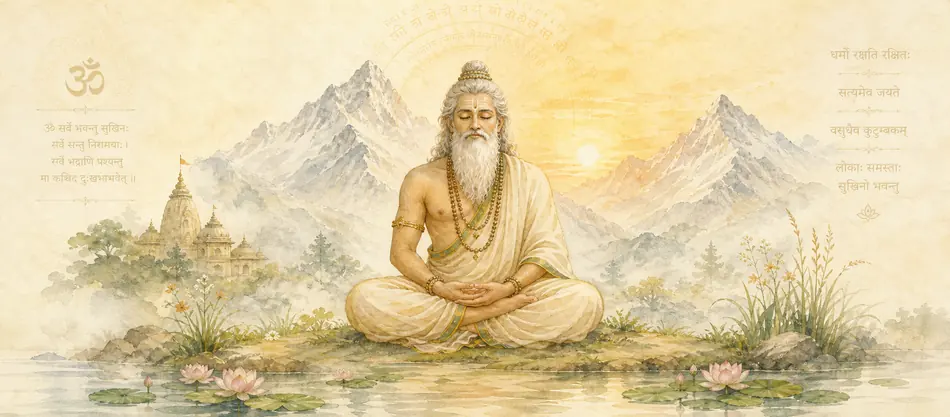
Shiva-tattva (Sanskrit: शिवतत्त्व, Śiva-tattva) is the first and highest of the ontological categories of the 36 Tattvas, denoting the absolute principle of pure consciousness, free from any distinction between subject and object. This is the level at which consciousness abides as the nondual unity of light (Prakasha) and bliss.
Etymology
The term “Shiva-tattva” (śiva-tattva) consists of two Sanskrit components: “Shiva” (śiva), from the root √śvi, meaning “auspicious,” “benevolent,” or “pure,” and “tattva,” formed from the pronoun “tat” (“that”) with the suffix “-tva,” expressing an abstract quality or “thatness.” Thus, “tattva” means “true essence” or principle, while “Shiva-tattva” means “the essence of Shiva,” that is, the principle representing pure, unlimited consciousness.
Philosophical Significance
In the philosophical system of Kashmir Shaivism, Shiva-tattva occupies a unique position as the first principle in the scheme of the 36 Tattvas. According to Kshemaraja in the “Pratyabhijna-hridayam,” the creative aspect of Paramashiva is called Shiva-tattva, which represents the initial creative impulse (prathama spanda) of the Absolute.
The “Shattrimshat-tattva-sandoha” states:
“The Highest Form (of the Absolute, Anuttara Murti), creating this entire universe by Its Will—the pulsating Spanda—is called by the wise the first, Shiva-tattva.”
(Rajanakananda, Shattrimshat-tattva-sandoha, verse 1)
Nature and Characteristics
According to Abhinavagupta in the “Tantraloka,” Shiva-tattva is the state in which, through the action of Shakti-tattva, the objective aspect (“Idam/This”) is completely eliminated, so that only the subjective component of experience (“Aham/I”) remains. Kshemaraja calls this state Anashrita-Shiva—Shiva who rests on nothing external. In the “Paramarthasara,” Abhinavagupta describes Shiva-tattva as “the state of the pure ‘I,’ in which there is not even a hint of anything other,” shining as the infinite Self and absolute pure consciousness, devoid of even subtle differentiation.
In this principle, Prakasha (the light of consciousness) manifests in its pure form as the nondual unity of light and bliss, free from any objectification. Here consciousness experiences itself as the pure “I,” devoid of any objective content. This is not a static state of emptiness, but dynamic self-awareness filled with creative potentiality and serving as the source of all divine energies (Shaktis), which, while remaining inseparable from Shiva, subsequently manifest as Shakti-tattva, Sadashiva-tattva, and other levels.
Connections with Other Concepts
The “Spanda-shastra-karikas” and Kshemaraja’s commentaries emphasize that Shiva-tattva is the unmoving foundation from which Spanda pulsates. It is the expression of the dynamic aspect of the Absolute at the primary level of creative manifestation.
In the context of Pratyabhijna, Shiva-tattva is realized as the inner “I” of every being: recognizing the identity of individual consciousness with this universal level is liberation itself. Realization of Shiva-tattva means recognizing one’s true nature as unlimited Shiva.
Practical Application
Although Shiva-tattva itself lies beyond practical methods, awareness of its presence is the goal of all sadhana in [[Kashmir Shaivism|Kashmir Shaivism]]. The practical realization of Shiva-tattva is associated with awareness of pure “I”-consciousness, free from all objective projections. This is attained through the practice of withdrawing attention from all external and internal objects and abiding in pure self-awareness.
The practice of nimilana-samadhi (meditation with closed eyes) is of particular importance, as consciousness turns toward its own nature, free from all forms of objectivity. The “Vijnana-bhairava-tantra” describes methods for attaining this state through various techniques of suspending mental activity and abiding in pure awareness.
The realization of Shiva-tattva is also associated with understanding that the observing consciousness can never become an object of observation. This leads to the direct experience of one’s nature as the unchanging Witness of all states and experiences. The tradition emphasizes that even a simple recollection of this state or meditation on the nature of the light of consciousness can lead to flashes of immediate recognition of one’s true “I” as Shiva.
In the Texts
The concept of Shiva-tattva is examined in detail in the key texts of [[Kashmir Shaivism|Kashmir Shaivism]]:
In the Tantrāloka, Abhinavagupta explains: “Because of the supremacy of Shiva Tattva, which transcends Repose, there is no possibility within it of instruction, meditation, worship, or the like. Independent as it is, it is the highest tattva, which cannot be known and which transcends Mastery.”
In Abhinavagupta’s Paramārthasāra, Shiva Tattva is described as “the state of the pure ‘I,’ in which there is not even the slightest trace of anything else,” emphasizing its nature as absolute pure consciousness.
Kṣemarāja’s Pratyabhijñāhṛdayam describes Shiva Tattva as the creative aspect of Paramashiva, which “constitutes Shiva’s initial creative impulse.”
The Īśvarapratyabhijñākārikā states that Shiva Tattva is the omnipotent reality manifesting itself as knowledge and action, which constitute the essence of a living being.
In the Tantrasāra, Abhinavagupta indicates that Shiva Tattva is self-luminous consciousness that requires no external cause in order to manifest.
Vasugupta’s Shiva Sutras, although they do not use the term “Shiva Tattva” directly, describe the state of chit-svarupa—the inherent nature of consciousness—which corresponds to the level of Shiva Tattva.
See also
Paramashiva – the absolute transcendent reality
Shakti – the second tattva, the energetic aspect of Shiva
Spanda – the cosmic vibration of consciousness
Prakasha – the light of consciousness as the basis of Shiva Tattva
36 Tattvas – the complete system of ontological principles
Aham – pure “I”-consciousness
Idam – the objective aspect of experience
Pratyabhijna – recognition of the divine nature
Svatantrya – the absolute freedom of the Divine
