

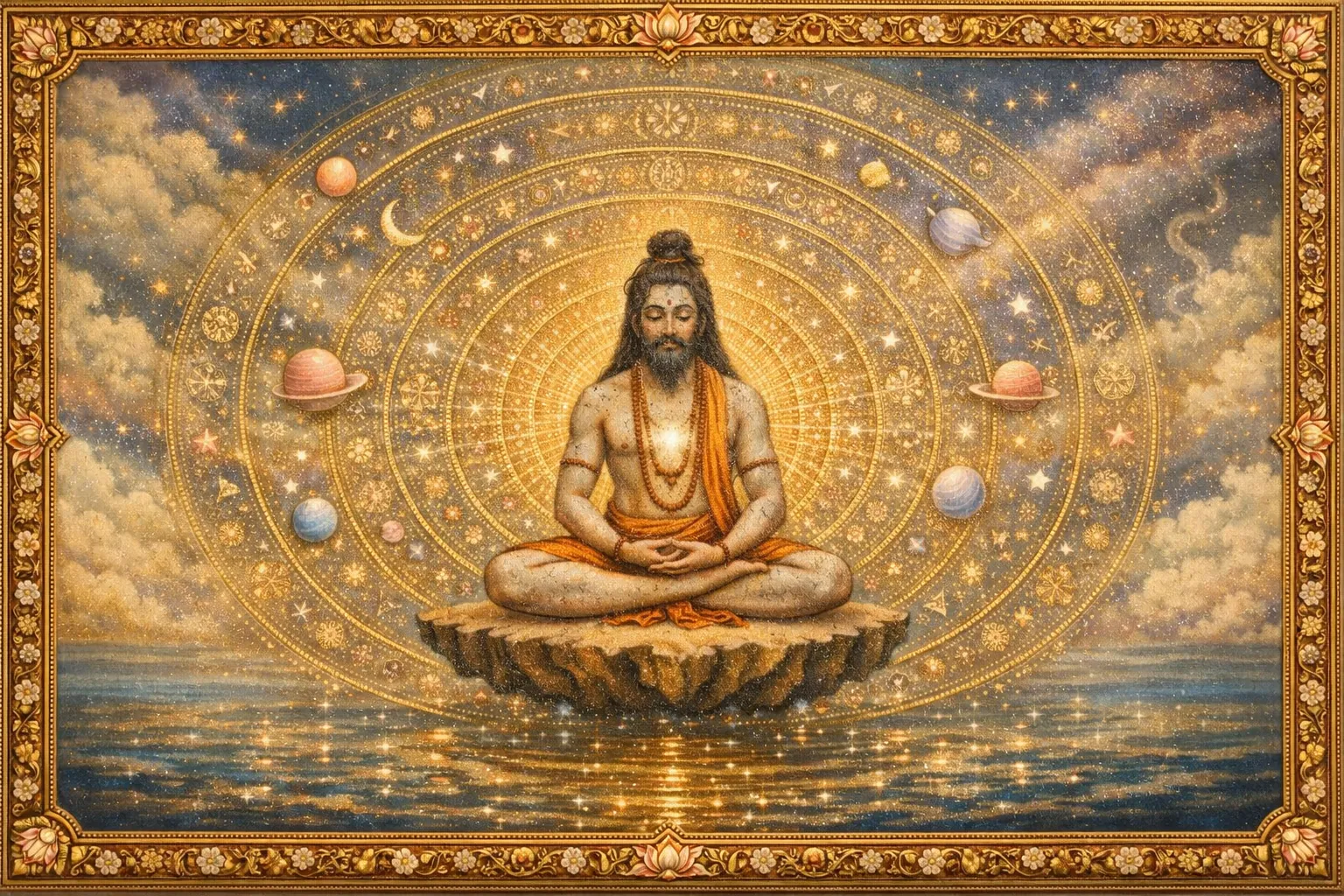
Spanda (Sanskrit: स्पन्द, spanda) is a fundamental principle of Kashmir Shaivism denoting the subtle vibration, pulsation, or oscillation that is the essential nature of supreme Consciousness (Shiva). This dynamic pulsation is the primordial creative force of the universe, which simultaneously manifests the world of forms and sustains it in being, while itself remaining immutable and absolute.
Etymology
The term “spanda” derives from the Sanskrit root “spand” (√spand), meaning “to quiver,” “to vibrate,” “to oscillate,” or “to pulsate.” It is a neuter noun formed from the verb “spandate,” denoting a special kind of movement—not displacement in space, but an inner quivering or pulsation. In the context of Kashmir Shaivism, the term acquires a deeper metaphysical meaning: an oscillation that does not occur in time and space, but is their source.
Philosophical Significance in the Context of Kashmir Shaivism
In the philosophy of Kashmir Shaivism, spanda serves as the fundamental principle explaining the relationship between the immutable, nondual Absolute (Shiva) and the ever-changing world of multiplicity. It is the creative pulsation that allows the unmanifest to become manifest without losing its original nature.
Spanda is a crucial concept in the monistic philosophy of Kashmir Shaivism because it offers a solution to a fundamental problem: how can the immutable Absolute be the source of change and diversity? According to this teaching, the entire universe is a manifestation of the vibration or pulsation of the one Consciousness (Shiva), which, while remaining absolutely transcendent, is simultaneously immanently present in the full diversity of forms.
The philosophical significance of spanda also lies in its presentation of the Absolute not as a static, inert reality, but as a dynamic, living, and creative force. This concept transcends the dualism between being and becoming, unity and multiplicity, affirming their primordial nondual unity.
Detailed Explanation
Spanda is not ordinary movement or vibration in the physical sense of the word. It is a special kind of “movement” that does not imply displacement in space or change over time. As Abhinavagupta explains in the “Īśvara-pratyabhijñā-vivṛti”:
“Spandana means a certain kind of movement. If there were movement from one’s own nature toward another object, it would be a specific movement rather than a certain kind of movement; otherwise, movement itself would become nothing. Therefore, Spanda is merely a pulsation endowed with the spiritual ecstasy of the essential nature of the Divine.”
According to the philosophy of the Spanda Shastra school, this subtle vibration has a dual aspect: unmeṣa and nimeṣa—opening and closing, expansion and contraction.
Kṣemarāja’s commentary on the “Spanda Kārikās” states:
“Spanda represents the stage of nimeṣa (absorption), which brings about the dissolution of the entire previously manifested aggregate of tattvas, from Shiva down to earth, as well as the stage of unmeṣa (expansion), which is the manifestation of the essence, or creator, in relation to the new state that is about to arise.”
It is important to understand that these two aspects of spanda—unmeṣa and nimeṣa—are not sequential processes, but occur simultaneously. As Kṣemarāja explains:
“The stage of nimeṣa, that is, the dissolution of the universe, constitutes unmeṣa, that is, the expansion of I-Consciousness. In turn, the stage of absorption of I-Consciousness, that is, nimeṣa, is the manifestation of the universe, that is, unmeṣa.”
Thus, spanda is a process in which the concealment of the manifested world is simultaneously the revelation of Supreme Consciousness, and vice versa. It is the dialectical unity of opposites that underlies all manifestations of being.
Place within the Overall System of Kashmir Shaivism
The concept of spanda forms the basis of one of the principal schools of Kashmir Shaivism—the Spanda school, founded by Vasugupta (8th–9th centuries) and developed by his disciple Kallaṭa. It is an integral part of the broader nondual philosophy of Kashmir Shaivism known as Trika (the triadic system).
In the system of 36 tattvas (ontological principles) of Kashmir Shaivism, Spanda belongs to the higher, transcendent principles associated with the levels of Shiva-tattva (the first principle) and Shakti-tattva (the second principle). It is an expression of the dynamic aspect of the Absolute, its creative energy or Shakti.
In relation to other schools of Kashmir Shaivism, the concept of Spanda is closely connected with the teachings of Pratyabhijna (Recognition) and the Krama system. As Kshemaraja notes in his commentary, the "Spanda-nirnaya," there is a close connection between the Spanda system and the Krama system, especially in their understanding of fivefold functioning through the mediation of the deities sṛṣṭi, rakta, kālī, and others.
Connections with Other Key Concepts
Spanda is directly connected with a number of key concepts in Kashmir Shaivism:
Shakti – the divine energy that is the dynamic, creative aspect of Shiva. Spanda is often regarded as an expression of Shakti and her vibrational nature.
Pratyabhijna – the recognition of one's own divine nature. Spanda provides the basis for this recognition, since it is through awareness of this inner pulsation of consciousness that one recognizes one's true nature.
Shakti-chakra – the "wheel of energies," or the totality of divine powers. In the "Spanda-nirnaya," Kshemaraja explains that Shakti-chakra is a manifestation of Spanda.
Unmesha and Nimesha – opening and closing, expansion and contraction, which represent the dual aspect of Spanda.
Svatantrya – the absolute freedom of the Divine. Spanda is an expression of this freedom, as the Absolute's capacity to create and become multiplicity while preserving its unitary nature.
Vimarsha – the self-awareness or self-reflection of the Absolute. Spanda represents the dynamic aspect of this self-awareness.
In the Texts
The concept of Spanda is discussed in detail in several key texts of Kashmir Shaivism:
"Shiva Sutras" – this text is believed to have been "received" by Vasugupta from Shiva himself. Although the term "Spanda" is not explicitly mentioned in the sutras, the concept of the vibration or pulsation of consciousness is implicitly present.
"Spanda Karikas" – the principal text of the Spanda school, traditionally attributed to Vasugupta or his disciple Kallata. This text provides a detailed description of the concept of Spanda. The first verse states:
> "We praise that Shankara (Shiva), who is the source, or cause, of the magnificent group of powers (Shakti-chakra), and by whose opening and closing of His eyes the manifestation and dissolution of the world take place."
"Spanda-nirnaya" – Kshemaraja's commentary on the "Spanda Karikas," in which he explains:
> "This Power of Supreme Vibration (Spanda) is the unitary I-Consciousness, containing within itself infinite manifestations and dissolutions. The nature of this I-consciousness is Bliss (ananda), arising from wonder at all that is pure (shuddha) and impure (ashuddha), and from the contraction and expansion of things and objects."
"Tantraloka" – Abhinavagupta's monumental work, in which the concept of Spanda is integrated into the broader context of the Trika teachings. In the "Tantraloka," Abhinavagupta relates Spanda to the concepts of the Divine's self-awareness (vimarsha) and absolute freedom (svatantrya).
Practical Application
The concept of Spanda has profound practical significance in the sadhana (spiritual practice) of Kashmir Shaivism. Its application can be considered from several perspectives:
Meditative Practices
In Kashmir Shaivism meditation, the practitioner directs attention toward the pulsation of consciousness, toward the subtle movement of energy that can be perceived at the moment of transition from one thought to another, from one state to another. As stated in the "Spanda Karikas" (III.9):
"That from which another thought (or awareness) arises in a person who is already occupied with another thought should undoubtedly be known as Unmeṣa (unmesha)."
The practitioner learns to recognize the space between thoughts, where pure consciousness manifests, uncolored by conceptual constructs.
Mindful Presence
The practice of continuous awareness of spanda leads to a state of constant presence in the “here and now,” to an uninterrupted awareness of one’s true nature even amid everyday activities.
As the “Spanda Karika” (I.21) states:
“Therefore, one who is constantly ready to discover the essence of spanda and is (truly) awake will quickly attain one’s own essential nature.”
Recognition in Extreme States
According to the “Spanda Karikas,” spanda manifests particularly clearly during moments of intense emotional states or transitions between states of consciousness.
The Spanda Karika (I.22) states:
“Enraged or tranquil, wondering, ‘What am I doing, (where) am I running?’—whatever state one may enter, spanda is (already) present there.”
This points to the practice of using intense emotional states as an opportunity to recognize one’s true nature.
