

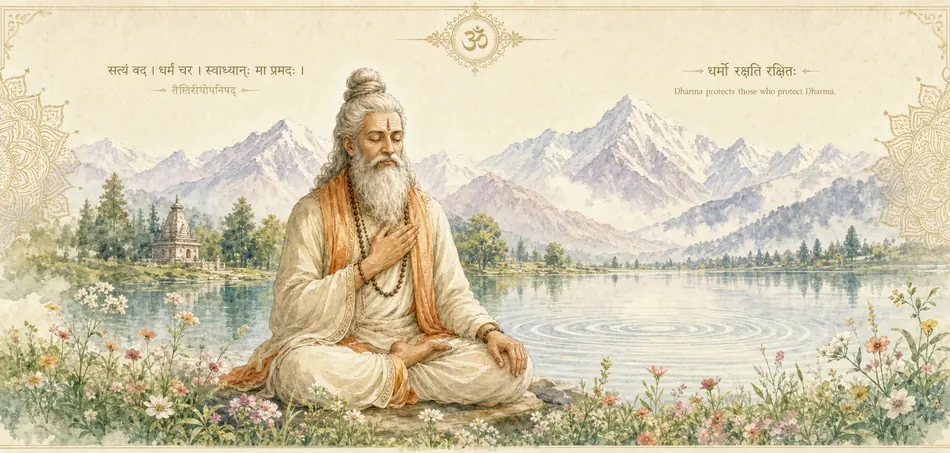
Spanda Shastra (Sanskrit: स्पन्दशास्त्र, spandaśāstra) is one of the four main philosophical schools of Kashmir Shaivism, focused on the doctrine of spanda—the primordial vibration or pulsation of absolute consciousness underlying the entire universe.
Etymology
The term “Spanda Shastra” consists of two Sanskrit words: “spanda” (स्पन्द, spanda)—“vibration,” “pulsation”—and “shastra” (शास्त्र, śāstra)—“teaching,” “science,” “treatise.” Thus, Spanda Shastra literally means “the doctrine of vibration” or “the science of cosmic pulsation.”
Philosophical Significance
The Spanda school is a philosophical and practical system developed for understanding and directly experiencing the dynamic nature of ultimate reality. According to this teaching, the entire universe is a manifestation of the subtle vibration (spanda) of absolute consciousness (Paramashiva), which pulsates between states of manifestation and non-manifestation.
The central thesis of Spanda Shastra is that reality is not static but is in constant motion, even though this vibration occurs within immutable consciousness. Paradoxically, spanda is both movement and non-movement at the same time—it is “the movement of the unmoving” or “vibration without displacement.”
Unlike other Indian philosophical systems, which often regard changeability as an illusion or a lower order of reality, Spanda Shastra integrates dynamism into the very essence of absolute reality, asserting that it is through spanda that Shiva manifests his creative energy (Shakti).
Context within the System of Kashmir Shaivism
Spanda Shastra developed in parallel with other schools of Kashmir Shaivism:
Trika—a system emphasizing the threefold nature of reality
Kula—an esoteric system focused on energetic aspects
Pratyabhijna—a system centered on the recognition of one’s own divine nature
Although these schools have different emphases, they complement one another and are often regarded as different aspects of the single doctrine of non-dual Shaivism. Spanda Shastra is particularly closely connected with Pratyabhijna, since spanda (vibration) is the mechanism through which pratyabhijna (recognition) occurs.
In the historical development of Kashmir Shaivism, Spanda Shastra is considered an earlier systematization of the teaching, whereas Pratyabhijna represents a later and more philosophically developed system. Nevertheless, in the works of later masters such as [[Abhinavagupta|Abhinavagupta]] and [[Kshemaraja|Kshemaraja]], these two traditions were fully integrated.
Connection with Other Concepts
Spanda Shastra employs a number of key concepts that connect it with other terminology of Kashmir Shaivism:
Spanda—the school’s central concept, meaning the primordial vibration of consciousness
Spanda Shakti—the energetic aspect of spanda through which it manifests
Nimesha and Unmesha—phases of pulsation: the contraction and expansion of spanda
Svatantrya —Shiva’s absolute freedom, expressed through spanda
Sahaja—the natural state in which spanda is directly experienced
Madhya—the center or interval between two polarities, where spanda can be apprehended
Different Interpretations
Within Kashmir Shaivism, there are different interpretations of the doctrine of spanda:
The energetic interpretation regards spanda as subtle energetic vibrations that can be felt through [[Prana|prana]] and [[Kundalini|kundalini]].
The epistemological interpretation views spanda as the basis of all cognitive processes and the means by which consciousness knows itself and objects.
The cosmological interpretation describes spanda as the principle governing the cycles of creation, preservation, and destruction of the universe.
Practical interpretation focuses on methods for detecting spanda in everyday experience and using this awareness for spiritual transformation.
In later texts of Kashmir Shaivism, especially in the works of Abhinavagupta, all these interpretations were synthesized into a comprehensive teaching.
In the Texts
The principal texts of the Spanda school are:
The Shiva Sutras—the foundational text of Kashmir Shaivism as a whole, received by Vasugupta (9th century) through divine revelation. Although the term “spanda” rarely occurs in it, many sutras indirectly refer to this concept.
The Spanda Karikas (or Spanda Sutras)—the principal text of the Spanda school, containing 52 verses that systematically expound the teaching of spanda. It is traditionally attributed either to Vasugupta himself or to his disciple Kallata.
Spanda Sandoha—a brief commentary by Kshemaraja on the Spanda Karikas.
Spanda Nirnaya—a detailed commentary by Kshemaraja on the Spanda Karikas, integrating the teaching of spanda with later developments in Pratyabhijna.
Spanda Pradipika—a commentary by [[Utpaladeva|Utpaladeva]] on the Spanda Karikas.
Vritti—Kallata’s commentary on the Spanda Karikas.
Practical Application
The Spanda school presents not only a theoretical system but also a range of practical methods for spiritual realization:
Detecting spanda in everyday experience:
Attending to moments of transition between states (sandhi)
Observing the boundary between perception and awareness
Tracking subtle pulsations in the body and breath
Special techniques:
Shaktichakra-sandhana—the practice of seeking the center between inhalation and exhalation
Hridaya-spanda-nusandhana—meditation on the pulsation in the spiritual heart
Para-spanda-dharana—concentration on the supreme vibration
Integration with other practices:
Spanda-oriented approaches to Prana and kundalini]]
Perceiving mantras as forms of sonic spanda
Seeing yantras as visual representations of spanda
Stages of practice:
From gross forms of spanda (physical sensations) to subtler ones (mental)
From subtle forms to the most subtle ones (at the level of pure consciousness)
Recognizing all forms of experience as manifestations of the one spanda
According to the Spanda Karikas, when a practitioner becomes fully aware of spanda, they attain the state of Jivanmukti (liberation while living), in which all ordinary limitations (malas) dissolve in the awareness of unity with Shiva.
History of the School
Vasugupta (9th century) is traditionally regarded as the founder of the Spanda school. According to legend, he received the Shiva Sutras in a revelation from Shiva himself on Mount Mahadeva near Srinagar in Kashmir.
His disciple Kallata (c. 850–900) systematized and disseminated the teaching, writing a commentary on the Spanda Karikas and establishing a lineage of transmission. Through Kallata, the teaching passed to his disciples, including Pradyumnabhatta.
The Spanda school was later integrated with other branches of Kashmir Shaivism, especially Pratyabhijna, through the efforts of such masters as Utpaladeva, Abhinavagupta, and Kshemaraja (10th–11th centuries).
By the 12th century, most schools of Kashmir Shaivism had been synthesized into a unified system, although Spanda Shastra continued to retain its significance as one of the most important aspects of this tradition.
See Also
Spanda
Pratyabhijna Shastra
Trika Shastra
Kula Shastra
Spanda Karikas
Vasugupta
Kallata
Kshemaraja
Shiva Sutras
Dynamic Aspects of Kashmir Shaivism
Sources and Literature
Dyczkowski, Mark S.G. (1987). The Doctrine of Vibration: An Analysis of the Doctrines and Practices of Kashmir Shaivism. Albany: State University of New York Press.
Singh, Jaideva (1980). Spanda-Kārikās: The Divine Creative Pulsation. Delhi: Motilal Banarsidass.
Muller-Ortega, Paul Eduardo (1989). The Triadic Heart of Śiva: Kaula Tantricism of Abhinavagupta in the Non-Dual Shaivism of Kashmir. Albany: State University of New York Press.
Bäumer, Bettina (2008). "The Concept of Spanda in the Literature of Kashmir Shaivism." In Expanding and Merging Horizons: Contributions to South Asian and Cross-Cultural Studies in Commemoration of Wilhelm Halbfass, edited by Karin Preisendanz. Vienna: Austrian Academy of Sciences Press.
Silburn, Lilian (1988). Kundalini: Energy of the Depths. Albany: State University of New York Press.
Rastogi, Navjivan (1987). Introduction to the Tantraloka: A Study in Structure. Delhi: Motilal Banarsidass.
Pandey, K.C. (2006). Abhinavagupta: An Historical and Philosophical Study. Varanasi: Chaukhamba Amarabharati Prakashan.
Lawrence, David Peter (1999). Rediscovering God with Transcendental Argument: A Contemporary Interpretation of Monistic Kashmiri Saiva Philosophy. Albany: State University of New York Press.
Categories
Schools of Kashmir Shaivism
Spanda Shastra
Non-Dual Shaivism
Philosophy of Consciousness in Kashmir Shaivism
Tantric Schools
