

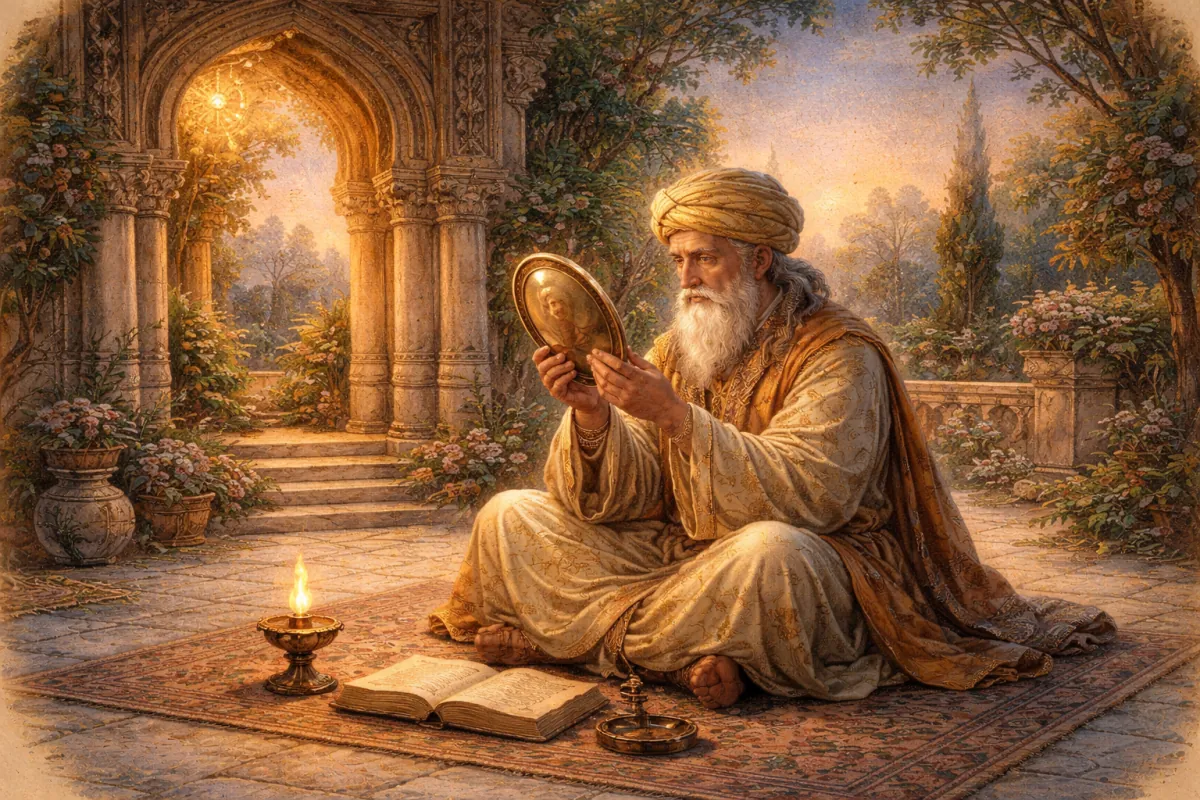
Vimarsha (vimarśa) is a fundamental concept of Kashmir Shaivism denoting the self-reflexive aspect of pure consciousness, its capacity for self-awareness and self-expression. Vimarsha is the dynamic, active aspect of the Absolute, through which the light of consciousness knows itself and manifests the entire diversity of the universe.
Etymology
The Sanskrit term “vimarsha” (vimarśa) derives from the prefix “vi-” (vi-), denoting particular intensity or diversity, and the root “mrish” (mṛś), meaning “to touch,” “to feel,” or “to reflect.” Its literal meaning is “a special touch,” “intense sensation,” or “complete awareness.” In the philosophical context of Kashmir Shaivism, the term acquired the specific meaning of consciousness’s self-awareness or self-reflection.
Philosophical Significance
In the metaphysics of Kashmir Shaivism, vimarsha represents one of the two inseparable aspects of the Supreme Reality. While prakasha (prakāśa) is the essential aspect of the Absolute, the pure light of consciousness, vimarsha is its dynamic, creative aspect, its capacity for self-awareness and self-expression.
Abhinavagupta, the greatest systematizer of Kashmir Shaivism, compares prakasha to a mirror and vimarsha to the reflections in that mirror in his monumental work, the “Tantraloka.” It is important to understand, however, that both aspects are inseparable and exist in unity, just as fire is inseparable from its capacity to burn.
In the Trika tradition, vimarsha is identified with Shakti—the divine feminine energy that complements Shiva (who is associated with prakasha). This relationship is expressed in the classical formula “Shiva-Shakti-atmakam jagat” (“The world consists of Shiva and Shakti”). As a dynamic principle, vimarsha gives rise to the diversity of manifestations of the one Reality, creating the appearance of division and multiplicity.
Utpaladeva, the founder of the Pratyabhijna school, defines vimarsha as the “essence of ‘I-ness’” (ahantā-sāra) in his treatise “Ishvara-pratyabhijna-karika.” This indicates that self-consciousness, the fundamental experience of “I am,” is a direct manifestation of vimarsha. Through vimarsha, absolute consciousness does not remain empty but becomes filled with content and meaning.
In the epistemology of Kashmir Shaivism, vimarsha plays a key role, since every act of cognition entails not only illuminating an object with the light of consciousness (prakasha), but also reflexively becoming aware of it (vimarsha). Vimarsha makes possible not only the experience of objects but also the awareness of that very experience.
In his commentary on the “Shiva Sutras,” Kshemaraja notes that vimarsha manifests at various levels of reality:
At the highest level—as the pure self-awareness of the Absolute;
At intermediate levels—as various mental and cognitive processes;
At the lowest level—as the differentiated perception of the manifold world.
In the context of spanda (the pulsation or vibration of consciousness), vimarsha may be regarded as the energetic aspect of this vibration—that which gives it dynamism and direction. Thus, the concepts of spanda and vimarsha are closely interconnected and complement each other.
It is important to note that vimarsha is not something external or secondary to prakasha. In reality, they are two inseparable aspects of one and the same Reality, and the distinction between them is merely conceptual, serving as an aid in philosophical analysis and the practical realization of nondual experience.
The concept of vimarsha is also closely connected with the notion of svatantrya (absolute freedom), which is an inherent quality of the Absolute. It is precisely through vimarsha that divine consciousness possesses svatantrya—the freedom to create, sustain, and dissolve the entire diversity of the manifested world.
Practical Application
In practical terms, recognizing vimarsha as the active, dynamic aspect of consciousness is of great importance to the spiritual seeker. The tradition of Kashmir Shaivism includes specific methods aimed at directly recognizing vimarsha and integrating it into everyday experience.
One such practice is described in the “Vijnana Bhairava Tantra,” where the practitioner is instructed to focus on the moment a thought (vikalpa) arises—this very moment is a manifestation of vimarsha. Through such concentration, one can directly experience the self-reflexive nature of consciousness.
In the tantric rituals of the Kaula tradition, the feminine principle embodies vimarsha, which is expressed through the worship of Shakti in her various forms. The ritual union of the masculine and feminine principles symbolizes the unity of prakasha and vimarsha.
In the context of working with Kundalini, vimarsha may be associated with the upward movement of energy through the central channel, sushumna. As this ascent proceeds, increasingly subtle and intense aspects of self-awareness are revealed.
Mantra practices are also associated with the principle of vimarsha, since the sound or vibration of a mantra is considered a direct expression of the Absolute’s vimarsha. This applies especially to the higher levels of speech (parapara-vak), which transcend ordinary articulated speech.
In the Texts
The concept of vimarsha is elaborated in detail in many key texts of Kashmir Shaivism:
In the "Shiva Sutras" (especially in Kshemaraja’s commentaries), vimarsha is described as an integral aspect of supreme consciousness.
In the "Spanda Karika," vimarsha is associated with the principle of spanda—the pulsation or vibration of consciousness.
In Utpaladeva’s "Ishvara Pratyabhijna Karika" and Abhinavagupta’s commentaries on it, vimarsha is regarded as the foundation of self-awareness and cognitive activity.
In Abhinavagupta’s "Tantraloka," vimarsha is analyzed in the context of cosmology and the doctrine of the tattvas (principles of reality).
In the "Paramarthasara," vimarsha is described as the foundation of divine creativity.
The "Vijnana Bhairava Tantra" presents practical methods for recognizing vimarsha in everyday experience.
See also:
Prakasha (Light of Consciousness)
Shakti (Divine Energy)
Svatantrya (Absolute Freedom)
Spanda (Vibration of Consciousness)
Paramashiva (Supreme Reality)
Aham (I-Principle)
Paraparavak (Supreme Speech)
Categories:
Philosophical Concepts and Terms
Metaphysical Principles
Trika
Shakti
Spanda Shastra
