

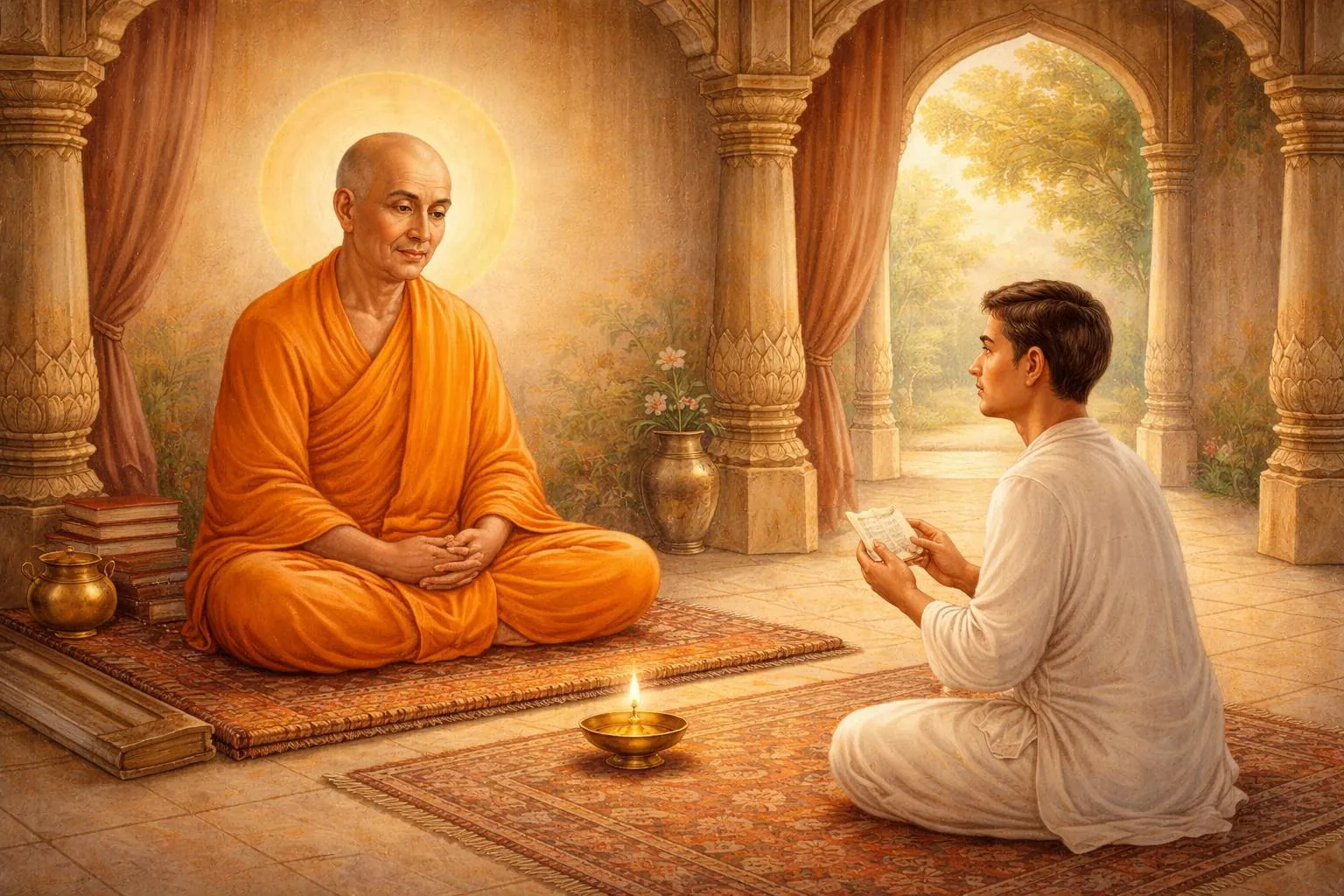
In the Sanatana Dharma tradition, the institution of monastic mentorship holds a central position in the system of knowledge transmission. A monk (sannyasi, sadhu, muni) represents a living embodiment of the renounced path (sannyasa-ashrama) and acts as an intermediary between the sacred knowledge of the shastras and the spiritual aspiration of the disciple.
A sannyasi monk in the Shaivite tradition represents jiva-dasha — the state of living liberation.
He is not bound by worldly obligations or social conventions. His authority does not stem from worldly power or position, but from tapas (spiritual power accumulated through asceticism), sadhana (realized practice), and parampara (belonging to an unbroken line of succession).
Shiva Purana (Vayaviya-samhita, 10.31-32) explains the principle of honoring monks:
“Whoever honors a sannyasin dressed in gerua (ochre robes), immersed in meditation on Shiva, honors Shiva himself. Gifts offered to such a renunciant bring boundless fruits.”
This points to the theological principle of guru-shiva-avabhasa — the understanding of the mentor as a manifestation of the deity itself, which justifies the sacredness of the consultation process.
The Spiritual Nature of Consultation
A monk's consultation in the context of Sanatana Dharma is fundamentally different from secular or psychological counseling. It is not an exchange of opinions, a therapy session, or a friendly chat. The consultation is a dharma-sanvada — a sacred dialogue in which spiritual knowledge is transmitted and the internal state of the disciple is tuned to the frequency of the tradition.
In this process, the monk acts not as an individual with subjective views, but as an intermediary of dharma, through whom the impersonal wisdom of the teaching is channeled. This is why a seeker, when seeking a consultation with a specific monk, automatically accepts the spiritual authority of the entire parampara that this monk represents.
Ethical Foundations of Interaction
Proper interaction with a monk is based on the principle of vinaya — humble discipline and respect. This principle is not a matter of formal politeness but reflects an internal state of shraddha (faith, trust) and samarpana (offering oneself to the learning process).
Preparation for consultation requires adherence to the following guidelines:
- Written request — the lay disciple formulates the request in writing, which encourages clarity of intention and demonstrates the seriousness of the aspiration. The written form eliminates impulsiveness and requires reflection on one's own questions.
- Observance of hierarchy — addressing senior monks (Mahants, Mandaleshwars) is done through an assistant or secretary, reflecting the traditional principle of guru-seva-krama — step-by-step service, where access to higher levels of spiritual guidance is determined by the disciple's readiness and merits.
- Ritual preparation — dressing in white ritual clothing symbolizes inner purification and the transition into a sacred space. The color white (shveta) is traditionally associated with purity (shaucha), goodness (sattva), and spiritual aspiration.
- Namaste at the beginning and end of the consultation — from namas (“bow, respect”) + te (“to you”) — a gesture of joining the palms before the heart with a slight tilt of the head, expressing recognition of the divine presence in the mentor and humility before the wisdom of the tradition.
Inacceptable Manifestations
The tradition categorically excludes the following elements from the consultation space:
- Emotional lack of restraint (rajasika-bhava) — manifestations of anger, resentment, or irritation, which cloud the clarity of perception and disrupt the sacred atmosphere of knowledge transmission.
- Argument and polemics — a consultation is not a discussion between equals, but a process of instruction where the monk, possessing realized knowledge, points the way.
- Getting personal — attempts to evaluate the monk as an ordinary individual, making judgments about his qualities, or comparing him with other mentors.
- Low vocabulary — the use of slang, idioms, profanity, or overfamiliarity violates the principle of vacha-shuddhi (purity of speech) and demonstrates a lack of inner culture.
- Reproaches and accusations — projecting one's own failures onto the teaching or the mentor indicates immaturity and unreadiness for the spiritual path.
If such manifestations occur, the monk is obliged to interrupt the consultation, as continuing the interaction in the absence of proper conduct profanes the sacred process of transmission and causes harm to both the disciple and the teaching itself.
Topics of Consultations
Monastic guidance covers strictly defined areas of spiritual life:
- Entering Dharma — initial instructions for a new convert, explanation of the basic principles of the teaching, ethical obligations, and the structure of the path.
- Clarification of mystical experiences — interpretation of meditative experiences, visions, and energetic phenomena in the light of the tradition, cautioning against false interpretations and spiritual pride.
- Clarification of the learning process — building an individual trajectory for sadhana, determining priority practices, and adjusting methodology.
- Change of spiritual status — transitioning from the state of a householder (grihastha) to karma-sannyasa or formal sannyasa, which requires deep inner preparation and the blessing of elders.
- Receiving method transmission — initiation into specific practices, receiving mantras, and ritual techniques that require direct transmission from an authorized mentor.
- Opening of thoughts — a confessional practice where the disciple reveals inner doubts, obstacles, and violations of vows to receive spiritual advice and purification.
- Questions of service — instructions regarding the fulfillment of duties in the community, karma yoga, and interaction with other disciples.
The Consultation Process
The guidance of the consultation process belongs to the monk. This corresponds to the traditional principle of guru-mukha (“from the mouth of the guru”), where the flow of knowledge is directed by the teacher according to the readiness, karmic characteristics, and current needs of the disciple. The monk:
- Determines the direction of the conversation, identifying the disciple's true, rather than superficial, questions;
- Leads to the necessary conclusions through leading questions and explanations, allowing the disciple to reach understanding themselves;
- Sets ethical and logical boundaries of communication, stopping inappropriate topics or incorrect formulations;
- Transmits not only information but bhava — the inner state, the vibration of the tradition.
This approach is rooted in parampara-siddhanta — the principle of continuous transmission, where every word of the mentor is not a personal opinion but an echo of ancient wisdom passed through generations of realized masters.
Modern Implementation of Ancient Principles
In the conditions of the modern world, consultations can be carried out not only physically but also remotely — via video link, phone calls, or correspondence. However, technological means do not waive spiritual requirements. The virtual space must be sanctified with the same reverence and inner alignment as physical presence in an ashram.
A Western seeker entering the path of Sanatana Dharma often brings along attitudes toward equal dialogue, democratic communication, and the right to doubt. These attitudes must be transformed, for spiritual learning requires a different paradigm — the paradigm of guru-bhakti (devotion to the teacher) and vichara (discriminative inquiry under guidance). Not blind faith, but trust based on the recognition of spiritual authority; not passivity, but active humility that opens the channel for perceiving the truth. A monk's consultation is a gateway to the tradition, the first step toward establishing a living connection with the parampara. In this act, the seeker leaves the position of an observer and becomes a participant in a sacred process that has lasted for millennia.
You can receive a consultation from the monks:
Shiva Prema Sagar Ashram (Italy)
"Sadhu Tapovan" Ashram (Russia)
Om Shanti
