

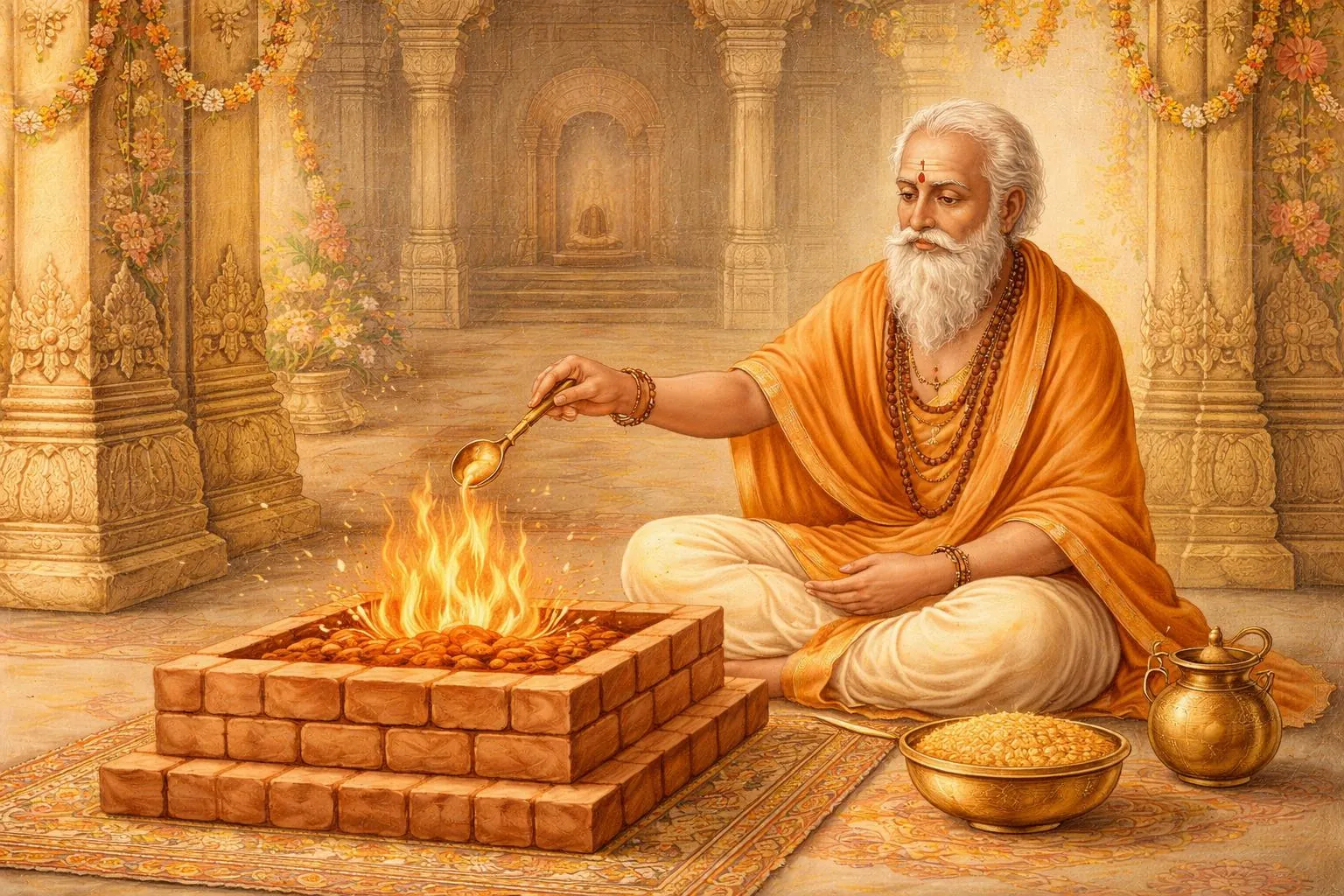
Homa (Skt. homa) is a sacred fire sacrifice, one of the fundamental Vedic rituals of worshipping the Divine through the element of fire (Agni). The term originates from the Sanskrit root "hu" (hu), meaning "to pour," "to sacrifice," or "to offer." In the Vedic tradition, homa is also referred to as yajna (yajña — sacrifice), agnihotra (agnihotra — fire offering), or havan (havan).
Etymologically, homa represents the act of sacred libation into the fire, where Agni acts as a mediator between the human and divine dimensions of existence.
Definition
Homa is an ancient Vedic ritual of fire sacrifice in which fire (Agni) is invoked as a sacred mediator to convey offerings to a chosen Deity. The practice of homa is rooted in the earliest layers of the Hindu tradition and is detailed in the Vedas, Brahmanas, Shrauta-sutras, and Grihya-sutras.
The Yajurveda states:
"Agnir devanam avamo devah" — "Agni is the first among the gods, the deity of deities."
The Bhagavad Gita (3.10-11) instructs:
"In the beginning of creation, Prajapati created mankind along with sacrifice and blessed them: 'May you prosper by this sacrifice, for its performance shall bestow upon you all you desire.'"
According to the Tantras and Agamas, homa represents not only an external ritual action but also an internal alchemical transformation of consciousness. Fire symbolizes the divine power that consumes impurities and obstacles, transforming them into pure spiritual energy.
Three key components are present in the fire ritual:
- Agni (Agni) — the sacred fire as a manifestation of divine light and a mediator between worlds.
- Devata (Devatā) — the invoked Deity to whom the offerings and prayers are addressed.
- Havya (Havya) — sacrificial materials (ghee, grains, herbs), symbolizing the renunciation of ego and worldly attachments.
Homa performs four fundamental functions:
- Karma-nashana (karma-nāśana) — the elimination of negative karma and karmic debts.
- Shuddhi (śuddhi) — the purification of the subtle body and consciousness from impurities.
- Sankalpa-siddhi (saṅkalpa-siddhi) — the fulfillment of intentions and the achievement of set goals.
- Devatarshana (devatārṣana) — the establishment of a direct connection with divine energies and the attainment of their blessing.
Essence of the Practice in a Spiritual Context
Homa is one of the most powerful ritual tools of Sanatana Dharma for transforming the internal and external state of the practitioner. Unlike meditation or japa, which act primarily on the mental plane, homa works on all levels of being simultaneously: physical, pranic, mental, vijnanamaya, and anandamaya.
The fire sacrifice removes energetic blocks and hindrances that obstruct spiritual progress and material well-being. Through invoking a specific Deity into the fire, the practitioner receives a direct transmission of divine shakti (power), which heals, protects, and leads to realization.
Types of Homas by Purpose
The tradition offers a wide range of homas, each addressed to a specific Deity and aimed at solving particular tasks:
- Ganapati Homa is dedicated to Lord Ganesha, the remover of obstacles. It is recommended for starting new endeavors, overcoming difficulties in personal life, and protection from negative influences.
- Shiva Homa is addressed to Lord Shiva as the embodiment of transforming power. It purifies karma, grants protection from all dangers, and facilitates the fulfillment of intentions.
- Mahamrityunjaya Homa invokes the aspect of Shiva as the conqueror of death. It is conducted for healing from severe illnesses, removing their karmic causes, and protection from premature departure. Shiva-Parvati Homa unites the energies of Shiva and Shakti. It harmonizes internal polarities, improves relationships, and provides strength to achieve goals.
- Maha Vishnu Homa is addressed to Vishnu the Preserver. It promotes spiritual growth, learning, and the attainment of well-being and happiness in the family.
- Dattatreya Homa is dedicated to Lord Dattatreya, the personification of the Trimurti and patron of the World Community tradition. It grants insight into non-dual vision, self-liberation, and pure perception.
- Saraswati Homa invokes the Goddess of knowledge and arts. It supports learning, creative processes, and the development of eloquence and wisdom.
- Savitar Gayatri Homa is the most purifying. It washes away negative karma, harmonizes the mind, unlocks potential, and promotes longevity and family happiness.
- Mahalakshmi Homa is dedicated to the Goddess of abundance. It is conducted for material prosperity, wealth, and the fulfillment of desires.
- Durga Homa invokes the protective power of the Divine Mother. It clears fears and negativity, granting confidence and courage.
- Saptarishi Homa is addressed to the seven great rishi-progenitors. It grants supreme wisdom and the power of yoga.
- Brihaspati Homa is dedicated to Jupiter as the teacher of the gods. It promotes spiritual growth, wisdom, prosperity, and the strengthening of dharma.
- Surya Homa invokes the Sun Deity. It endows one with vital force, health, and creative potential, and promotes self-realization.
- Hanuman Homa is addressed to Hanuman as a protector from all calamities. It removes negative influences, protects against possession, strengthens health, and offsets the influence of Saturn.
- Navagraha Homa harmonizes the influence of all nine planets, improving all spheres of life.
- Shani Homa is dedicated to Saturn. It removes the negative aspects of this planet, granting the ability to accept responsibility and overcome difficulties.
- Pitri Homa is conducted to honor departed ancestors. It grants them peace, purifies ancestral programs, and strengthens support from the lineage.
Practice of Ordering a Homa
The World Community of Sanatana Dharma provides the opportunity to join collective homas with a personal sankalpa (intention) and offerings, or to order an individual ritual entirely dedicated to the practitioner's specific goals.
Options for Practice Intensity:
Rituals can be conducted with varying degrees of intensity depending on the complexity of the task and the depth of transformation the practitioner seeks to achieve:
- One-time Homa — a single performance of the ritual to solve a specific situational task.
- Prolonged Practice — systematic performance of the homa over an extended period from one to six months for deep purification and transformation.
Spatial Distribution:
- Single Location Performance — the homa is performed in one ashram of the tradition.
- Multiple Location Performance — the ritual is performed simultaneously in two to five ashrams of the World Community, which manifoldly increases the energetic impact and accelerates the realization of the intention.
Performing a homa in several ashrams simultaneously creates a powerful resonance field of blessing that encompasses the practitioner from all sides and removes obstacles at all levels of existence.
Ordering Procedure
To order an individual homa or join a collective ritual with a personal sankalpa, it is necessary to contact the coordinator of ritual services of the World Community:
During the consultation, the following is determined:
- The type of homa according to the practitioner's intention.
- The intensity of performance (duration and number of ashrams).
- The date and time of the ritual.
- The necessary offerings and sankalpa (formulation of intention).
The practitioner provides their details to be included in the ritual and formulates a clear intention, which will be recited by the brahmin during the ceremony. After all details are agreed upon, the necessary donation (dakshina) for the ritual is made.
Preparation for Homa
For maximum effectiveness of the homa, the practitioner is recommended to:
- Observe a sattvic lifestyle during the period of the ritual.
- If possible, fast on the day of the homa or stick to light vegetarian food.
- Practice japa of the mantra of the corresponding Deity.
- Visualize the desired result with full trust in divine grace.
- Maintain internal focus and gratitude.
Homa is a sacred offering, an act of humility and devotion through which the practitioner opens themselves to the flow of divine grace. The results of the homa manifest in accordance with divine will and individual karma, but tradition testifies to the deep transforming power of this ancient ritual.
The fire of the homa is a gateway between worlds. Through the flame of the sacrificial fire, human intention ascends to the heavens, and divine blessing descends to earth. In this sacred exchange, the alchemy of transformation takes place.
