

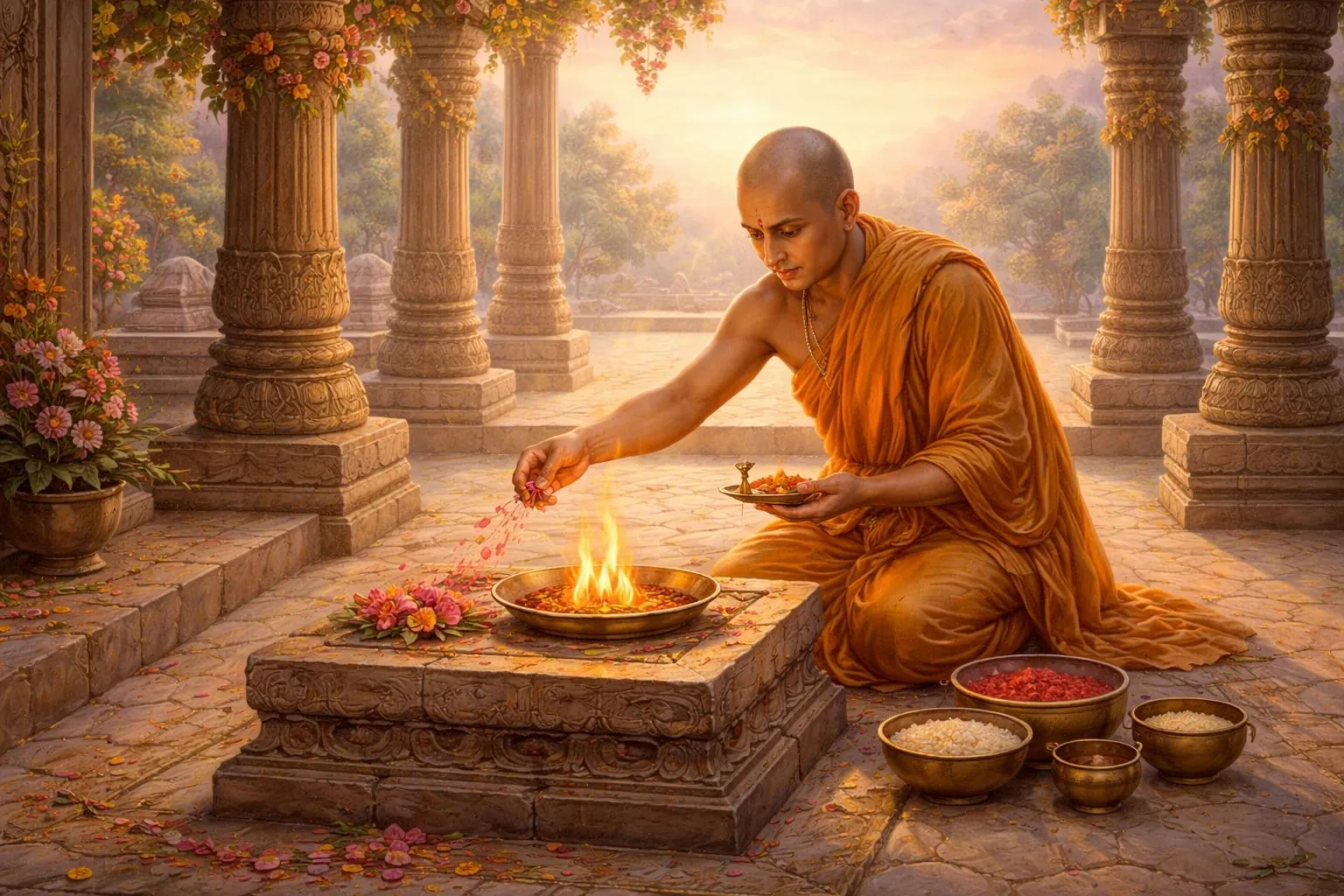
In the structure of Sanatana Dharma, ritual practice constitutes a fundamental part of the Karma-kanda—the section of the Vedas dedicated to the correct performance of dharmic actions. The classical tradition distinguishes between three categories of rituals: nitya-karma (obligatory daily rites), naimittika-karma (situational rituals associated with special circumstances), and kamya-karma (optional rituals for achieving specific goals).
The Rigveda proclaims:
“By means of the sacrifice the gods performed the sacrifice”
(Rigveda 10.90.16).
The Bhagavad Gita affirms the principle of reciprocity between deities and humans:
“Nourish the gods with this [sacrifice], and may the gods nourish you; thus, mutually nourishing one another, you shall attain the highest good”
(Bhagavad Gita 3.11).
This mechanism defines the essence of paushti-karma: a ritual action creates an energetic circuit in which a person, through proper veneration, activates divine forces that, in response, bestow spiritual and material blessings upon them.
Theology of Ritual Action
Ritual is understood not as a symbolic action, but as a factual operation with subtle energies, where sankalpa (ritual intention) directs cosmic forces toward a specific goal. Tradition asserts that a correctly performed ritual, accompanied by a pure sankalpa and proper mantras, possesses objective efficacy regardless of the subjective faith of the participants.
Classification of Ritual Goals
The Shastras distinguish four main categories of ritual goals (purushartha-sadhana):
- Abhicharika — rituals for removing obstacles and protection against hostile forces
- Paushtika — rituals for increasing prosperity, health, and longevity
- Vashikarana — rituals for attracting favorable influences
- Shantika — pacifying rituals to eliminate calamities
Paushti-karma, therefore, represents the second class of ritual activity, oriented toward cultivating all forms of well-being—from material prosperity to spiritual progress.
The Role of the Authorized Performer
The Dharma Shastras establish that the highest effectiveness of a ritual is achieved when it is performed by a qualified sadhaka—a practitioner who:
- has received proper diksha (initiation) into the corresponding mantra-sadhana
- is in a state of ritual purity
- possesses a steady practice and realization.
In monastic traditions, this role belongs to initiated monks (sannyasis) who have renounced worldly attachments and dedicated themselves entirely to spiritual practice.
Ritual Tradition for the Modern Seeker
Tradition teaches that ritual is not a relic of the past, but a functioning technology for the transformation of consciousness and life circumstances. When we offer flowers to a deity on an altar, recite sacred mantras, or light a sacred fire, we are not merely performing symbolic gestures—we are activating real energetic flows that affect the subtle levels of our existence.
Modern quantum physics has discovered what yogis have known for millennia: matter and energy are interchangeable, intention influences reality, and sound vibrations possess form-giving power. Ritual is an applied science of working with these principles at the level of spiritual energy.
Structure of Ritual Service
In the tradition of the World Community of Sanatana Dharma, ritual service is organized so that a seeker can receive blessings and support for spiritual practices even from a distance, without possessing their own qualifications to perform complex rites. This is achieved through the institution of pratinidhi (representation): a monk acts as a conduit for spiritual power, directing the energy of the ritual to a specific person through sankalpa—a formal intention specifying the name, location, and purpose of the rite.
This practice has a solid foundation in the Tantric tradition, where space and time are understood not as absolute limitations, but as conventional parameters overcome by the power of mantra-shakti and the purity of the practitioner's intention.
Puja: Establishing Divine Presence
Puja is the central ritual of Hindu worship, in which the deity is invited to be present in a consecrated image (murti) and is received as an honored guest. The classical scheme of puja includes panchopachara—five offerings corresponding to the five elements: incense (earth), flowers (water), a lamp (fire), fragrances (air), and food (ether). Through these offerings, the practitioner symbolically places the entire manifested universe at the deity's disposal, acknowledging their dependence on the divine will and asking for blessings.
The community regularly conducts collective pujas to various aspects of the Absolute, which a seeker can join through sankalpa and material offerings to the altar:
- Shiva-puja addresses Lord Shiva as the embodiment of detachment (vairagya), self-control (atma-samyama), and all that is auspicious (shiva). For a seeker striving for liberation, developing these qualities is a necessary condition for spiritual progress. Regular participation in Shiva-puja strengthens inner detachment, the ability to maintain balance in changing circumstances, and attracts favorable opportunities for practice.
- Dattatreya-puja honors Lord Dattatreya—the unified incarnation of the Trimurti (Brahma, Vishnu, and Shiva), the cosmic Guru, and the protector of sadhakas. Dattatreya personifies the principle of guru-tattva—the divine teacher who exists simultaneously as the ultimate reality, as the external teacher, and as the inner voice of wisdom. Puja to the ishta-devata grants all kinds of well-being (sarva-mangala) and removes obstacles on the spiritual path.
- Vishnu-puja addresses the aspect of the Absolute as the preserver of cosmic order and the embodiment of dharma. For a seeker in need of stability in life circumstances, protection from chaos, and the strengthening of a dharmic lifestyle, the veneration of Vishnu is a powerful means of harmonization.
- Guru-puja (Mahapuja) honors the Guru principle as the manifestation of the light of truth (jnana-prakasha), our own Atman, and supreme wisdom. This practice strengthens the samaya connection between student and teacher, deepens guru-yoga, and grants clarity of discernment (viveka) and right judgment (buddhi) in times of uncertainty.
- Lakshmi-Saraswati-puja invokes the energies of material well-being (Lakshmi) and wisdom, knowledge, and creative abilities (Saraswati). Tradition teaches that true prosperity is possible only through a harmonious combination of material security and spiritual knowledge—dhana (wealth) should serve jnana (knowledge), not enslave the consciousness.
- Durga-puja addresses the Divine Mother in her warrior aspect—as the protectress against demonic forces, diseases, obstacles, and all forms of negativity. For a seeker facing serious life difficulties or spiritual trials, Durga is an invincible ally.
- Siddha-puja honors perfected yogis (siddhas) who have attained spiritual realization and possess the ability to grant siddhis—both worldly perfections (health, prosperity, abilities) and spiritual attainments. This puja is especially effective for overcoming obstacles in any undertaking.
Special Purpose Ritual Practices
In addition to regular pujas, the tradition offers specialized ritual practices for specific goals:
- Recitation of sacred texts (parayana) — an ancient practice in which a consecrated text is read aloud with proper intonation and attention. The Shastras teach that great texts such as the "Yoga Vasistha," "Tripura Rahasya," "Avadhuta Gita," "Moksha Dharma," "Ribhu Gita," "Shiva Gita," "Sripada Srivallabha Charitamrutam," and "Shiva Purana" contain not just philosophical information, but living spiritual power (shastra-shakti). When an initiated monk reads these texts in a specific space, the energy field of that place is purified and filled with the blessings inscribed in the words of the sages. This practice is available only when a monk is physically present at the site of the ritual.
- Protective rituals (raksha-karma) create an energetic shield around a person or space. These include Ganesha Arati and Ganesha Puja (removing obstacles and creating a favorable beginning), Shanti Stotra (pacifying hymns to harmonize energies), Lakshmi hymns (attracting prosperity and repelling poverty), Durga Arati and Durga Puja (protection from hostile forces), as well as special practices of theurgy (deva-sadhana) to establish a direct connection with protective deities. These rituals can be conducted remotely, as a qualified practitioner is capable of directing protective energy across space through mantra-shakti and visualization.
- Blessing and consecration of a dwelling (vastu-shuddhi) — a complex rite that cleanses the energetic space of a home from negative influences and consecrates it with the presence of divine forces. It traditionally includes the morning sutra (ritual chanting to awaken positive energies), the Brahma Mantra (invoking the cosmic creative principle), consecration with water, Shivalinga Puja (establishing the presence of Shiva as the foundation), Lakshmi Puja (attracting prosperity), and Ganesha Puja (removing obstacles). The physical presence of a monk in the space being consecrated is necessary for this ritual.
- Transmission of practices for self-performance — the tradition also provides for teaching seekers basic rituals that they can then perform independently in their daily practice. These practices include: Lakshmi Arati, Lakshmi Puja, and the Lakshmi Sadhana of Vasistha (for attracting material and spiritual prosperity); Dhanvantari and Mahamrityunjaya sadhanas (for healing and longevity); and Dattatreya Kavacha (protective mantra-armor). These transmissions can take place both in person and through online platforms, after which the practitioner gains the right and ability to perform these rituals independently.
The Principle of Sankalpa and Intention
A key element of any ritual is the sankalpa—a formal ritual intention declared at the beginning of the rite. The sankalpa specifies cosmic coordinates of time (era, year, month, day, tithi, nakshatra), the place of performance, the name of the petitioner, and the specific goal of the ritual. This principle reflects the understanding that the universe functions not mechanically, but intelligently, responding to the clearly formulated intentions of conscious beings.
For the modern seeker, it is important to understand that requesting a ritual is not a mechanical transaction, but a spiritual action requiring inner involvement. Ideally, the person should be in a meditative state at the time of the ritual, visualizing the deity, repeating its mantra, or simply remaining in a prayerful mood. Such inner synchronization increases the effectiveness of the ritual manifold.
Intensity and Duration
Tradition provides for varying the intensity of ritual practice depending on the seriousness of the request and the practitioner's willingness to invest effort. A ritual can be performed:
- Once — for general blessings or the resolution of minor obstacles
- Regularly over a specific period (from one to six months) — for serious goals requiring sustained energetic impact, such as the healing of chronic conditions, resolving complex life situations, or achieving significant spiritual breakthroughs
- Simultaneously in several ashrams (from one to five) — to create the most powerful energetic field possible, where several qualified sadhakas simultaneously address the same deity with a single sankalpa
How to Order a Ritual
To order a ritual, the seeker contacts the community's ritual practice coordinator, informs them of their situation and intention, and then receives recommendations regarding the most suitable type of ritual, its duration, and the form of participation. The material offering (dakshina) accompanying the ritual order is not a payment for a service, but an expression of respect for the tradition, support for the monastic community, and a symbol of willingness to give something of value in exchange for receiving spiritual benefit—a principle deeply rooted in the Vedic understanding of cosmic exchange.
Conclusion: Ritual as a Bridge Between Worlds
For a person raised in a materialistic paradigm, ritual practice can be a revelation: it turns out that the world is organized not as a dead mechanism, but as a living, intelligent cosmos responding to correct address. Ritual is the language in which a human can speak with divine forces, and the tradition of Sanatana Dharma has preserved this language in its purity and efficacy. By turning to the ritual service of the community, the seeker receives not just psychological comfort, but real spiritual support proven by millennia of continuous practice. It is a bridge between ancient wisdom and modern life, between individual effort and cosmic grace, between human limitation and divine perfection.
To order a ritual, please contact the ritual practice coordinator
