

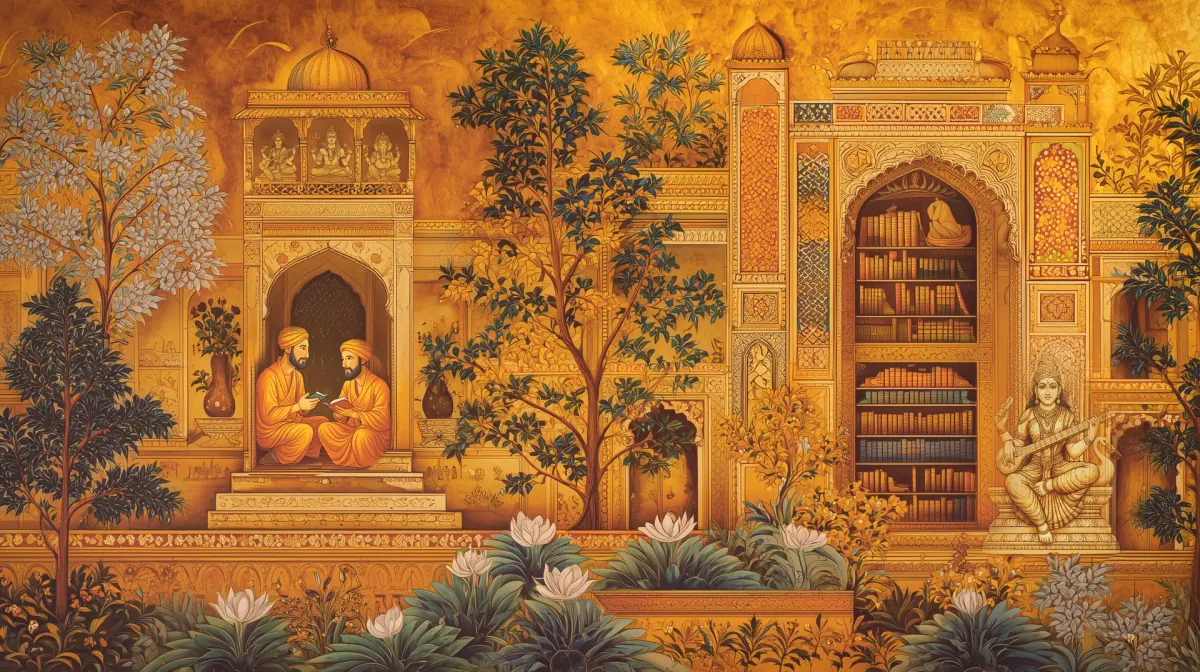
Why the Stage of Preliminary Practices is Necessary
Taking the Creed is the beginning of a conscious Path, but not the beginning of intensive practice. The tradition clearly indicates: between the decision to walk the Path and deep methods, there must be a phase of consciousness maturation.
This phase is called preliminary practices.
Their task is not to achieve states, but to shape the sadhu's worldview for a lifetime.
Without this stage, practice becomes either superficial or dangerously one-sided.
The Purpose of Preliminary Practices
Preliminary practices are necessary to:
- build the correct view,
- root faith in the Teaching and the lineage of transmission,
- prepare the mind, ethics, and lifestyle,
- form a stable motivation for Liberation.
This is the foundation without which subsequent practices do not bear fruit.
Mastering the Philosophy of the Teaching
During the first year after taking the Creed, the student must gradually and thoughtfully master the basic texts of the Tradition.
Recommended texts:
- "Tripura Rahasya"
- "Yoga Vasistha"
- "Viveka Chudamani" by Sri Adi Shankaracharya
As well as the Guru's books:
- "The Radiance of Precious Secrets" (Volumes 1 and 2)
- "The Universe of a Jnani"
- "The Source of Consciousness"
- "My Life in God"
- "The Vessel of Dharma" (Volumes 1 and 2)
The study of these texts is not academic in nature.
Their task is to change the way of seeing the world and oneself.
Mastering Daily Forms of Worship
At this stage, the student begins to get acquainted with the rhythm of spiritual life through:
- daily practices of "Sutra" and "Bhajan Mandala"
- worship at the home altar
- performing arati
These actions form:
- inner discipline,
- a connection with sacred time,
- a culture of presence in practice.
Beginning Mantra Sadhana
Daily chanting of mantras in the amount of one to seven rounds is recommended:
- To Shiva:
OM NAMAH SHIVAYA
- To Dattatreya:
OM DRAM DATTATREYAYA NAMAHA
Mantra at this stage is not a technique, but the purification of consciousness and strengthening the connection with the Ishta-devata.
Practice of Sandhya Upasana
The student begins to get acquainted with sandhya upasana — the practice of honoring the sacred transition moments of the day.
This forms:
- a sense of the rhythm of the Universe,
- attentiveness to the states of the mind,
- stability of awareness.
Taking Prasad
The student learns to:
- accept consecrated food,
- treat food as a blessing,
- see the connection between the body, consciousness, and the sacred.
This is a simple but deeply transformative practice.
Ethics and Preparation for Diksha
Throughout the preliminary stage, special attention is paid to:
- observance of the principles of yama and niyama,
- purification of the lifestyle,
- inner readiness to accept grihastha-diksha (karma-sannyasa diksha).
Ethics here is not a prohibition, but a form of protecting consciousness.
Final Assignment of the Preliminary Stage
Upon completion of the preliminary practices, the student must:
- read the texts in full:
"Yoga Vasistha" and "Tripura Rahasya",
- write a treatise "Qualities of a Disciple in the Tradition", based on the texts: "Viveka Chudamani", "The Phenomenon of Guru Yoga", "The Radiance of Precious Secrets" (Volume 1).
This assignment tests not knowledge, but maturity of understanding.
Transition to Basic Practices
Only after completing the stage of preliminary practices is the student considered ready for:
- basic methods of contemplation,
- deeper ritual forms,
- intensive sadhana.
Such is the order of the Path, established by the Tradition and confirmed by the experience of generations.
Preliminary practices are not a delay on the Path. They are the careful formation of the vessel capable of holding the light of Wisdom.
He who does not rush at this stage goes far and steadily.
Approved on August 09, 2019, by the founder of the World Community of Sanatana Dharma, Mahamandaleshwar Guru Swami Vishnudevananda Giri.
Recommended for all beginners entering the path of Dharma.
