Namaste!

item image

The First Step — Taking Refuge in Sharanagati

author •date 21.07.2026 •duration 2 min. reading •views 32 просм.

When faith in the Truth has already awakened and you have comprehended it through the Creed, a natural question arises: “What comes next?” Faith that lives only in the mind is like a map: it is useful, but it is not the journey itself. For the spiritual quest to become a real Path, you must take a step traditionally known as Taking Refuge (in Sanskrit, Sharanagati). This is the moment when abstract philosophy becomes a living connection with the Supreme. The Five Jewels (Pancharatna) In our tradition, Refuge is not merely an abstract idea, but five living pillars: Shiva (the Primordial Lord), Shakti (Divine Energy), Guru (
Spiritual traditionCreedSpiritual pathRefuge
item image

Seven Lands of Wisdom

author •date 21.07.2026 •duration 5 min. reading •views 33 просм.

Thousands of years ago, sages described seven stages of inner transformation that every seeker passes through—these stages are called the seven grounds of wisdom (Sanskrit: sapta-jñāna-bhūmikā) and are explained in detail in the Yoga Vasistha. Guru Swami Vishnudevananda Giri says that all of us, as living beings, occupy a place on this ladder of seven bhumis. The saints are at its summit, while we are somewhere on the first few rungs. Sometimes moving from one bhumi to another requires an entire lifetime—this is what spiritual evolution is all about. A sadhu’s task is to make the leap: to burn away karma, dissolve the mind

Seven lands of wisdomJnana-bhumi
item image

What is the “Creed” in our tradition?

author •date 21.07.2026 •duration 4 min. reading •views 36 просм.

When faith awakens in a person, it can arise in different ways. Some have endured suffering; others have had a spiritual experience—an out-of-body experience, lucid dreaming, or a kundalini awakening. Some have gone through clinical death. Others had the predisposition from their youth, and their faith simply matured. Whatever path has led us to faith, it is a blessing. But faith in a general sense is a diffuse force. A person feels that God exists, that there is something higher, yet cannot clearly explain to themselves what exactly they believe in. In our tradition, the Creed exists to concentrate this inner force. What

RefugeSharanagatiRefugeFaithSharanamCreed
item image

Your New Life: Status, Practice, and Further Growth

author •date 21.07.2026 •duration 2 min. reading •views 38 просм.

Taking Refuge is not the final destination, but a conscious beginning of the Path. From this moment on, you cease to be merely an observer or seeker. You become an official follower of the Teaching, a disciple of the Guru, and a full member of the spiritual family—the Sangha. A New Status in the Universe In our tradition, taking Refuge is regarded as a change in your “citizenship” in the Universe. This event is recorded in the “book of life” of your mind, and the divine forces become aware of it. Your new status is a constant reminder of your decision to move toward Liberation. You join a specific school—Advaita Vedanta in

RefugeSpiritual traditionDiscipleshipSamayaRefugeSharanagati
item image

The First Year After Taking Refuge

author •date 21.07.2026 •duration 4 min. reading •views 109 просм.

After taking Refuge, a special period begins. It is a time of quiet, painstaking work. This stage is called the preliminary practices, and it lasts approximately one year. During this year, the entire foundation on which the further Path will rest is laid: a correct understanding of the Teaching, trust in the lineage, discipline of the mind, and purity in everyday life. Why exactly one year? Because consciousness changes slowly. You can read a dozen books in a month and remain the same. Or you can thoughtfully live through every text, every mantra, every morning worship—and after a year discover that you see the world thro

RefugeRefugeKarmaWorshipMantraUpasanaVedic PhilosophyRefuge Tree
item image

Accept a spiritual name: Ashta-avarana-diksha

author •date 21.07.2026 •duration 7 min. reading •views 80 просм.

Ashta-avarana-diksha (Sanskrit: aṣṭa-āvaraṇa-dīkṣā) is initiation into the eight protective coverings. The word “ashta” means “eight,” “avarana” means a covering, protection, or sheath. “Diksha” is an initiation that simultaneously bestows spiritual power and removes karmic obstacles. This is one of the key initiations on the spiritual path in our tradition. It follows the taking of Refuge and creates an invisible yet tangible protective structure around the practitioner—a mandala of eight elements, each of which supports and safeguards them on the path. Why Protection Is Needed on the Spiritual Path When a person begins s

Spiritual traditionDikshaCreedAshta-avarana-dikshaDiksha GuruRefugeSpiritual pathAvarana
item image

Refuge-Taking Ceremony: How to Prepare?

author •date 21.07.2026 •duration 2 min. reading •views 37 просм.

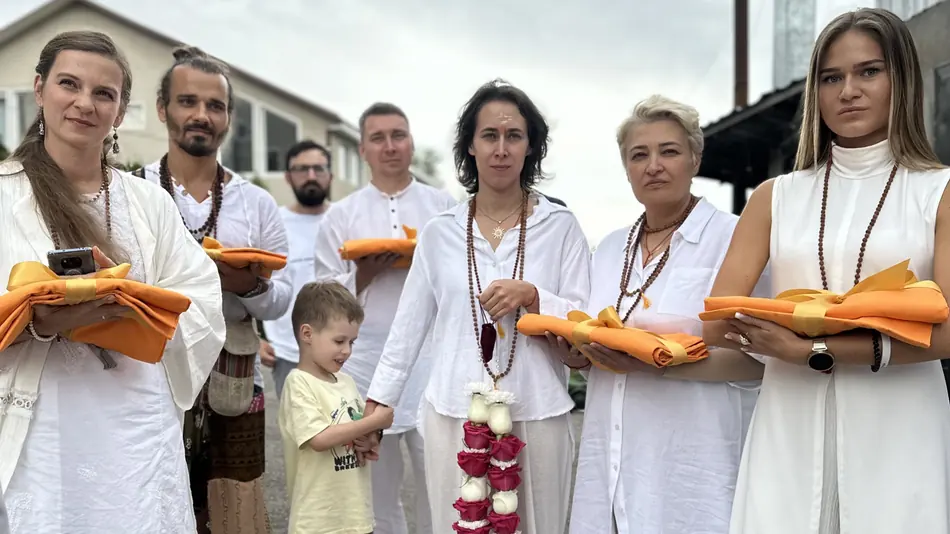
Contact the coordinator (Tejomayi) to arrange the time and place of the ritual. The ceremony is conducted individually or in a group before the altar under the guidance of a sannyasi (monk). It lasts about an hour. Inner and Physical Purity On the appointed day, observe the purification rules: Ablution — take a full-body ritual bath (snana) in the morning Fasting — abstain from food until the ritual is complete Clothing — come in clean clothing, preferably white (a symbol of purity and sattva guna) Offerings Taking Refuge is accompanied by an offering at the altar: Food and flowers — fresh fruit, sweets, or fresh flowers D

RefugeRefugeRitualRitual purity
item image

Text of the Creed

author •date 06.07.2026 •duration 3 min. reading •views 72 просм.

I believe in Parabrahman, one without a second, the non-dual Reality, in That which is unborn, has no name, form, qualities, or attributes, in the eternal, infinite, omnipresent, all-pervading, pure Consciousness abiding in all beings as sat-chit-ananda. I believe that the Absolute possesses the capacity for continuous creative manifestations and appears as the three cosmic forces of the Universe—creation (srishti-shakti), preservation (sthiti-shakti), and destruction (samhara-shakti), as well as the forces of wisdom (jnana-shakti), will (iccha-shakti), and action (kriya-shakti), personified as Brahma, Vishnu, Shiva (Trimu

FaithAdvaitaSharanagatiCreedTeachingTeachings of the SiddhasSpiritual traditionRefuge
item image

Why faith is needed on the spiritual path

author •date 06.07.2026 •duration 5 min. reading •views 33 просм.

On the spiritual path, many rely on the intellect: they read books, analyze philosophical systems, and compare approaches. This is useful — but not enough. Intellectual understanding makes up only a small part of real progress. A much greater role is played by what in our tradition is called shraddha (Sanskrit: śraddhā) — faith. Not blind, not fanatical — but a deep inner conviction in the truth of the path, the teaching, and the Teacher. The very conviction that does not waver at the first difficulties. What Is Shraddha Shraddha is a capacious concept. It includes faith in the Dharma, in God, in the Guru, in the lineage o

RefugeCreed
item image

Entering the Great Path of Liberation

author •date 22.03.2026 •duration 3 min. reading •views 41 просм.

The Path of Liberation, moksha-dharma, is not just one of many paths. It is a path that leads beyond samsara, beyond karma, and beyond conditioned existence. Entering this path does not begin with techniques, practices, or rituals. It begins with an inner revolution of consciousness. Before a person becomes a disciple of a Guru and a part of the sangha, certain foundations must mature within them. To practice moksha-dharma deeply within the tradition, it is necessary to give rise to three great states of consciousness. 1. Great skepticism toward samsaric ignorance The first is great skepticism toward samsara, its values, p

RefugePath of LiberationViryaDikshaMoksha-dharmaVairagyaMumukshutvaGuru-yoga
Articles
Vidya AI
Search
Lectures
World Community of Sanatana Dharma
The world community unites people from many countries who belong to Sanatana Dharma (Hinduism) and practice yoga and meditation under the guidance of the enlightened Master of practical Advaita Swami Vishnudevananda Giri Maharaja.
Join Us
support@sanatanadharma.world