

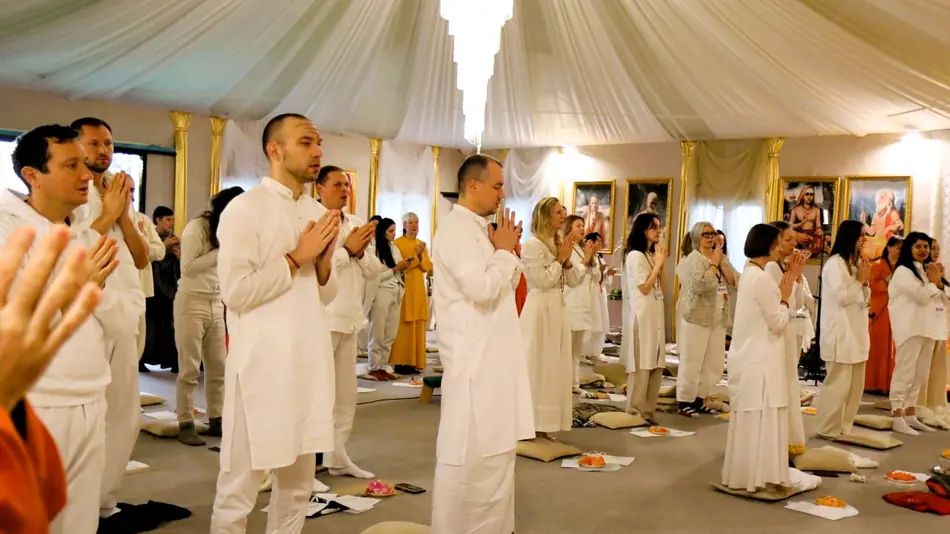
Sharanagati (Skt. śaraṇāgati) traces back to the Sanskrit root "shri" (śrī) — "to resort to protection," and "gati" (gati) — "movement, path." Literally, it means "the act of seeking refuge" or "surrendering oneself to the protection of the Supreme." In the texts of Advaita Vedanta and Shaiva Tantras, this term indicates the conscious establishment of a connection between the soul and the Absolute through specific forms of spiritual support.
The related term sharanam (śaraṇam) is translated as "refuge, protection, shelter." In a spiritual context, sharanam is that which serves as a reliable support on the path to Liberation (moksha).
Sharanagati is a formal act of taking spiritual refuge, sealing the seeker's entry into the tradition of Sanatana Dharma. According to the classification of the sixteen samskaras (purificatory sacraments) described in the Dharma-shastras, sharanagati belongs to the category of spiritual empowerments preceding diksha (formal initiation).
In the "Bhagavad Gita" (XVIII.66), Lord Krishna proclaims the principle of total surrender:
"Abandon all varieties of religion and just surrender unto Me. I shall deliver you from all sinful reactions. Do not fear."
This shloka is the quintessence of sharanagati: total trust in the Absolute and the renunciation of reliance solely on one's own ego.
The "Shiva Purana" (Vidyeshvara Samhita, 10.13-14) states:
"He who has taken refuge in Shiva with a pure heart is liberated from all sins and attains the supreme good. Just as a child finds protection in a mother's arms, so the devotee finds safety in Shiva."
Refuge as a Living Connection with the Absolute
For most seekers, the concept of "God" or "Brahman" remains too abstract. How does one establish a personal relationship with the Absolute? How does one feel His real support?
Refuge (sharanam) is the Absolute manifested in concrete forms accessible to perception. It is divine pedagogy that allows the finite mind to establish a connection with the Infinite. Taking refuge is an act of conscious trust and the humbling of the ego, an acknowledgment that on the path to moksha, the practitioner relies not only on their own efforts but also on the wisdom of the centuries-old Tradition (parampara).
In the absolute sense, Brahman itself—the impersonal Absolute of Advaita Vedanta—is the refuge. However, for a practitioner at a relative level of perception, Brahman manifests in specific forms: in the Teacher, the sacred Teaching, divine powers, and the spiritual community. By trusting these manifested forms, the sadhaka gradually learns to trust God Himself.
Refuge as the Foundation of Spiritual Practice
In Sanskrit terminology, the spiritual path is described by a triad: Base (adhara), Path (marga), and Fruit (phala). Refuge belongs to the category of the base—without it, progress along the path and reaching the fruit (Liberation) is impossible.
By reciting the words of the refuge formula, the practitioner affirms what has already ripened in their heart: the yearning for Truth (satya), trust in the Teacher, and faith in their own divine potential (atma-shraddha). This is not a blind acceptance of dogmas but a conscious declaration of intent.
What taking refuge provides:
Clarity. The practitioner clearly formulates the objects of faith and spiritual priorities for themselves. This creates mental discipline and focus.
A foundation for sadhana. Without refuge, spiritual practice may be intense but lacks stability and protection from obstacles (vighna).
Personal connection with the Absolute. Refuge is the beginning of a divine dialogue between the soul (jiva) and the Supreme (Paramatman), an invitation for the Divine presence into daily life.
Spiritual family. By taking refuge, the seeker becomes part of a sacred lineage (parampara) and gains spiritual brothers and sisters in the form of the sangha.
Refuge as an Internal Turn
Taking refuge is not a rejection of inner freedom nor blind submission to external authority. It is the acquisition of a reliable spiritual support. Freedom without support often leads to chaos and mental scattering (vikshepa), while support without awareness degenerates into dogmatism. Refuge unites the freedom of inquiry with responsibility toward the Tradition.
The seeker ceases to be a lonely wanderer and becomes part of a great spiritual family, supported by the power of an ancient lineage of transmission. Sadhana ceases to be an individual experiment and becomes a conscious ascent along the Path, sanctified by the experience of countless saints and siddhas.
As stated in the "Shvetashvatara Upanishad" (VI.23):
"To him who has the highest devotion (bhakti) to God, and as much devotion to his Guru, these teachings will be revealed in all their fullness. Only to a great soul (mahatma) is their meaning revealed."
Taking refuge is the moment when the practitioner says "Yes" to their true nature (svarupa) and begins a conscious journey toward Liberation.
